
Study: 63% of Seafood Species Depleted
In environmental news, a new study says 63 percent of the world’s seafood stock are below their target levels. The study, published in the journal Science, says rampant overfishing has spread from “rivers to coastal areas to the (Continental) shelf to the deep sea.”
Science Magazine Abstract:
Rebuilding Global Fisheries
Worm et al.
After a long history of overexploitation, increasing efforts to restore marine ecosystems and rebuild fisheries are under way. Here, we analyze current trends from a fisheries and conservation perspective. In 5 of 10 well-studied ecosystems, the average exploitation rate has recently declined and is now at or below the rate predicted to achieve maximum sustainable yield for seven systems. Yet 63% of assessed fish stocks worldwide still require rebuilding, and even lower exploitation rates are needed to reverse the collapse of vulnerable species. Combined fisheries and conservation objectives can be achieved by merging diverse management actions, including catch restrictions, gear modification, and closed areas, depending on local context. Impacts of international fleets and the lack of alternatives to fishing complicate prospects for rebuilding fisheries in many poorer regions, highlighting the need for a global perspective on rebuilding marine resources.
Science 31 July 2009:
Vol. 325. no. 5940, pp. 578 - 585
DOI: 10.1126/science.1173146
for journal article:
http://www.sciencemag.org/cgi/content/abstract/325/5940/578
31 July 2009
30 July 2009
Global Poll Finds 73% Want Higher Priority for Climate Change
Global Poll Finds 73% Want Higher Priority for Climate Change
Britons among the most enthusiastic about action to stop global warming, while Americans among least willing to put environment first, according to global public opinion poll

more graphs available at: WorldPublicOpinion.org
A majority of peoples around the world want their governments to put action on climate change at the top of the political agenda, a new global public opinion poll suggests.
Unfortunately for Barack Obama though, who has put energy reform at the top of his White House to-do list, Americans are not necessarily among them.
Only 44% of Americans thought climate change should be a major preoccupation for the Obama administration, the survey co-ordinated by the University of Maryland's Programme on International Policy Attitudes said. The only other two countries unwilling to see their governments make climate change a top focus were Iraq and the Palestinian territories. In 15 other countries though there was strong support for governments to do more to deal with climate change.
Britons were among the most enthusiastic supporters for greater government intervention, with 77% urging officials to do more. Germans, however, think their government has already done enough. Some 83% think their government has already adopted climate change action as a top priority; 27% would like the government to turn its attention elsewhere.
"The public is pulling for more — a lot more, no, but a bit more, yes. There is definitely political capital there to move the ball forward and that is pretty much universal," said Steven Kull, the director of the survey which drew on data gathered by academic and marketing polling organisations in the respective countries. Overall about 73% of those polled believe governments should make climate change a top priority.
The poll, which sampled the opinions of 18,578 people in 19 countries, found broad popular support for making climate change a top priority extended even to those countries whose governments have yet to commit to global action. In China there was overwhelming support — 94% — for the government to keep climate change on the front burner. And in India, which is also rapidly emerging as one of the world's leading producers of global warming pollution, 59% of the public wanted their government to make climate change a top priority...
for complete polling information at WorldPublicOpinion.org:
2009-07-29
http://www.worldpublicopinion.org/pipa/articles/btenvironmentra/631.php?lb=bte&pnt=631&nid=&id=
for polling information about International Public Opinion on the Environment and Climate Change at WorldPublicOpinion.org:
http://www.worldpublicopinion.org/pipa/articles/btenvironmentra/index.php?nid=&id=&lb=bte
for complete article:
Global poll finds 73% want higher priority for climate change
2009-07-29
http://www.guardian.co.uk/environment/2009/jul/30/climate-change-us
for dataset and article:
Which countries believe in climate change?
A new poll shows different attitudes to climate change around the globe
2009-07-29
http://www.guardian.co.uk/news/datablog/2009/jul/29/climate-change
Britons among the most enthusiastic about action to stop global warming, while Americans among least willing to put environment first, according to global public opinion poll
more graphs available at: WorldPublicOpinion.org
A majority of peoples around the world want their governments to put action on climate change at the top of the political agenda, a new global public opinion poll suggests.
Unfortunately for Barack Obama though, who has put energy reform at the top of his White House to-do list, Americans are not necessarily among them.
Only 44% of Americans thought climate change should be a major preoccupation for the Obama administration, the survey co-ordinated by the University of Maryland's Programme on International Policy Attitudes said. The only other two countries unwilling to see their governments make climate change a top focus were Iraq and the Palestinian territories. In 15 other countries though there was strong support for governments to do more to deal with climate change.
Britons were among the most enthusiastic supporters for greater government intervention, with 77% urging officials to do more. Germans, however, think their government has already done enough. Some 83% think their government has already adopted climate change action as a top priority; 27% would like the government to turn its attention elsewhere.
"The public is pulling for more — a lot more, no, but a bit more, yes. There is definitely political capital there to move the ball forward and that is pretty much universal," said Steven Kull, the director of the survey which drew on data gathered by academic and marketing polling organisations in the respective countries. Overall about 73% of those polled believe governments should make climate change a top priority.
The poll, which sampled the opinions of 18,578 people in 19 countries, found broad popular support for making climate change a top priority extended even to those countries whose governments have yet to commit to global action. In China there was overwhelming support — 94% — for the government to keep climate change on the front burner. And in India, which is also rapidly emerging as one of the world's leading producers of global warming pollution, 59% of the public wanted their government to make climate change a top priority...
for complete polling information at WorldPublicOpinion.org:
2009-07-29
http://www.worldpublicopinion.org/pipa/articles/btenvironmentra/631.php?lb=bte&pnt=631&nid=&id=
for polling information about International Public Opinion on the Environment and Climate Change at WorldPublicOpinion.org:
http://www.worldpublicopinion.org/pipa/articles/btenvironmentra/index.php?nid=&id=&lb=bte
for complete article:
Global poll finds 73% want higher priority for climate change
2009-07-29
http://www.guardian.co.uk/environment/2009/jul/30/climate-change-us
for dataset and article:
Which countries believe in climate change?
A new poll shows different attitudes to climate change around the globe
2009-07-29
http://www.guardian.co.uk/news/datablog/2009/jul/29/climate-change


29 July 2009
Human Activity is Driving Earth's 'Sixth Great Extinction Event'
Human Activity is Driving Earth's 'Sixth Great Extinction Event'
Population growth, pollution and invasive species are having a disastrous effect on species in the southern hemisphere, a major review by conservationists warns
Earth is experiencing its "sixth great extinction event" with disease and human activity taking a devastating toll on vulnerable species, according to a major review by conservationists.
Much of the southern hemisphere is suffering particularly badly, and Australia, New Zealand and neighbouring Pacific islands may become the extinction hot spots of the world, the report warns.
Ecosystems in Polynesia, Micronesia and Melanesia need urgent and effective conservation policies, or the region's already poor record on extinctions will worsen significantly.
Researchers trawled 24,000 published reports to compile information on the native flora and fauna of Australasia and the Pacific islands, which have six of the most biodiverse regions on the planet. Their report identifies six causes driving species to extinction, almost all linked in some way to human activity.
"Our region has the notorious distinction of having possibly the worst extinction record on Earth," said Richard Kingsford, an environmental scientist at the University of New South Wales in Sydney and lead author of the report. "We have an amazing natural environment, but so much of it is being destroyed before our eyes. Species are being threatened by habitat loss and degradation, invasive species, climate change, over-exploitation, pollution and wildlife disease."
The review, published in the journal Conservation Biology, highlights destruction and degradation of ecosystems as the main threat...
...The report sets out a raft of recommendations to slow the decline by introducing laws to limit land clearing, logging and mining; restricting deliberate introduction of invasive species; reducing carbon emissions and pollution; and limiting fisheries. It raises particular concerns about bottom trawling, and the use of cyanide and dynamite, and calls for early-warning systems to pick up diseases in the wild.
"The burden on the environment is going to get worse unless we are a lot smarter about reducing our footprint," said Kingsford. "Unless we get this right, future generations will surely be paying more in quality of life and the environment. And our region will continue its terrible reputation of leading the world in the extinction of plants and animals."
for complete article:
2009-07-28
http://www.guardian.co.uk/environment/2009/jul/28/species-extinction-hotspots-australia
Population growth, pollution and invasive species are having a disastrous effect on species in the southern hemisphere, a major review by conservationists warns
Earth is experiencing its "sixth great extinction event" with disease and human activity taking a devastating toll on vulnerable species, according to a major review by conservationists.
Much of the southern hemisphere is suffering particularly badly, and Australia, New Zealand and neighbouring Pacific islands may become the extinction hot spots of the world, the report warns.
Ecosystems in Polynesia, Micronesia and Melanesia need urgent and effective conservation policies, or the region's already poor record on extinctions will worsen significantly.
Researchers trawled 24,000 published reports to compile information on the native flora and fauna of Australasia and the Pacific islands, which have six of the most biodiverse regions on the planet. Their report identifies six causes driving species to extinction, almost all linked in some way to human activity.
"Our region has the notorious distinction of having possibly the worst extinction record on Earth," said Richard Kingsford, an environmental scientist at the University of New South Wales in Sydney and lead author of the report. "We have an amazing natural environment, but so much of it is being destroyed before our eyes. Species are being threatened by habitat loss and degradation, invasive species, climate change, over-exploitation, pollution and wildlife disease."
The review, published in the journal Conservation Biology, highlights destruction and degradation of ecosystems as the main threat...
...The report sets out a raft of recommendations to slow the decline by introducing laws to limit land clearing, logging and mining; restricting deliberate introduction of invasive species; reducing carbon emissions and pollution; and limiting fisheries. It raises particular concerns about bottom trawling, and the use of cyanide and dynamite, and calls for early-warning systems to pick up diseases in the wild.
"The burden on the environment is going to get worse unless we are a lot smarter about reducing our footprint," said Kingsford. "Unless we get this right, future generations will surely be paying more in quality of life and the environment. And our region will continue its terrible reputation of leading the world in the extinction of plants and animals."
for complete article:
2009-07-28
http://www.guardian.co.uk/environment/2009/jul/28/species-extinction-hotspots-australia
28 July 2009
World Will Warm Faster Than Predicted in Next Five Years
World Will Warm Faster Than Predicted in Next Five Years
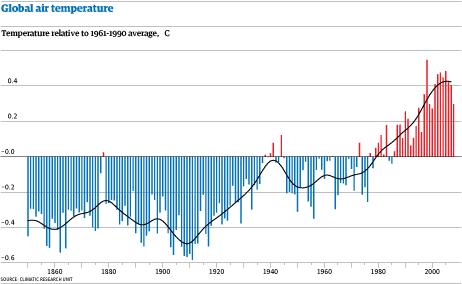
New estimate based on the forthcoming upturn in solar activity and El Niño southern oscillation cycles
source: guardian.co.uk
The world faces record-breaking temperatures as the sun's activity increases, leading the planet to heat up significantly faster than scientists had predicted for the next five years, according to a study...The research, to be published in Geophysical Research Letters, was carried out by Judith Lean, of the US Naval Research Laboratory, and David Rind, of Nasa's Goddard Institute for Space Studies.
The work is the first to assess the combined impact on global temperature of four factors: human influences such as CO2 and aerosol emissions; heating from the sun; volcanic activity and the El Niño southern oscillation, the phenomenon by which the Pacific Ocean flips between warmer and cooler states every few years.
The analysis shows the relative stability in global temperatures in the last seven years is explained primarily by the decline in incoming sunlight associated with the downward phase of the 11-year solar cycle, together with a lack of strong El Niño events. These trends have masked the warming caused by CO2 and other greenhouse gases.
As solar activity picks up again in the coming years, the research suggests, temperatures will shoot up at 150% of the rate predicted by the UN's Intergovernmental Panel on Climate Change. Lean and Rind's research also sheds light on the extreme average temperature in 1998. The paper confirms that the temperature spike that year was caused primarily by a very strong El Niño episode. A future episode could be expected to create a spike of equivalent magnitude on top of an even higher baseline, thus shattering the 1998 record.
The study comes within days of announcements from climatologists that the world is entering a new El Niño warm spell. This suggests that temperature rises in the next year could be even more marked than Lean and Rind's paper suggests...
for complete article:
2009-07-27
http://www.guardian.co.uk/environment/2009/jul/27/world-warming-faster-study
New estimate based on the forthcoming upturn in solar activity and El Niño southern oscillation cycles
source: guardian.co.uk
The world faces record-breaking temperatures as the sun's activity increases, leading the planet to heat up significantly faster than scientists had predicted for the next five years, according to a study...The research, to be published in Geophysical Research Letters, was carried out by Judith Lean, of the US Naval Research Laboratory, and David Rind, of Nasa's Goddard Institute for Space Studies.
The work is the first to assess the combined impact on global temperature of four factors: human influences such as CO2 and aerosol emissions; heating from the sun; volcanic activity and the El Niño southern oscillation, the phenomenon by which the Pacific Ocean flips between warmer and cooler states every few years.
The analysis shows the relative stability in global temperatures in the last seven years is explained primarily by the decline in incoming sunlight associated with the downward phase of the 11-year solar cycle, together with a lack of strong El Niño events. These trends have masked the warming caused by CO2 and other greenhouse gases.
As solar activity picks up again in the coming years, the research suggests, temperatures will shoot up at 150% of the rate predicted by the UN's Intergovernmental Panel on Climate Change. Lean and Rind's research also sheds light on the extreme average temperature in 1998. The paper confirms that the temperature spike that year was caused primarily by a very strong El Niño episode. A future episode could be expected to create a spike of equivalent magnitude on top of an even higher baseline, thus shattering the 1998 record.
The study comes within days of announcements from climatologists that the world is entering a new El Niño warm spell. This suggests that temperature rises in the next year could be even more marked than Lean and Rind's paper suggests...
for complete article:
2009-07-27
http://www.guardian.co.uk/environment/2009/jul/27/world-warming-faster-study
Declassified Docs Reveal U.S. Military Spying on WA Peace Groups
Declassified Docs Reveal Military Operative Spied on WA Peace Groups
Newly declassified documents reveal that an active member of Students for a Democratic Society and Port Militarization Resistance in Washington state was actually an informant for the US military. The man everyone knew as “John Jacob” was in fact John Towery, a member of the Force Protection Service at Fort Lewis. The military’s role in the spying raises questions about possibly illegal activity. The Posse Comitatus law bars the use of the armed forces for law enforcement inside the United States. [The Fort Lewis military] base’s Public Affairs office publicly acknowledged for the first time that Towery is a military operative. “This could be one of the key revelations of this era,” said Eileen Clancy, who has closely tracked government spying on activist organizations.
Before his true identity was revealed, the informant was known as “John Jacob,” an active member of antiwar groups in the towns of Olympia and Tacoma. But using documents obtained under a Freedom of Information Act request, the activists learned that “John Jacob” is in fact John Towery, a member of the Force Protection Service at the nearby Fort Lewis military base. The activists claim Towery has admitted to them he shared information with an intelligence network that stretches from local and state police to several federal agencies, to the US military. They also say he confirmed the existence of other government spies but wouldn’t reveal their identity.
BRENDAN MASLAUSKAS DUNN (Olympia-based activist with Students for a Democratic Society and Port Militarization Resistance):
"...he admitted to several things. He admitted that, yes, he did in fact spy on us. He did in fact infiltrate us. He admitted that he did pass on information to an intelligence network, which, as you mentioned earlier, was composed of dozens of law enforcement agencies ranging from municipal to county to state to regional and several federal agencies, including Immigration Customs Enforcement, Joint Terrorism Task Force, FBI, Homeland Security, the Army in Fort Lewis. So he admitted to other things, too..."
MIKE GERMAN (National Security Policy Counsel for the American Civil Liberties Union. He was an FBI agent specializing in domestic counterterrorism from 1988 to 2004):
"This is a pretty clear violation of Posse Comitatus. Now, what the military would argue, and has argued, is that they have a right to engage in force protection, which obviously, in its normal understanding of that term, is a defensive sort of capability, i.e. they can put guards at the gates of military bases and protect from threats from without. But they seem to have been, since 2002, considering that as an offensive capability, where they’re actually sending operatives out to spy on community activists, which is, of course, prohibited and something that, you know, the First and the Fourth Amendment become engaged.
And, you know, this is something that we found out through a FOIA back in 2005 the military was engaged in through a group called the Counterintelligence Field Activity. And they had a database of activists called Talon that, again, collected this US person information that the military has no business collecting. And that was shut down. But unfortunately, you know, they just created a new mechanism. This appears to be the Fusion centers and these Fusion cells that they’re using that, they seem to think, give them a method of circumventing Posse Comitatus and the restrictions on military intelligence gathering in the United States...And what these [Fusion] centers are is multi-jurisdictional intelligence centers that involve state, local and federal law enforcement, as well as other government entities—you know, a lot of times there are emergency services type of entities, but actually can’t involve any government entity—but also involve oftentimes the military and private companies...Today, the DHS recognizes at least seventy-two fusion centers. So these things are rapidly growing, without any sort of proper boundaries on what activities happen within them and without really any idea of what it is the military is doing in these fusion centers and what type of access they have to US person information."
ANJALI KAMAT (DemocracyNow! journalist):
"The government documents also show that intelligence officers from other government and military agencies inquired Olympia police about the Washington state peace activists. In an email to an Olympia police officer from February 2008, Thomas Glapion, Chief Investigations/Intel of New Jersey’s McGuire Air Force, writes, quote, “Good Morning, first let me thank you for the effort. To the contrary you were quite the help to me. You are now part of my Intel network. I’m still looking at possible protests by the PMR SDS MDS and other left wing anti war groups so any Intel you have would be appreciated…In return if you need anything from the Armed Forces I will try to help you as well,” end-quote."
for complete article:
2009-07-28
http://www.democracynow.org/2009/7/28/broadcast_exclusive_declassified_docs_reveal_military
Newly declassified documents reveal that an active member of Students for a Democratic Society and Port Militarization Resistance in Washington state was actually an informant for the US military. The man everyone knew as “John Jacob” was in fact John Towery, a member of the Force Protection Service at Fort Lewis. The military’s role in the spying raises questions about possibly illegal activity. The Posse Comitatus law bars the use of the armed forces for law enforcement inside the United States. [The Fort Lewis military] base’s Public Affairs office publicly acknowledged for the first time that Towery is a military operative. “This could be one of the key revelations of this era,” said Eileen Clancy, who has closely tracked government spying on activist organizations.
Before his true identity was revealed, the informant was known as “John Jacob,” an active member of antiwar groups in the towns of Olympia and Tacoma. But using documents obtained under a Freedom of Information Act request, the activists learned that “John Jacob” is in fact John Towery, a member of the Force Protection Service at the nearby Fort Lewis military base. The activists claim Towery has admitted to them he shared information with an intelligence network that stretches from local and state police to several federal agencies, to the US military. They also say he confirmed the existence of other government spies but wouldn’t reveal their identity.
BRENDAN MASLAUSKAS DUNN (Olympia-based activist with Students for a Democratic Society and Port Militarization Resistance):
"...he admitted to several things. He admitted that, yes, he did in fact spy on us. He did in fact infiltrate us. He admitted that he did pass on information to an intelligence network, which, as you mentioned earlier, was composed of dozens of law enforcement agencies ranging from municipal to county to state to regional and several federal agencies, including Immigration Customs Enforcement, Joint Terrorism Task Force, FBI, Homeland Security, the Army in Fort Lewis. So he admitted to other things, too..."
MIKE GERMAN (National Security Policy Counsel for the American Civil Liberties Union. He was an FBI agent specializing in domestic counterterrorism from 1988 to 2004):
"This is a pretty clear violation of Posse Comitatus. Now, what the military would argue, and has argued, is that they have a right to engage in force protection, which obviously, in its normal understanding of that term, is a defensive sort of capability, i.e. they can put guards at the gates of military bases and protect from threats from without. But they seem to have been, since 2002, considering that as an offensive capability, where they’re actually sending operatives out to spy on community activists, which is, of course, prohibited and something that, you know, the First and the Fourth Amendment become engaged.
And, you know, this is something that we found out through a FOIA back in 2005 the military was engaged in through a group called the Counterintelligence Field Activity. And they had a database of activists called Talon that, again, collected this US person information that the military has no business collecting. And that was shut down. But unfortunately, you know, they just created a new mechanism. This appears to be the Fusion centers and these Fusion cells that they’re using that, they seem to think, give them a method of circumventing Posse Comitatus and the restrictions on military intelligence gathering in the United States...And what these [Fusion] centers are is multi-jurisdictional intelligence centers that involve state, local and federal law enforcement, as well as other government entities—you know, a lot of times there are emergency services type of entities, but actually can’t involve any government entity—but also involve oftentimes the military and private companies...Today, the DHS recognizes at least seventy-two fusion centers. So these things are rapidly growing, without any sort of proper boundaries on what activities happen within them and without really any idea of what it is the military is doing in these fusion centers and what type of access they have to US person information."
ANJALI KAMAT (DemocracyNow! journalist):
"The government documents also show that intelligence officers from other government and military agencies inquired Olympia police about the Washington state peace activists. In an email to an Olympia police officer from February 2008, Thomas Glapion, Chief Investigations/Intel of New Jersey’s McGuire Air Force, writes, quote, “Good Morning, first let me thank you for the effort. To the contrary you were quite the help to me. You are now part of my Intel network. I’m still looking at possible protests by the PMR SDS MDS and other left wing anti war groups so any Intel you have would be appreciated…In return if you need anything from the Armed Forces I will try to help you as well,” end-quote."
for complete article:
2009-07-28
http://www.democracynow.org/2009/7/28/broadcast_exclusive_declassified_docs_reveal_military
Colorado River Running Dry by 2050
Colorado River Running on Empty by 2050
The lifeblood of the American west, the Coloradoc river, is running dry under current usage, according to a study from the University of Colorado.
Travelling almost 1,500 miles, the river supplies drinking and irrigation water for about 30 million people from Colorado to the Gulf of California.
The study looked at how water supplies would be affected by climate fluctuations and water demand.
Reservoirs low
In 2000 reservoirs fed by the river were at 95 per cent of capacity. In 2009 they had dropped to 59 per cent of capacity.
If climate change results in a 10 per cent reduction in the Colorado River's average stream flows, as some recent studies predict, the chances of fully depleting reservoir storage will exceed 25 per cent by 2057.
If climate change results in a 20 per cent reduction, the chances of fully depleting reservoir storage will exceed 50 per cent by 2057, said the study.
Depleting supplies
'On average, drying caused by climate change would increase the risk of fully depleting reservoir storage by nearly ten times more than the risk we expect from population pressures alone,' said study author Balaji Rajagopalan.
'By mid-century this risk translates into a 50 percent chance in any given year of empty reservoirs, an enormous risk and a huge water management challenge,' he said.
Researchers warned against being 'lulled into a false sense of security' by the current high water capacity of the Colorado River system.
for complete article:
2009-07-28
http://www.guardian.co.uk/environment/2009/jul/28/network-usa
The lifeblood of the American west, the Coloradoc river, is running dry under current usage, according to a study from the University of Colorado.
Travelling almost 1,500 miles, the river supplies drinking and irrigation water for about 30 million people from Colorado to the Gulf of California.
The study looked at how water supplies would be affected by climate fluctuations and water demand.
Reservoirs low
In 2000 reservoirs fed by the river were at 95 per cent of capacity. In 2009 they had dropped to 59 per cent of capacity.
If climate change results in a 10 per cent reduction in the Colorado River's average stream flows, as some recent studies predict, the chances of fully depleting reservoir storage will exceed 25 per cent by 2057.
If climate change results in a 20 per cent reduction, the chances of fully depleting reservoir storage will exceed 50 per cent by 2057, said the study.
Depleting supplies
'On average, drying caused by climate change would increase the risk of fully depleting reservoir storage by nearly ten times more than the risk we expect from population pressures alone,' said study author Balaji Rajagopalan.
'By mid-century this risk translates into a 50 percent chance in any given year of empty reservoirs, an enormous risk and a huge water management challenge,' he said.
Researchers warned against being 'lulled into a false sense of security' by the current high water capacity of the Colorado River system.
for complete article:
2009-07-28
http://www.guardian.co.uk/environment/2009/jul/28/network-usa
26 July 2009
Secret Graphic Images of the Devastating Impact of Global Warming in the Arctic Released by US Military
Revealed: The Secret Evidence of Global Warming Bush Tried to Hide
Photos from US spy satellites declassified by the Obama White House provide the first graphic images of how the polar ice sheets are retreating in the summer. The effects on the world's weather, environments and wildlife could be devastating
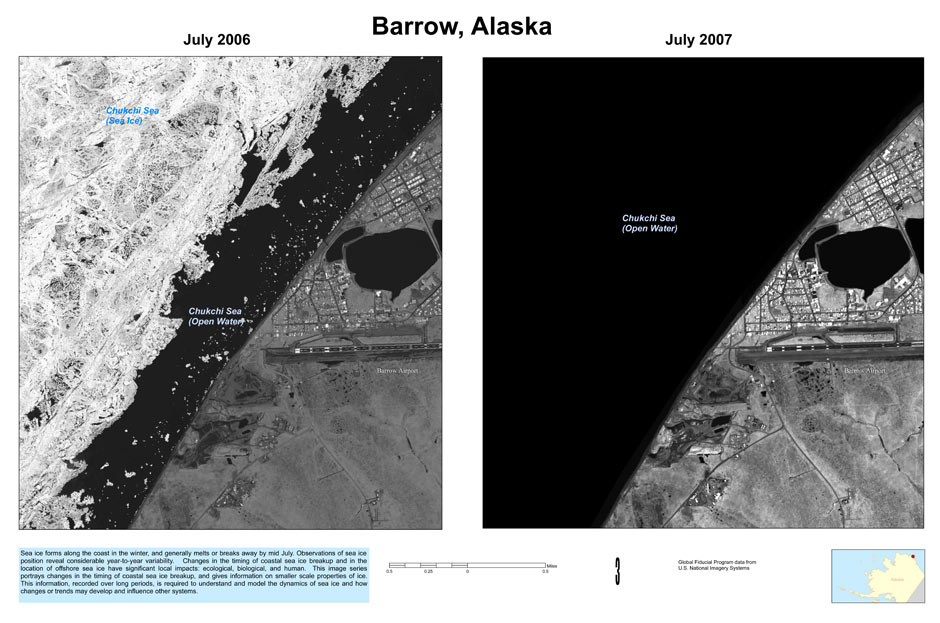
Satellite images of polar ice sheets taken in July 2006 and July 2007 showing the retreating ice during the summer. Photograph: Public Domain
Graphic images that reveal the devastating impact of global warming in the Arctic have been released by the US military. The photographs, taken by spy satellites over the past decade, confirm that in recent years vast areas in high latitudes have lost their ice cover in summer months.
The pictures, kept secret by Washington during the presidency of George W Bush, were declassified by the White House last week. President Barack Obama is currently trying to galvanise Congress and the American public to take action to halt catastrophic climate change caused by rising levels of carbon dioxide in the atmosphere...
"These are one-metre resolution images, which give you a big picture of the summertime Arctic," said Thorsten Markus of Nasa's Goddard Space Flight Centre. "This is the main reason why we are so thrilled about it. One-metre resolution is the dimension that's been missing."
Disappearing summer sea ice poses considerable dangers, scientists have warned. Ice shelves are used by animals such as polar bears as platforms for hunting seals and other sea creatures. Without them, they could starve. In addition, ice reflects solar radiation. Without that process, the Arctic sea could warm up even more. The phenomenon threatens to set off runaway heating of the planet, say climatologists.
The latest revelations have triggered warnings from scientists that they no longer have the funds to keep a comprehensive track of climate change. Last week the head of the US's National Oceanic and Atmospheric Administration (NOAA), Professor Jane Lubchenco, warned that the gathering of satellite data - crucial to predicting future climate changes - was now at "great risk" because America's ageing satellite fleet was not being replaced...
for complete article:
2009-07-26
http://www.guardian.co.uk/environment/2009/jul/26/climate-change-obama-administration
Photos from US spy satellites declassified by the Obama White House provide the first graphic images of how the polar ice sheets are retreating in the summer. The effects on the world's weather, environments and wildlife could be devastating
Satellite images of polar ice sheets taken in July 2006 and July 2007 showing the retreating ice during the summer. Photograph: Public Domain
Graphic images that reveal the devastating impact of global warming in the Arctic have been released by the US military. The photographs, taken by spy satellites over the past decade, confirm that in recent years vast areas in high latitudes have lost their ice cover in summer months.
The pictures, kept secret by Washington during the presidency of George W Bush, were declassified by the White House last week. President Barack Obama is currently trying to galvanise Congress and the American public to take action to halt catastrophic climate change caused by rising levels of carbon dioxide in the atmosphere...
"These are one-metre resolution images, which give you a big picture of the summertime Arctic," said Thorsten Markus of Nasa's Goddard Space Flight Centre. "This is the main reason why we are so thrilled about it. One-metre resolution is the dimension that's been missing."
Disappearing summer sea ice poses considerable dangers, scientists have warned. Ice shelves are used by animals such as polar bears as platforms for hunting seals and other sea creatures. Without them, they could starve. In addition, ice reflects solar radiation. Without that process, the Arctic sea could warm up even more. The phenomenon threatens to set off runaway heating of the planet, say climatologists.
The latest revelations have triggered warnings from scientists that they no longer have the funds to keep a comprehensive track of climate change. Last week the head of the US's National Oceanic and Atmospheric Administration (NOAA), Professor Jane Lubchenco, warned that the gathering of satellite data - crucial to predicting future climate changes - was now at "great risk" because America's ageing satellite fleet was not being replaced...
for complete article:
2009-07-26
http://www.guardian.co.uk/environment/2009/jul/26/climate-change-obama-administration
18 July 2009
Global Loss of Seagrasses 29% and Accelerating
Loss of Seagrasses 'Accelerating'
~Rate of seagrass loss comparable to the loss of tropical rainforest~
Nearly 30% of global seagrass beds have been lost since records began, and the rate of loss is accelerating, according to a new study.
Marine biologist Professor Gary Kendrick, of the University of Western Australia in Perth, and colleagues report their findings this week in the Proceedings of the National Academy of Sciences.
"The losses have been quite substantial," says Kendrick. "Every year we're losing about 110 square kilometres of seagrasses globally."
He and colleagues found that since 1980, 29% of seagrass has disappeared and the overall rate of loss has accelerated from 0.9% a year, before 1940, to 7% a year, since 1990...
...Nutrients in sewage and run-off from agriculture and industry are the major cause of seagrass death, says Kendrick.
These nutrients trigger the growth of algae, plants and animals that grow above or on seagrass, and stop it from getting the sunlight it needs...
Impacts
Kendrick says the rate of seagrass loss is comparable to the loss of tropical rainforest.
He says studies have found seagrass fixes as much carbon dioxide as tropical forests, and is also a crucial part of the ocean food chain.
About 75% of seagrass feeds bacteria, which are the bottom of the ocean food chain, says Kendrick: "They actually feed the whole food web."
He says the other 25% of seagrass is eaten directly by animals such as dugongs, green turtles, fish, snails and crustaceans, as well as birds like geese and swans.
Seagrass meadows are also crucial to the survival of fish that live in coral reefs, says Kendrick: "So there's a very close connection between reef systems and seagrass systems in the tropics."
...The loss of seagrass negatively affects fisheries and human health through degradation of the ecosystem, says Kendrick.
He says seagrass buffers coastal areas from damaging waves, expected to increase with rising seas, and also acts as a filter for toxic materials released into the ocean from industry...
for complete news article:
2009-06-30
http://www.abc.net.au/science/articles/2009/06/30/2611630.htm
for complete journal article:
http://www.pnas.org/
~Rate of seagrass loss comparable to the loss of tropical rainforest~
Nearly 30% of global seagrass beds have been lost since records began, and the rate of loss is accelerating, according to a new study.
Marine biologist Professor Gary Kendrick, of the University of Western Australia in Perth, and colleagues report their findings this week in the Proceedings of the National Academy of Sciences.
"The losses have been quite substantial," says Kendrick. "Every year we're losing about 110 square kilometres of seagrasses globally."
He and colleagues found that since 1980, 29% of seagrass has disappeared and the overall rate of loss has accelerated from 0.9% a year, before 1940, to 7% a year, since 1990...
...Nutrients in sewage and run-off from agriculture and industry are the major cause of seagrass death, says Kendrick.
These nutrients trigger the growth of algae, plants and animals that grow above or on seagrass, and stop it from getting the sunlight it needs...
Impacts
Kendrick says the rate of seagrass loss is comparable to the loss of tropical rainforest.
He says studies have found seagrass fixes as much carbon dioxide as tropical forests, and is also a crucial part of the ocean food chain.
About 75% of seagrass feeds bacteria, which are the bottom of the ocean food chain, says Kendrick: "They actually feed the whole food web."
He says the other 25% of seagrass is eaten directly by animals such as dugongs, green turtles, fish, snails and crustaceans, as well as birds like geese and swans.
Seagrass meadows are also crucial to the survival of fish that live in coral reefs, says Kendrick: "So there's a very close connection between reef systems and seagrass systems in the tropics."
...The loss of seagrass negatively affects fisheries and human health through degradation of the ecosystem, says Kendrick.
He says seagrass buffers coastal areas from damaging waves, expected to increase with rising seas, and also acts as a filter for toxic materials released into the ocean from industry...
for complete news article:
2009-06-30
http://www.abc.net.au/science/articles/2009/06/30/2611630.htm
for complete journal article:
http://www.pnas.org/
17 July 2009
Global Warming to Open Up "North-East Passage" in Arctic
Global Warming to Open Up North-East Arctic Tanker Route
Melting ice in the Russian Arctic will create a safer, shorter route cut for tankers, but will have even bigger implications for the global energy market
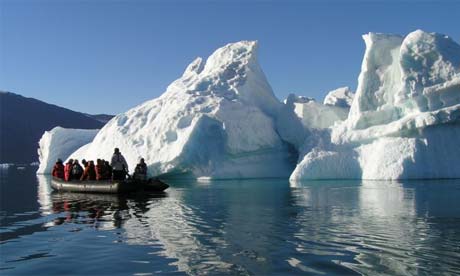
'Soon there will be no summer Arctic ice,' says Norway's foreign minister. Photograph: PR
"The rise in temperatures across the Arctic is twice the world average. Soon there will be no summer ice – that will open up new routes and new strategic issues for the world," he said. The forecast follows previous predictions that the more famous north-west passage will be opened by climate change.
The melting ice also has implications for the global energy market. The Arctic is thought to hold 20% of world resources of fossil fuels – principally sub-sea gas in the massive Shtokman field. The Russian government plans to start extracting gas from the Barents Sea by 2011 with French partners Total and the Norwegian state-owned Statoil...The Norwegian environmental group Bellona has published plans by Russian scientists to use nuclear-powered underwater drill vessels...
for complete article:
2009-07-17
http://www.guardian.co.uk/environment/2009/jul/14/global-warming-tanker-route
Melting ice in the Russian Arctic will create a safer, shorter route cut for tankers, but will have even bigger implications for the global energy market
'Soon there will be no summer Arctic ice,' says Norway's foreign minister. Photograph: PR
A new "north-east passage" for shipping around Russia's Arctic coast and across the North Pole will be opened within a decade as global warming causes the ice cap to melt, Norway's foreign minister has predicted.
"The rise in temperatures across the Arctic is twice the world average. Soon there will be no summer ice – that will open up new routes and new strategic issues for the world," he said. The forecast follows previous predictions that the more famous north-west passage will be opened by climate change.
The melting ice also has implications for the global energy market. The Arctic is thought to hold 20% of world resources of fossil fuels – principally sub-sea gas in the massive Shtokman field. The Russian government plans to start extracting gas from the Barents Sea by 2011 with French partners Total and the Norwegian state-owned Statoil...The Norwegian environmental group Bellona has published plans by Russian scientists to use nuclear-powered underwater drill vessels...
for complete article:
2009-07-17
http://www.guardian.co.uk/environment/2009/jul/14/global-warming-tanker-route
10 July 2009
Most Americans Don't Believe Humans Responsible for Climate Change
Most Americans Don't Believe Humans Responsible for Climate Change, Study Finds
In contrast, scientists overwhelmingly believe global warming is caused by human activity
Barack Obama's sense of urgency in getting Congress and the international community to act on climate change does not appear to have rubbed off on the average American, a new study published today reveals.
About 49% of Americans believe the Earth is getting warmer because of the burning of fossil fuels and other human activity, the survey by the Pew Research Centre and the American Association for the Advancement of Science said. Some 36% attributed global warming to natural changes in the atmosphere and another 10% said there was no clear evidence that the earth was indeed undergoing climate change.
Scientists in contrast are overwhelmingly persuaded that global warming is caused by humans - some 84% blame human activity. A strong majority - some 70% - also believe it is a very serious problem. Despite that degree of consensus, some 35% of Americans continues to believe - wrongly it turns out - that climate change remains a matter of scientific controversy. Only about 47% of the public views climate change as a very serious problem, a finding that has remained stable over the years, the survey said. In other public opinion polls over the years, climate change has ranked near the bottom of the list of pressing problems.
The Pew poll, like others in the past, also found attitudes towards climate change breaking down according to political allegiance. Some 67% of Republicans either deny the existence of climate change or attribute the phenomenon to natural causes. In contrast, 64% of Democrats believe that the earth is getting warmer because of human activity.
for complete article:
Most Americans Don't Believe Humans Responsible for Climate Change, Study Finds
2009-07-10
http://www.guardian.co.uk/environment/2009/jul/09/climate-change-debate-human-activity
for survey by the Pew Research Center for the People & the Press and the American Association for the Advancement of Science:
Public Praises Science; Scientists Fault Public, Media
2009-07-09
http://people-press.org/report/528/
for news article about above survey:
Survey Shows Gap Between Scientists and the Public
2009-07-10
http://www.nytimes.com/2009/07/10/science/10survey.html?hpw
In contrast, scientists overwhelmingly believe global warming is caused by human activity
Barack Obama's sense of urgency in getting Congress and the international community to act on climate change does not appear to have rubbed off on the average American, a new study published today reveals.
About 49% of Americans believe the Earth is getting warmer because of the burning of fossil fuels and other human activity, the survey by the Pew Research Centre and the American Association for the Advancement of Science said. Some 36% attributed global warming to natural changes in the atmosphere and another 10% said there was no clear evidence that the earth was indeed undergoing climate change.
Scientists in contrast are overwhelmingly persuaded that global warming is caused by humans - some 84% blame human activity. A strong majority - some 70% - also believe it is a very serious problem. Despite that degree of consensus, some 35% of Americans continues to believe - wrongly it turns out - that climate change remains a matter of scientific controversy. Only about 47% of the public views climate change as a very serious problem, a finding that has remained stable over the years, the survey said. In other public opinion polls over the years, climate change has ranked near the bottom of the list of pressing problems.
The Pew poll, like others in the past, also found attitudes towards climate change breaking down according to political allegiance. Some 67% of Republicans either deny the existence of climate change or attribute the phenomenon to natural causes. In contrast, 64% of Democrats believe that the earth is getting warmer because of human activity.
for complete article:
Most Americans Don't Believe Humans Responsible for Climate Change, Study Finds
2009-07-10
http://www.guardian.co.uk/environment/2009/jul/09/climate-change-debate-human-activity
for survey by the Pew Research Center for the People & the Press and the American Association for the Advancement of Science:
Public Praises Science; Scientists Fault Public, Media
2009-07-09
http://people-press.org/report/528/
for news article about above survey:
Survey Shows Gap Between Scientists and the Public
2009-07-10
http://www.nytimes.com/2009/07/10/science/10survey.html?hpw
NASA Satellite Survey Reveals Dramatic Arctic Sea Ice Thinning
NASA Satellite Survey Reveals Dramatic Arctic Sea Ice Thinning
Study - based on satellite measurements - among first to estimate the thickness of the Arctic ice, rather than surface area
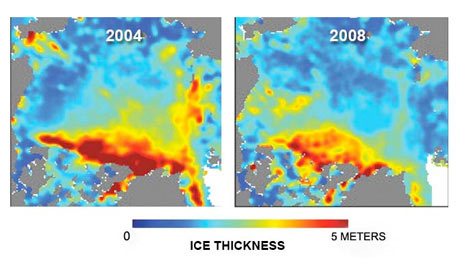
ICESat measurements of the distribution of winter sea ice thickness over the Arctic Ocean in 2004 (left) and 2008 (right). Photograph: Ron Kwok/NASA/JPL
Arctic sea ice thinned dramatically between the winters of 2004 and 2008, with thin seasonal ice replacing thick older ice as the dominant type for the first time on record. The new results, based on data from a NASA Earth-orbiting spacecraft, provide further evidence for the rapid, ongoing transformation of the Arctic's ice cover...[The] new study has revealed that the Arctic Ocean's permanent blanket of ice around the North Pole has thinned by more than 40% since 2004.
Scientists said the rapid loss was "remarkable" and could force experts to reassess how quickly the Arctic ice in the summer may disappear completely. They blame the loss on global warming, which has driven temperatures in the Arctic to record highs and summer ice extent to recent lows.
The study, based on satellite measurements, is among the first to estimate the thickness of the Arctic ice, rather than just its surface area.
Ron Kwok, senior research scientist at Nasa's Jet Propulsion Laboratory in California, said: "Even in years when the overall extent of sea ice remains stable or grows slightly, the thickness and volume of the ice cover is continuing to decline, making the ice more vulnerable to continued shrinkage."
The study looked at measurements taken of the Arctic region by the Icesat satellite, launched in 2003.
Overall, the experts found that the ice, typically up to about 3m thick, thinned by 67cm over the last four winters.
Converting to ice volume, the scientists worked out the amount of so-called multiyear ice, which persists through Arctic summers, had decreased in the winter by up to 6,300 cubic kilometres since 2005 – a decline of more than 40%. The research is published in the Journal of Geophysical Research: Oceans.
Kwok said: "Ice volume allows us to calculate annual ice production and gives us an inventory of the fresh water and total ice mass stored in Arctic sea ice. Our data will help scientists better understand how fast the volume of Arctic ice is decreasing and how soon we might see a nearly ice-free Arctic in summer."
Earlier this year, scientists warned that sea ice volume reached a record low in 2008 due to an unusually high proportion of the thinner first year ice.
Donghui Yi, a scientist with Nasa's Goddard Space Flight Centre in Maryland who worked on the study, said: "The main reason [for the ice thinning] is the growth in melting of the multiyear ice, which is caused by the warmer weather. More ice melts in summer and then you get less in winter."
The Arctic ice cap fluctuates with the seasons, growing in the freezing winter and shrinking over the summer. An important finding of the study is that the majority of Arctic ice no longer survives the summer. In 2003, this multiyear ice made up 62% of the region's total ice volume. By 2008, this was down to 32%. The remaining 68% was "first-year" seasonal ice, which was open water during the summer, so is thinner and more likely to melt away.
for complete article:
Nasa satellites reveal extent of Arctic sea ice loss
2009-07-08
http://www.guardian.co.uk/environment/2009/jul/08/arctic-ice-ocean
for complete report:
New NASA Satellite Survey Reveals Dramatic Arctic Sea Ice Thinning
2009-07-07
http://www.nasa.gov/home/hqnews/2009/jul/HQ_09-155_Thin_Sea_Ice.html
Study - based on satellite measurements - among first to estimate the thickness of the Arctic ice, rather than surface area
ICESat measurements of the distribution of winter sea ice thickness over the Arctic Ocean in 2004 (left) and 2008 (right). Photograph: Ron Kwok/NASA/JPL
Arctic sea ice thinned dramatically between the winters of 2004 and 2008, with thin seasonal ice replacing thick older ice as the dominant type for the first time on record. The new results, based on data from a NASA Earth-orbiting spacecraft, provide further evidence for the rapid, ongoing transformation of the Arctic's ice cover...[The] new study has revealed that the Arctic Ocean's permanent blanket of ice around the North Pole has thinned by more than 40% since 2004.
Scientists said the rapid loss was "remarkable" and could force experts to reassess how quickly the Arctic ice in the summer may disappear completely. They blame the loss on global warming, which has driven temperatures in the Arctic to record highs and summer ice extent to recent lows.
The study, based on satellite measurements, is among the first to estimate the thickness of the Arctic ice, rather than just its surface area.
Ron Kwok, senior research scientist at Nasa's Jet Propulsion Laboratory in California, said: "Even in years when the overall extent of sea ice remains stable or grows slightly, the thickness and volume of the ice cover is continuing to decline, making the ice more vulnerable to continued shrinkage."
The study looked at measurements taken of the Arctic region by the Icesat satellite, launched in 2003.
Overall, the experts found that the ice, typically up to about 3m thick, thinned by 67cm over the last four winters.
Converting to ice volume, the scientists worked out the amount of so-called multiyear ice, which persists through Arctic summers, had decreased in the winter by up to 6,300 cubic kilometres since 2005 – a decline of more than 40%. The research is published in the Journal of Geophysical Research: Oceans.
Kwok said: "Ice volume allows us to calculate annual ice production and gives us an inventory of the fresh water and total ice mass stored in Arctic sea ice. Our data will help scientists better understand how fast the volume of Arctic ice is decreasing and how soon we might see a nearly ice-free Arctic in summer."
Earlier this year, scientists warned that sea ice volume reached a record low in 2008 due to an unusually high proportion of the thinner first year ice.
Donghui Yi, a scientist with Nasa's Goddard Space Flight Centre in Maryland who worked on the study, said: "The main reason [for the ice thinning] is the growth in melting of the multiyear ice, which is caused by the warmer weather. More ice melts in summer and then you get less in winter."
The Arctic ice cap fluctuates with the seasons, growing in the freezing winter and shrinking over the summer. An important finding of the study is that the majority of Arctic ice no longer survives the summer. In 2003, this multiyear ice made up 62% of the region's total ice volume. By 2008, this was down to 32%. The remaining 68% was "first-year" seasonal ice, which was open water during the summer, so is thinner and more likely to melt away.
for complete article:
Nasa satellites reveal extent of Arctic sea ice loss
2009-07-08
http://www.guardian.co.uk/environment/2009/jul/08/arctic-ice-ocean
for complete report:
New NASA Satellite Survey Reveals Dramatic Arctic Sea Ice Thinning
2009-07-07
http://www.nasa.gov/home/hqnews/2009/jul/HQ_09-155_Thin_Sea_Ice.html
01 July 2009
ExxonMobil Continuing to Fund Climate Sceptic Groups
ExxonMobil Continuing to Fund Climate Sceptic Groups
Records show ExxonMobil gave hundreds of thousands of pounds to lobby groups that have published 'misleading and inaccurate information' about climate change
The world's largest oil company is continuing to fund lobby groups that question the reality of global warming, despite a public pledge to cut support for such climate change denial, a new analysis shows.
Company records show that ExxonMobil handed over hundreds of thousands of [dollars] to such lobby groups in 2008. These include the National Center for Policy Analysis (NCPA) in Dallas, Texas, which received $75,000 (£45,500), and the Heritage Foundation in Washington DC, which received $50,000.
According to Bob Ward, policy and communications director at the Grantham Research Institute on Climate Change and the Environment, at the London School of Economics, both the NCPA and the Heritage Foundation have published "misleading and inaccurate information about climate change."
On its website, the NCPA says: "NCPA scholars believe that while the causes and consequences of the earth's current warming trend is [sic] still unknown, the cost of actions to substantially reduce CO2 emissions would be quite high and result in economic decline, accelerated environmental destruction, and do little or nothing to prevent global warming regardless of its cause."
The Heritage Foundation published a "web memo" in December that said: "Growing scientific evidence casts doubt on whether global warming constitutes a threat, including the fact that 2008 is about to go into the books as a cooler year than 2007". Scientists, including those at the UK Met Office say that the apparent cooling is down to natural changes and does not alter the long-term warming trend.
In its 2008 corporate citizenship report, published last year, ExxonMobil said it would cut funds to several groups that "divert attention" from the need to find new sources of clean energy.
The NCPA and Heritage Foundation are included among groups funded by ExxonMobil, according to details of its "2008 Worldwide Contributions and Community Investments" published recently...
for complete articles:
ExxonMobil continuing to fund climate sceptic groups, records show
2009-07-01
http://www.guardian.co.uk/environment/2009/jul/01/exxon-mobil-climate-change-sceptics-funding
Why ExxonMobil must be taken to task over climate denial funding
ExxonMobil should keep its promise by ending its financial support for lobby groups that mislead the public about climate change, writes Bob Ward
2009-07-01
http://www.guardian.co.uk/environment/cif-green/2009/jul/01/bob-ward-exxon-mobil-climate
Records show ExxonMobil gave hundreds of thousands of pounds to lobby groups that have published 'misleading and inaccurate information' about climate change
The world's largest oil company is continuing to fund lobby groups that question the reality of global warming, despite a public pledge to cut support for such climate change denial, a new analysis shows.
Company records show that ExxonMobil handed over hundreds of thousands of [dollars] to such lobby groups in 2008. These include the National Center for Policy Analysis (NCPA) in Dallas, Texas, which received $75,000 (£45,500), and the Heritage Foundation in Washington DC, which received $50,000.
According to Bob Ward, policy and communications director at the Grantham Research Institute on Climate Change and the Environment, at the London School of Economics, both the NCPA and the Heritage Foundation have published "misleading and inaccurate information about climate change."
On its website, the NCPA says: "NCPA scholars believe that while the causes and consequences of the earth's current warming trend is [sic] still unknown, the cost of actions to substantially reduce CO2 emissions would be quite high and result in economic decline, accelerated environmental destruction, and do little or nothing to prevent global warming regardless of its cause."
The Heritage Foundation published a "web memo" in December that said: "Growing scientific evidence casts doubt on whether global warming constitutes a threat, including the fact that 2008 is about to go into the books as a cooler year than 2007". Scientists, including those at the UK Met Office say that the apparent cooling is down to natural changes and does not alter the long-term warming trend.
In its 2008 corporate citizenship report, published last year, ExxonMobil said it would cut funds to several groups that "divert attention" from the need to find new sources of clean energy.
The NCPA and Heritage Foundation are included among groups funded by ExxonMobil, according to details of its "2008 Worldwide Contributions and Community Investments" published recently...
for complete articles:
ExxonMobil continuing to fund climate sceptic groups, records show
2009-07-01
http://www.guardian.co.uk/environment/2009/jul/01/exxon-mobil-climate-change-sceptics-funding
Why ExxonMobil must be taken to task over climate denial funding
ExxonMobil should keep its promise by ending its financial support for lobby groups that mislead the public about climate change, writes Bob Ward
2009-07-01
http://www.guardian.co.uk/environment/cif-green/2009/jul/01/bob-ward-exxon-mobil-climate
Subscribe to:
Posts (Atom)

 Posts
Posts

