
Rich Countries Must Be Prepared to Make Deeper Cuts in Emissions: Prescott
Former deputy prime minister, John Prescott, current climate change envoy for the Council of Europe, launches climate change campaign and calls for equalisation of emissions per capita
Developed countries will have to take the lead in fighting climate change by carrying a greater share of the burden of reducing emissions, John Prescott will say today.
Securing a deal at Copenhagen later this year "will be 10 times more difficult than Kyoto", said Prescott, the Council of Europe's "rapporteur" on climate change, and a Kyoto protocol negotiator.
The former deputy prime minister will say at the launch in east London of a new climate change campaign called "New Earth Deal":
"We believe that any deal negotiated must consider the principle of common but differentiated responsibilities and respective capabilities.
"That means that social justice and the reduction of poverty must be at the very heart of any agreement. It also means equalising greenhouse gas emissions per head in each country.
"The climate change we're experiencing across the world has been caused by the richer developed countries. They must now recognise the central principle that the polluter pays.
"But since climate change affects all nations whatever their size, wealth or population, a consensus is absolutely necessary for a binding and sustainable agreement.
"Failure is not an option at Copenhagen and that's why our Europe-wide campaign will be galvanising public opinion to lobby governments to make that deal."
The campaign will include a Road to Copenhagen Climate Change Conference to be held at the Council of Europe in Strasbourg in September.
It will be attended by politicians and environmentalists from more than 60 countries, and will be opened by the UN's Intergovernmental Panel on Climate Change chair Rajendra Pachauri and feature a contribution from former US vice president Al Gore.
There will also be a social networking website where people can learn about the issues, follow the campaign on Twitter and Facebook, do their own climate change deal and have it automatically sent to their Council of Europe politician and the environment minister for their own countries.
The campaign will also feature a tour of schools and educational establishments where Prescott and other members of the Council of Europe assembly will deliver a presentation on climate change and listen to young people's concerns.
On Sunday, Prescott risked the wrath of green campaigners by warning a "plan B" may be necessary if agreement is not reached between the main parties. "A lot of people fear that if you moved away from those [2020 and 2050] targets you would get the NGOs screaming and shouting, 'you have sold out', but I had to ignore them to get the deal at Kyoto'," he said.
for complete articles:
Rich countries must be prepared to make deeper cuts in emissions: Prescott
2009-08-26
http://www.guardian.co.uk/environment/2009/aug/26/john-prescott-climate-change
Carbon targets may be too tough, says John Prescott
Emissions plan may have to be watered down to reach a deal, claims former deputy prime minister
2009-08-23
http://www.guardian.co.uk/environment/2009/aug/23/copenhagen-carbon-emissions
New Earth Deal:
http://newearthdeal.org/
on Facebook:
http://www.facebook.com/pages/Copenhagen-Denmark/New-Earth-Deal/134969923784
on Twitter:
http://twitter.com/newearthdeal
26 August 2009
Water Shortage Threatens Two Million People in Southern Iraq
Water Shortage Threatens Two Million People in Southern Iraq
Two million people face life without water
A water shortage described as the most critical since the earliest days of Iraq's civilisation is threatening to leave up to 2 million people in the south of the country without electricity and almost as many without drinking water.
An already meagre supply of electricity to Iraq's fourth-largest city of Nasiriyah has fallen by 50% during the last three weeks because of the rapidly falling levels of the Euphrates river, which has only two of four power-generating turbines left working.
If, as predicted, the river falls by a further 20cm during the next fortnight, engineers say the remaining two turbines will also close down, forcing a total blackout in the city.
Down river, where the Euphrates spills out into the Shatt al-Arab waterway at the north-eastern corner of the Persian Gulf, the lack of fresh water has raised salinity levels so high that two towns...have this week evacuated. "We can no longer drink this water," said one local woman from the village of al-Fal. "Our animals are all dead and many people here are diseased."
Iraqi officials have been attempting to grapple with the magnitude of the crisis for months, which, like much else in this fractured society, has many causes, both man-made and natural.
Two winters of significantly lower than normal rainfalls – half the annual average last year and one-third the year before – have followed six years of crippling instability, in which industry barely functioned and agriculture struggled to meet half of subsistence needs.
"For thousands of years Iraq's agricultural lands were rich with planted wheat, rice and barley," said Salah Aziz, director of planning in Iraq's agricultural ministry, adding that land was "100% in use".
"This year less than 50% of the land is in use and most of the yields are marginal. This year we cannot begin to cover even 40% of Iraq's fruit and vegetable demand."
..."Not even during Saddam's time did we face the prospect of something so grave," said Nasiriyah's governor, Qusey al-Ebadi...
"[Neighbouring countries] have diverted the path of the river for their internal use. This has had a very damaging effect. We have a large number of branches of the Tigris that we share with Iran. In most their volumes are low, or completely dried up. In 2006/07 [the marshlands] almost reached 75% of original levels. Now the surface water is around 20%. Water resources have this year become not only serious, but critical. Iraq has not faced a water shortage like this."
for complete article:
2009-08-26
http://www.guardian.co.uk/world/2009/aug/26/water-shortage-threat-iraq
Two million people face life without water
A water shortage described as the most critical since the earliest days of Iraq's civilisation is threatening to leave up to 2 million people in the south of the country without electricity and almost as many without drinking water.
An already meagre supply of electricity to Iraq's fourth-largest city of Nasiriyah has fallen by 50% during the last three weeks because of the rapidly falling levels of the Euphrates river, which has only two of four power-generating turbines left working.
If, as predicted, the river falls by a further 20cm during the next fortnight, engineers say the remaining two turbines will also close down, forcing a total blackout in the city.
Down river, where the Euphrates spills out into the Shatt al-Arab waterway at the north-eastern corner of the Persian Gulf, the lack of fresh water has raised salinity levels so high that two towns...have this week evacuated. "We can no longer drink this water," said one local woman from the village of al-Fal. "Our animals are all dead and many people here are diseased."
Iraqi officials have been attempting to grapple with the magnitude of the crisis for months, which, like much else in this fractured society, has many causes, both man-made and natural.
Two winters of significantly lower than normal rainfalls – half the annual average last year and one-third the year before – have followed six years of crippling instability, in which industry barely functioned and agriculture struggled to meet half of subsistence needs.
"For thousands of years Iraq's agricultural lands were rich with planted wheat, rice and barley," said Salah Aziz, director of planning in Iraq's agricultural ministry, adding that land was "100% in use".
"This year less than 50% of the land is in use and most of the yields are marginal. This year we cannot begin to cover even 40% of Iraq's fruit and vegetable demand."
..."Not even during Saddam's time did we face the prospect of something so grave," said Nasiriyah's governor, Qusey al-Ebadi...
"[Neighbouring countries] have diverted the path of the river for their internal use. This has had a very damaging effect. We have a large number of branches of the Tigris that we share with Iran. In most their volumes are low, or completely dried up. In 2006/07 [the marshlands] almost reached 75% of original levels. Now the surface water is around 20%. Water resources have this year become not only serious, but critical. Iraq has not faced a water shortage like this."
for complete article:
2009-08-26
http://www.guardian.co.uk/world/2009/aug/26/water-shortage-threat-iraq


21 August 2009
Egypt Faces Climate Change Catastrophe
Nile Delta: 'We are going underwater. The sea will conquer our lands'
The Nile Delta is under threat from rising sea levels. Without the food it produces, Egypt faces catastrophe
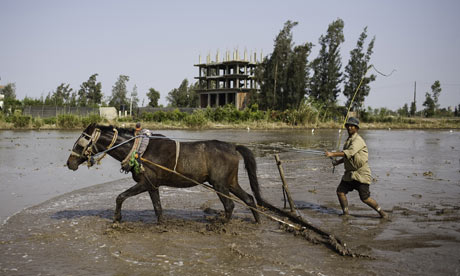
A farmer ploughs his rice paddy in the Delta. Photograph: Jason Larkin
...Two years ago, the Intergovernmental Panel on Climate Change declared Egypt's Nile Delta to be among the top three areas on the planet most vulnerable to a rise in sea levels, and even the most optimistic predictions of global temperature increase will still displace millions of Egyptians from one of the most densely populated regions on earth.
The Delta spills out from the northern stretches of the capital into 10,000 square miles of farmland fed by the Nile's branches. It is home to two-thirds of the country's rapidly growing population, and responsible for more than 60% of its food supply: Egypt relies unconditionally on it for survival. But with its 270km of coastline lying at a dangerously low elevation (large parts are between zero and 1m above sea level, with some areas lying below it), any melting of the polar ice caps could see its farmland and cities – including the historical port of Alexandria – transformed into an ocean floor. A 1m rise in the sea level, which many experts think likely within the next 100 years, will cause 20% of the Delta to go underwater. At the other extreme, the 14m rise that would result from the disappearance of Greenland and western Antarctica would leave the Mediterranean lapping at the northern suburbs of Cairo, with practically all of the Delta underwater.
Already, a series of environmental crises are parking themselves on the banks of the Nile. Some are subtle, like the river's quiet vanishing act in the Delta's northern fields; others, like the dramatic collapse of coastal lands into the ocean, are more striking. [...the menace of coastal erosion, which is steadily ingesting the edge of Egypt in some places at an astonishing rate of almost 100m a year.] Major flooding is yet to become a reality but, from industrial pollution to soil salinity, a whole new set of interconnected green concerns is now forcing its way into Egyptian public discourse for the first time.
"The Delta is a kind of Bangladesh story," says Dr Rick Tutwiler, director of the American University in Cairo's Desert Development Centre. "You've got a massive population, overcrowding, a threat to all natural resources from the pressure of all the people, production, pollution, cars and agricultural chemicals. And on top of all that, there's the rising sea. It's the perfect storm."
..."We currently have a major water deficit in Egypt, with only 700 cubic metres of freshwater per person," explains Professor Salah Soliman of Alexandria University. "That's already short of the 1,000 cubic metres per person the UN believes is the minimum needed for water security. Now, with the population increase, it will drop to 450 cubic metres per person – and this is all before we take into account the impact of climate change."
That impact is likely to be a 70% drop in the amount of Nile water reaching the Delta over the next 50 years, due to increased evaporation and heavier demands on water use upstream. The consequences of all these ecological changes on food production are staggering: experts at Egypt's Soils, Water and Environment Research Institute predict that wheat and maize yields could be down 40% and 50% respectively in the next 30 years, and that farmers who make a living off the land will lose around $1,000 per hectare for each degree rise in the average temperature...
"We're not responsible for climate change," says Soliman, pointing out that Egypt's contribution to global carbon emissions is an underwhelming 0.5%, nine times less per capita than the US. "But unfortunately the consequence of climate change is no respecter of national borders."
for complete article:
2009-08-21
http://www.guardian.co.uk/environment/2009/aug/21/climate-change-nile-flooding-farming
The Nile Delta is under threat from rising sea levels. Without the food it produces, Egypt faces catastrophe
A farmer ploughs his rice paddy in the Delta. Photograph: Jason Larkin
...Two years ago, the Intergovernmental Panel on Climate Change declared Egypt's Nile Delta to be among the top three areas on the planet most vulnerable to a rise in sea levels, and even the most optimistic predictions of global temperature increase will still displace millions of Egyptians from one of the most densely populated regions on earth.
The Delta spills out from the northern stretches of the capital into 10,000 square miles of farmland fed by the Nile's branches. It is home to two-thirds of the country's rapidly growing population, and responsible for more than 60% of its food supply: Egypt relies unconditionally on it for survival. But with its 270km of coastline lying at a dangerously low elevation (large parts are between zero and 1m above sea level, with some areas lying below it), any melting of the polar ice caps could see its farmland and cities – including the historical port of Alexandria – transformed into an ocean floor. A 1m rise in the sea level, which many experts think likely within the next 100 years, will cause 20% of the Delta to go underwater. At the other extreme, the 14m rise that would result from the disappearance of Greenland and western Antarctica would leave the Mediterranean lapping at the northern suburbs of Cairo, with practically all of the Delta underwater.
Already, a series of environmental crises are parking themselves on the banks of the Nile. Some are subtle, like the river's quiet vanishing act in the Delta's northern fields; others, like the dramatic collapse of coastal lands into the ocean, are more striking. [...the menace of coastal erosion, which is steadily ingesting the edge of Egypt in some places at an astonishing rate of almost 100m a year.] Major flooding is yet to become a reality but, from industrial pollution to soil salinity, a whole new set of interconnected green concerns is now forcing its way into Egyptian public discourse for the first time.
"The Delta is a kind of Bangladesh story," says Dr Rick Tutwiler, director of the American University in Cairo's Desert Development Centre. "You've got a massive population, overcrowding, a threat to all natural resources from the pressure of all the people, production, pollution, cars and agricultural chemicals. And on top of all that, there's the rising sea. It's the perfect storm."
..."We currently have a major water deficit in Egypt, with only 700 cubic metres of freshwater per person," explains Professor Salah Soliman of Alexandria University. "That's already short of the 1,000 cubic metres per person the UN believes is the minimum needed for water security. Now, with the population increase, it will drop to 450 cubic metres per person – and this is all before we take into account the impact of climate change."
That impact is likely to be a 70% drop in the amount of Nile water reaching the Delta over the next 50 years, due to increased evaporation and heavier demands on water use upstream. The consequences of all these ecological changes on food production are staggering: experts at Egypt's Soils, Water and Environment Research Institute predict that wheat and maize yields could be down 40% and 50% respectively in the next 30 years, and that farmers who make a living off the land will lose around $1,000 per hectare for each degree rise in the average temperature...
"We're not responsible for climate change," says Soliman, pointing out that Egypt's contribution to global carbon emissions is an underwhelming 0.5%, nine times less per capita than the US. "But unfortunately the consequence of climate change is no respecter of national borders."
for complete article:
2009-08-21
http://www.guardian.co.uk/environment/2009/aug/21/climate-change-nile-flooding-farming
Tony Blair on Climate Change: Don't Make Sacrifices, Keep Consuming...Sustainably
Tony Blair: 'We can't ask people not to own cars'
Despite a projected tripling of traffic in China over the next decade, the focus should be on low-carbon technology rather than sacrifice, says a report by Tony Blair's Climate Group
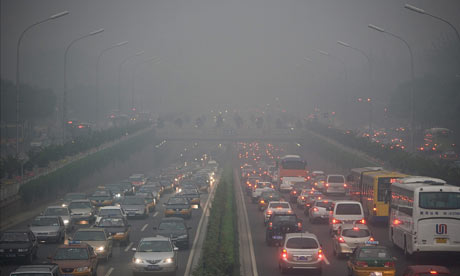
Traffic runs slowly as heavy haze hangs over Beijing, China. Photograph: Diego Azubel/EPA
Car ownership cannot be sacrificed in the fight against climate change, Tony Blair said today in Beijing, despite a projected tripling of traffic in China over the next decade.
In a report forecasting 150m cars on China's roads, which will produce a fifth of global exhaust emissions by 2020, the former UK prime minister said it was impractical to expect governments to curb sales.
"I think the way we consume has to change, but I think it is completely unrealistic to say to people you can't have a car, you can't use a motorbike. It is just not going to happen," he said.
Instead, he said, the focus should be on developing low-carbon technology and expanding the manufacturing and infrastructure for hybrid and electric vehicles.
He was talking at the launch of a new report by his Climate Group, which suggests the world's most populous nation is taking the lead in many fields of low-carbon industry.
While many environmentalists stress the need to curb consumption worldwide to deal with global warming, Blair emphasised change rather than sacrifice.
"We are changing the way we live not so that we don't consume and get the material benefits that people like ourselves actually enjoy, but we are changing it so that we do so in a way that is sustainable," he said.
Asking developing nations not to follow suit, he said, was unrealistic. "If you were to say to people in China that we in the west have grown our economies and consumed all this, but you must live in poverty for the sake of the planet, then they are going to say 'No, I am not'," he said.
for complete article:
2009-08-20
http://www.guardian.co.uk/environment/2009/aug/20/tony-blair-cars-china
Despite a projected tripling of traffic in China over the next decade, the focus should be on low-carbon technology rather than sacrifice, says a report by Tony Blair's Climate Group
Traffic runs slowly as heavy haze hangs over Beijing, China. Photograph: Diego Azubel/EPA
Car ownership cannot be sacrificed in the fight against climate change, Tony Blair said today in Beijing, despite a projected tripling of traffic in China over the next decade.
In a report forecasting 150m cars on China's roads, which will produce a fifth of global exhaust emissions by 2020, the former UK prime minister said it was impractical to expect governments to curb sales.
"I think the way we consume has to change, but I think it is completely unrealistic to say to people you can't have a car, you can't use a motorbike. It is just not going to happen," he said.
Instead, he said, the focus should be on developing low-carbon technology and expanding the manufacturing and infrastructure for hybrid and electric vehicles.
He was talking at the launch of a new report by his Climate Group, which suggests the world's most populous nation is taking the lead in many fields of low-carbon industry.
While many environmentalists stress the need to curb consumption worldwide to deal with global warming, Blair emphasised change rather than sacrifice.
"We are changing the way we live not so that we don't consume and get the material benefits that people like ourselves actually enjoy, but we are changing it so that we do so in a way that is sustainable," he said.
Asking developing nations not to follow suit, he said, was unrealistic. "If you were to say to people in China that we in the west have grown our economies and consumed all this, but you must live in poverty for the sake of the planet, then they are going to say 'No, I am not'," he said.
for complete article:
2009-08-20
http://www.guardian.co.uk/environment/2009/aug/20/tony-blair-cars-china
Australia Passes 20% Renewables Bill
Australia Passes 20% Renewables Bill
Australia's parliament today passed a law demanding that 20% of the country's electricity come from renewable sources by 2020, matching European targets.
The law would quadruple the renewable energy target set by the previous government in 2001 and provide enough clean electricity to power the households of all 21 million Australians.
The target matches one set by the European Union, which leads the world in green power technology.
But some officials warned that more aggressive cuts in greenhouse gas emissions are needed as well...
Last week the Senate rejected a government-proposed bill that would have taxed industries' carbon emissions starting in 2011 and slashed the country's emissions by up to 25% below 2000 levels by 2020.
for complete article:
2009-08-20
http://www.guardian.co.uk/environment/2009/aug/20/australia-renewable-energy-bill
Australia's parliament today passed a law demanding that 20% of the country's electricity come from renewable sources by 2020, matching European targets.
The law would quadruple the renewable energy target set by the previous government in 2001 and provide enough clean electricity to power the households of all 21 million Australians.
The target matches one set by the European Union, which leads the world in green power technology.
But some officials warned that more aggressive cuts in greenhouse gas emissions are needed as well...
Last week the Senate rejected a government-proposed bill that would have taxed industries' carbon emissions starting in 2011 and slashed the country's emissions by up to 25% below 2000 levels by 2020.
for complete article:
2009-08-20
http://www.guardian.co.uk/environment/2009/aug/20/australia-renewable-energy-bill
15 August 2009
UN's Climate Chief Warns of Real Risk of Failure at Climate Change Talks
UN's Climate Chief Warns of Real Risk of Failure at Climate Change Talks
Yvo de Boer says process too slow to reach deal at close of meeting in Bonn aimed at trimming 200-page draft treaty
A new global treaty on climate change is unlikely unless negotiations accelerate, the UN's top climate change official warned today. Speaking at the close of another meeting intended to lay the ground for a new deal, Yvo de Boer, head of the UN climate secretariat said there was a real risk of failure.
According to Reuters, he said: "If we continue at this rate we're not going to make it." De Boer said the week-long meeting in Bonn had made only "selective progress" towards trimming a huge 200-page draft treaty text.
He warned that just 15 days of negotiations remain before key UN talks begin in December in Copenhagen at meetings in Bangkok in September and October and Barcelona in November.
The Bonn talks were not expected to make a significant breakthrough. Observers said there was little movement on the key issues of new curbs on greenhouse gas pollution and funds to help poorer nations cope with global warming...
"Delegates spent too much time arguing over procedures and technicalities. This is not the way to overcome mistrust between rich and poor nations," said Kim Carstensen, head of WWF Global Climate Initiative. "Delegates are kept back by political gridlock. The political leaders must now unblock the process."...
for complete article:
2009-08-14
http://www.guardian.co.uk/environment/2009/aug/14/bonn-climate-change-talks
Yvo de Boer says process too slow to reach deal at close of meeting in Bonn aimed at trimming 200-page draft treaty
A new global treaty on climate change is unlikely unless negotiations accelerate, the UN's top climate change official warned today. Speaking at the close of another meeting intended to lay the ground for a new deal, Yvo de Boer, head of the UN climate secretariat said there was a real risk of failure.
According to Reuters, he said: "If we continue at this rate we're not going to make it." De Boer said the week-long meeting in Bonn had made only "selective progress" towards trimming a huge 200-page draft treaty text.
He warned that just 15 days of negotiations remain before key UN talks begin in December in Copenhagen at meetings in Bangkok in September and October and Barcelona in November.
The Bonn talks were not expected to make a significant breakthrough. Observers said there was little movement on the key issues of new curbs on greenhouse gas pollution and funds to help poorer nations cope with global warming...
"Delegates spent too much time arguing over procedures and technicalities. This is not the way to overcome mistrust between rich and poor nations," said Kim Carstensen, head of WWF Global Climate Initiative. "Delegates are kept back by political gridlock. The political leaders must now unblock the process."...
for complete article:
2009-08-14
http://www.guardian.co.uk/environment/2009/aug/14/bonn-climate-change-talks
Barack Obama's Key Climate Bill Hit by $45m PR Campaign
Barack Obama's Key Climate Bill Hit by $45m PR Campaign
America's oil, gas and coal industry has increased its lobbying budget by 50%, with key players spending $44.5m in the first three months of this year in an intense effort to cut off support for Barack Obama's plan to build a clean energy economy.
The spoiler campaign runs to hundreds of millions of dollars and involves industry front groups, lobbying firms, television, print and radio advertising, and donations to pivotal members of Congress. Its intention is to water down or kill off plans by the Democratic leadership to pass "cap and trade" legislation this year, which would place limits on greenhouse gas emissions.
A defeat for the bill would have global consequences. The international community is depending on America, as the world's biggest per capita polluter, to set out a firm plan for getting off dirty fuels in the months before crucial UN negotiations in Copenhagen in December.
But it is an unequal contest. Liberal and environmental organisations, as well as the major corporations that support climate change legislation, say they are being vastly outspent by fossil fuel interests.
"These guys are spending a billion dollars this year convincing Americans that they are clean, green, cuddly and warm," said Bob Perkowitz, founder of the eco- America PR firm. Perkowitz is to brief the White House yesterday on a new environmental messaging strategy. "The enviros are getting their message out, but they are being outspent by 10 to one." he said.On advertising, the ratio is about three to one. The oil and coal industry spent $76.1m on ads from 1 January to 27 April, according to CMAG data seen by the Guardian. Environmental groups, led by Al Gore's Alliance for Climate Protection, the Environmental Defence Fund and the Sierra Club, spent $28.6m on ads in the same period, Tracey said.
Despite its global significance, the fate of the draft "cap and trade" bill now lies in the hands of just a dozen Democrats, who have yet to back Obama's energy transformation. The Democratic leadership cannot take their support for granted. Seven of those pivotal Democrats received campaign donations in excess of $100,000 from the oil and gas industry, coal producers, and electricity firms during last year's elections, according to an analysis provided to the Guardian by the Centre for Responsive Politics. Another two received more than $90,000 last year.
for complete article:
2009-05-12
http://www.guardian.co.uk/environment/2009/may/12/us-climate-bill-oil-gas
America's oil, gas and coal industry has increased its lobbying budget by 50%, with key players spending $44.5m in the first three months of this year in an intense effort to cut off support for Barack Obama's plan to build a clean energy economy.
The spoiler campaign runs to hundreds of millions of dollars and involves industry front groups, lobbying firms, television, print and radio advertising, and donations to pivotal members of Congress. Its intention is to water down or kill off plans by the Democratic leadership to pass "cap and trade" legislation this year, which would place limits on greenhouse gas emissions.
A defeat for the bill would have global consequences. The international community is depending on America, as the world's biggest per capita polluter, to set out a firm plan for getting off dirty fuels in the months before crucial UN negotiations in Copenhagen in December.
But it is an unequal contest. Liberal and environmental organisations, as well as the major corporations that support climate change legislation, say they are being vastly outspent by fossil fuel interests.
"These guys are spending a billion dollars this year convincing Americans that they are clean, green, cuddly and warm," said Bob Perkowitz, founder of the eco- America PR firm. Perkowitz is to brief the White House yesterday on a new environmental messaging strategy. "The enviros are getting their message out, but they are being outspent by 10 to one." he said.On advertising, the ratio is about three to one. The oil and coal industry spent $76.1m on ads from 1 January to 27 April, according to CMAG data seen by the Guardian. Environmental groups, led by Al Gore's Alliance for Climate Protection, the Environmental Defence Fund and the Sierra Club, spent $28.6m on ads in the same period, Tracey said.
Despite its global significance, the fate of the draft "cap and trade" bill now lies in the hands of just a dozen Democrats, who have yet to back Obama's energy transformation. The Democratic leadership cannot take their support for granted. Seven of those pivotal Democrats received campaign donations in excess of $100,000 from the oil and gas industry, coal producers, and electricity firms during last year's elections, according to an analysis provided to the Guardian by the Centre for Responsive Politics. Another two received more than $90,000 last year.
for complete article:
2009-05-12
http://www.guardian.co.uk/environment/2009/may/12/us-climate-bill-oil-gas
Oil Lobby to Fund Fake Grassroots Campaign Against Climate Change Strategy
Oil Lobby to Fund Campaign Against Obama's Climate Change Strategy
Email from American Petroleum Institute outlines plan to create appearance of public opposition to Obama's climate and energy reform
The US oil and gas lobby are planning to stage public events to give the appearance of a groundswell of public opinion against legislation that is key to Barack Obama's climate change strategy, according to campaigners.
A key lobbying group will bankroll and organise 20 ''energy citizen'' rallies in 20 states. In an email obtained by Greenpeace, Jack Gerard, the president of the American Petroleum Institute (API), outlined what he called a "sensitive" plan to stage events during the August congressional recess to put a "human face" on opposition to climate and energy reform...
"Our goal is to energise people and show them that they are not alone," said Cathy Landry, for API, who confirmed that the memo was authentic.
The email from Gerard lays out ambitious plans to stage a series of lunchtime rallies to try to shape the climate bill that was passed by the house in June and will come before the Senate in September. "We must move aggressively," it reads.
The API strategy also extends to a PR drive. Gerard cites polls to test the effectiveness of its arguments against climate change legislation. It offers up the "energy citizen" rallies as ready-made events, noting that allies – which include manufacturing and farm alliances as well as 400 oil and gas member organisations – will have to do little more than turn up.
"API will provide the up-front resources," the email said. "This includes contracting with a highly experienced events management company that has produced successful rallies for presidential campaigns."...
Greenpeace described the meetings as "astroturfing" – events intended to exert pressure on legislators by giving the impression of a groundswell of public opinion. Kert Davies, its research director, said: "It is the behind the scenes plan to disrupt the debate and weaken political support for climate regulation."...
The API drive also points to a possible fracturing of the US Climate Action Partnership (Uscap), a broad coalition of corporations and energy organisations which was instrumental in drafting the Waxman-Markey climate change bill that passed in the House of Representatives in June.
Passage of the legislation is seen as crucial to the prospects of getting the world to sign on to a climate change treaty at Copenhagen next December.
Five members of Uscap are also in API, including BP which said its employees were aware of the rallies. Conoco Phillips, which was also a member of the climate action partnership, has also turned against climate change, warning on its website that the legislation will put jobs at risk, and compromise America's energy security. The company is also advertising the energy rallies on its website, urging readers: "Make your voice heard." ...
for complete articles:
Oil lobby to fund campaign against Obama's climate change strategy
2009-08-14
http://www.guardian.co.uk/environment/2009/aug/14/us-lobbying
Oil industry split on climate law protests
2009-08-14
http://www.ft.com/cms/s/0/410c5118-88ef-11de-b50f-00144feabdc0.html
Email from American Petroleum Institute outlines plan to create appearance of public opposition to Obama's climate and energy reform
The US oil and gas lobby are planning to stage public events to give the appearance of a groundswell of public opinion against legislation that is key to Barack Obama's climate change strategy, according to campaigners.
A key lobbying group will bankroll and organise 20 ''energy citizen'' rallies in 20 states. In an email obtained by Greenpeace, Jack Gerard, the president of the American Petroleum Institute (API), outlined what he called a "sensitive" plan to stage events during the August congressional recess to put a "human face" on opposition to climate and energy reform...
"Our goal is to energise people and show them that they are not alone," said Cathy Landry, for API, who confirmed that the memo was authentic.
The email from Gerard lays out ambitious plans to stage a series of lunchtime rallies to try to shape the climate bill that was passed by the house in June and will come before the Senate in September. "We must move aggressively," it reads.
The API strategy also extends to a PR drive. Gerard cites polls to test the effectiveness of its arguments against climate change legislation. It offers up the "energy citizen" rallies as ready-made events, noting that allies – which include manufacturing and farm alliances as well as 400 oil and gas member organisations – will have to do little more than turn up.
"API will provide the up-front resources," the email said. "This includes contracting with a highly experienced events management company that has produced successful rallies for presidential campaigns."...
Greenpeace described the meetings as "astroturfing" – events intended to exert pressure on legislators by giving the impression of a groundswell of public opinion. Kert Davies, its research director, said: "It is the behind the scenes plan to disrupt the debate and weaken political support for climate regulation."...
The API drive also points to a possible fracturing of the US Climate Action Partnership (Uscap), a broad coalition of corporations and energy organisations which was instrumental in drafting the Waxman-Markey climate change bill that passed in the House of Representatives in June.
Passage of the legislation is seen as crucial to the prospects of getting the world to sign on to a climate change treaty at Copenhagen next December.
Five members of Uscap are also in API, including BP which said its employees were aware of the rallies. Conoco Phillips, which was also a member of the climate action partnership, has also turned against climate change, warning on its website that the legislation will put jobs at risk, and compromise America's energy security. The company is also advertising the energy rallies on its website, urging readers: "Make your voice heard." ...
for complete articles:
Oil lobby to fund campaign against Obama's climate change strategy
2009-08-14
http://www.guardian.co.uk/environment/2009/aug/14/us-lobbying
Oil industry split on climate law protests
2009-08-14
http://www.ft.com/cms/s/0/410c5118-88ef-11de-b50f-00144feabdc0.html
California Green Building Code, A National First, Starts This Month
California Green Building Code, A National First, Starts This Month
California's green building code, the first of its kind in the nation, takes effect this month, the California Building Standards Commission announced this week.
The code standardizes practices for reducing the environmental impact of buildings in a variety of ways, from cutting water and electricity consumption to using less resource-intensive building materials. Application of the code is currently voluntary. It was adopted last year as a step toward mandatory green building standards, which Gov. Arnold Schwarzenegger has called for by 2010.
The use of gas, electricity and water in buildings accounts for about a quarter of California's greenhouse-gas emissions. Reducing those emissions is a central strategy in the state's war on global warming.
for complete article:
2009-08-14
http://www.mcclatchydc.com/environment/story/73738.html
California's green building code, the first of its kind in the nation, takes effect this month, the California Building Standards Commission announced this week.
The code standardizes practices for reducing the environmental impact of buildings in a variety of ways, from cutting water and electricity consumption to using less resource-intensive building materials. Application of the code is currently voluntary. It was adopted last year as a step toward mandatory green building standards, which Gov. Arnold Schwarzenegger has called for by 2010.
The use of gas, electricity and water in buildings accounts for about a quarter of California's greenhouse-gas emissions. Reducing those emissions is a central strategy in the state's war on global warming.
for complete article:
2009-08-14
http://www.mcclatchydc.com/environment/story/73738.html
08 August 2009
Climate Change Seen as Threat to U.S. Security
Climate Change Seen as Threat to U.S. Security
The changing global climate will pose profound strategic challenges to the United States in coming decades, raising the prospect of military intervention to deal with the effects of violent storms, drought, mass migration and pandemics, military and intelligence analysts say.
Such climate-induced crises could topple governments, feed terrorist movements or destabilize entire regions, say the analysts, experts at the Pentagon and intelligence agencies who for the first time are taking a serious look at the national security implications of climate change.
Recent war games and intelligence studies conclude that over the next 20 to 30 years, vulnerable regions, particularly sub-Saharan Africa, the Middle East and South and Southeast Asia, will face the prospect of food shortages, water crises and catastrophic flooding driven by climate change that could demand an American humanitarian relief or military response...
Much of the public and political debate on global warming has focused on finding substitutes for fossil fuels, reducing emissions that contribute to greenhouse gases and furthering negotiations toward an international climate treaty — not potential security challenges.
But a growing number of policy makers say that the world’s rising temperatures, surging seas and melting glaciers are a direct threat to the national interest. If the United States does not lead the world in reducing fossil-fuel consumption and thus emissions of global warming gases, proponents of this view say, a series of global environmental, social, political and possibly military crises loom that the nation will urgently have to address...
...The Pentagon will include a climate section in the Quadrennial Defense Review, due in February; the State Department will address the issue in its new Quadrennial Diplomacy and Development Review.
“The sense that climate change poses security and geopolitical challenges is central to the thinking of the State Department and the climate office,” said Peter Ogden, chief of staff to Todd Stern, the State Department’s top climate negotiator...
“We will pay for this one way or another,” Gen. Anthony C. Zinni, a retired Marine and the former head of the Central Command, wrote recently in a report he prepared as a member of a military advisory board on energy and climate at CNA, a private group that does research for the Navy. “We will pay to reduce greenhouse gas emissions today, and we’ll have to take an economic hit of some kind.
“Or we will pay the price later in military terms,” he warned. “And that will involve human lives.”
for complete article:
2009-08-08
http://www.nytimes.com/2009/08/09/science/earth/09climate.html?_r=1&ref=global-home
The changing global climate will pose profound strategic challenges to the United States in coming decades, raising the prospect of military intervention to deal with the effects of violent storms, drought, mass migration and pandemics, military and intelligence analysts say.
Such climate-induced crises could topple governments, feed terrorist movements or destabilize entire regions, say the analysts, experts at the Pentagon and intelligence agencies who for the first time are taking a serious look at the national security implications of climate change.
Recent war games and intelligence studies conclude that over the next 20 to 30 years, vulnerable regions, particularly sub-Saharan Africa, the Middle East and South and Southeast Asia, will face the prospect of food shortages, water crises and catastrophic flooding driven by climate change that could demand an American humanitarian relief or military response...
Much of the public and political debate on global warming has focused on finding substitutes for fossil fuels, reducing emissions that contribute to greenhouse gases and furthering negotiations toward an international climate treaty — not potential security challenges.
But a growing number of policy makers say that the world’s rising temperatures, surging seas and melting glaciers are a direct threat to the national interest. If the United States does not lead the world in reducing fossil-fuel consumption and thus emissions of global warming gases, proponents of this view say, a series of global environmental, social, political and possibly military crises loom that the nation will urgently have to address...
...The Pentagon will include a climate section in the Quadrennial Defense Review, due in February; the State Department will address the issue in its new Quadrennial Diplomacy and Development Review.
“The sense that climate change poses security and geopolitical challenges is central to the thinking of the State Department and the climate office,” said Peter Ogden, chief of staff to Todd Stern, the State Department’s top climate negotiator...
“We will pay for this one way or another,” Gen. Anthony C. Zinni, a retired Marine and the former head of the Central Command, wrote recently in a report he prepared as a member of a military advisory board on energy and climate at CNA, a private group that does research for the Navy. “We will pay to reduce greenhouse gas emissions today, and we’ll have to take an economic hit of some kind.
“Or we will pay the price later in military terms,” he warned. “And that will involve human lives.”
for complete article:
2009-08-08
http://www.nytimes.com/2009/08/09/science/earth/09climate.html?_r=1&ref=global-home
07 August 2009
Climate Change Melting U.S. Glaciers at Faster Rate
Climate Change Melting U.S. Glaciers at Faster Rate, Study Finds
US geological survey commissioned by Obama administration indicates a sharp rise in the melt rate of key American glaciers over the last 10-15 years
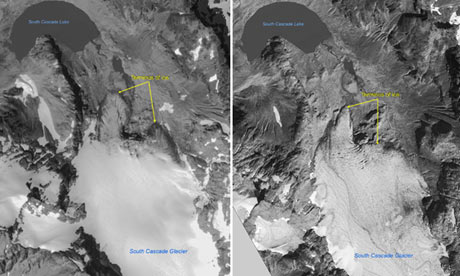
A composite image showing South Cascade glacier in Washington state (year 2000, left, 2006, right). A new study today found a sharp rise in the melt rate of three key American glaciers over the last 10-15 years. Photograph: USGS
Climate change is melting America's glaciers at the fastest rate in recorded history, exposing the country to higher risks of drought and rising sea levels, a US government study of glaciers said today.
The long-running study of three "benchmark" glaciers in Alaska and Washington state by the US geological survey (USGS) indicated a sharp rise in the melt rate over the last 10 or 15 years.
Scientists see the three - Wolverine and Gulkana in Alaska and South Cascade in Washington - as representative of thousands of other glaciers in North America.
"The observations show that the melt rate has definitely increased over the past 10 or 15 years," said Ed Josberger, a USGS scientist. "This certainly is a very strong indicator that climate change is occurring and its effects on glaciers are virtually worldwide."
The survey also found that all three glaciers had begun melting at the same higher rate - although they are in different climate regimes and some 1,500 miles apart...
For South Cascade, the average surface loss rate grew to 1.75 to 2m a year from about 1m a year...
Shrinking glaciers have led to a reduction in spring run-off which is intensifying the effects of drought in California and other states, especially later in the summer when other water sources dry up.
Glacier loss has also contributed to rising sea levels, which has put low-lying coastal areas - such as New Orleans - at greater risk of storm surges.
for complete article:
2009-08-06
http://www.guardian.co.uk/environment/2009/aug/06/america-glacier-melt
US geological survey commissioned by Obama administration indicates a sharp rise in the melt rate of key American glaciers over the last 10-15 years
A composite image showing South Cascade glacier in Washington state (year 2000, left, 2006, right). A new study today found a sharp rise in the melt rate of three key American glaciers over the last 10-15 years. Photograph: USGS
Climate change is melting America's glaciers at the fastest rate in recorded history, exposing the country to higher risks of drought and rising sea levels, a US government study of glaciers said today.
The long-running study of three "benchmark" glaciers in Alaska and Washington state by the US geological survey (USGS) indicated a sharp rise in the melt rate over the last 10 or 15 years.
Scientists see the three - Wolverine and Gulkana in Alaska and South Cascade in Washington - as representative of thousands of other glaciers in North America.
"The observations show that the melt rate has definitely increased over the past 10 or 15 years," said Ed Josberger, a USGS scientist. "This certainly is a very strong indicator that climate change is occurring and its effects on glaciers are virtually worldwide."
The survey also found that all three glaciers had begun melting at the same higher rate - although they are in different climate regimes and some 1,500 miles apart...
For South Cascade, the average surface loss rate grew to 1.75 to 2m a year from about 1m a year...
Shrinking glaciers have led to a reduction in spring run-off which is intensifying the effects of drought in California and other states, especially later in the summer when other water sources dry up.
Glacier loss has also contributed to rising sea levels, which has put low-lying coastal areas - such as New Orleans - at greater risk of storm surges.
for complete article:
2009-08-06
http://www.guardian.co.uk/environment/2009/aug/06/america-glacier-melt
Subscribe to:
Posts (Atom)

 Posts
Posts

