
CO2 Levels Not This High for 15 Million Years, When Climate Was 5° to 10°F Warmer and Seas Were 75 to 120 Feet Higher
~ “We have shown that this dramatic rise in sea level is associated with an increase in CO2 levels of about 100 ppm.” ~
You would have to go back at least 15 million years to find carbon dioxide levels on Earth as high as they are today, a UCLA scientist and colleagues report Oct. 8 in the online edition of the journal Science.
“The last time carbon dioxide levels were apparently as high as they are today — and were sustained at those levels — global temperatures were 5 to 10 degrees Fahrenheit higher than they are today, the sea level was approximately 75 to 120 feet higher than today, there was no permanent sea ice cap in the Arctic and very little ice on Antarctica and Greenland,” said the paper’s lead author, Aradhna Tripati, a UCLA assistant professor in the department of Earth and space sciences and the department of atmospheric and oceanic sciences.
“Carbon dioxide is a potent greenhouse gas, and geological observations that we now have for the last 20 million years lend strong support to the idea that carbon dioxide is an important agent for driving climate change throughout Earth’s history,” she said...
“A slightly shocking finding,” Tripati said, “is that the only time in the last 20 million years that we find evidence for carbon dioxide levels similar to the modern level of 387 parts per million was 15 to 20 million years ago, when the planet was dramatically different.”...
“We have shown that this dramatic rise in sea level is associated with an increase in carbon dioxide levels of about 100 parts per million, a huge change,” Tripati said. “This record is the first evidence that carbon dioxide may be linked with environmental changes, such as changes in the terrestrial ecosystem, distribution of ice, sea level and monsoon intensity.”
Today, the Arctic Ocean is covered with frozen ice all year long, an ice cap that has been there for about 14 million years.
“Prior to that, there was no permanent sea ice cap in the Arctic,” Tripati said...
for complete article:
Science: CO2 levels haven’t been this high for 15 million years, when it was 5° to 10°F warmer and seas were 75 to 120 feet higher — “We have shown that this dramatic rise in sea level is associated with an increase in CO2 levels of about 100 ppm.”
2009-10-18
http://climateprogress.org/2009/10/18/science-co2-levels-havent-been-this-high-for-15-million-years-when-it-was-5%C2%B0-to-10%C2%B0f-warmer-and-seas-were-75-to-120-feet-higher-we-have-shown-that-this-dramatic-rise-in-sea-level-i/#more-12516
19 October 2009
World Must Shift to Low-Carbon Economy by 2014 or Face Dangerous Climate Change
World Must Shift to Low-Carbon Economy by 2014 or Face Dangerous Climate Change, Says WWF
Delay in low-carbon technologies will make it impossible to cut CO2 quickly enough to avoid worst impacts of global warming ~
The world must start a "complete" shift to a low carbon economy by 2014 — or risk making dangerous climate change almost inevitable, a report warned today.
The study for conservation charity WWF showed that waiting until after 2014 to fully develop the clean industries needed to reduce greenhouse gas emissions, such as renewable energy, would leave it too late to halt temperature rises of more than 2C.
With low-carbon industry only able to grow at a certain rate, a delay in taking action will make it almost impossible for countries to roll out the technology in time to cut emissions by the amounts needed to avoid the worst impacts of global warming.
The research by analysts Climate Risk (pdf) also said countries must take action across a range of industries at once, including renewable energy, technology to capture the carbon emissions from fossil fuel power stations, preventing deforestation and improving energy efficiency.
If countries fail to tackle emissions across all sectors, they will end up getting the lowest-cost industries up and running first and not developing other areas until they are affordable.
This would make it impossible to meet targets to reduce emissions, the study warned...
Keith Allott, head of climate change at WWF-UK, said: "Clean industry sectors can only expand so far, so quickly.
"If we wait until later than 2014 to begin aggressively tackling the problem, we will have left it too late to ensure that all the low-carbon solutions required are ready to roll out at the scale needed if we intend to keep within the world's remaining carbon budget.
He said the report highlighted the need for a "complete industrial shift towards a low-carbon future" which must begin with a fair and binding deal on climate change in Copenhagen in December...
for complete article:
2009-10-18
http://www.guardian.co.uk/environment/2009/oct/19/wwf-low-carbon-technologies/print
for a copy of the research by analysts Climate Risk (pdf):
http://www.climaterisk.com.au/userfiles/image/Download%20Files/Climate%20Solutions%202%20-%20Full%20Report%5B1%5D.pdf
Delay in low-carbon technologies will make it impossible to cut CO2 quickly enough to avoid worst impacts of global warming ~
The world must start a "complete" shift to a low carbon economy by 2014 — or risk making dangerous climate change almost inevitable, a report warned today.
The study for conservation charity WWF showed that waiting until after 2014 to fully develop the clean industries needed to reduce greenhouse gas emissions, such as renewable energy, would leave it too late to halt temperature rises of more than 2C.
With low-carbon industry only able to grow at a certain rate, a delay in taking action will make it almost impossible for countries to roll out the technology in time to cut emissions by the amounts needed to avoid the worst impacts of global warming.
The research by analysts Climate Risk (pdf) also said countries must take action across a range of industries at once, including renewable energy, technology to capture the carbon emissions from fossil fuel power stations, preventing deforestation and improving energy efficiency.
If countries fail to tackle emissions across all sectors, they will end up getting the lowest-cost industries up and running first and not developing other areas until they are affordable.
This would make it impossible to meet targets to reduce emissions, the study warned...
Keith Allott, head of climate change at WWF-UK, said: "Clean industry sectors can only expand so far, so quickly.
"If we wait until later than 2014 to begin aggressively tackling the problem, we will have left it too late to ensure that all the low-carbon solutions required are ready to roll out at the scale needed if we intend to keep within the world's remaining carbon budget.
He said the report highlighted the need for a "complete industrial shift towards a low-carbon future" which must begin with a fair and binding deal on climate change in Copenhagen in December...
for complete article:
2009-10-18
http://www.guardian.co.uk/environment/2009/oct/19/wwf-low-carbon-technologies/print
for a copy of the research by analysts Climate Risk (pdf):
http://www.climaterisk.com.au/userfiles/image/Download%20Files/Climate%20Solutions%202%20-%20Full%20Report%5B1%5D.pdf


Britain Warns of Climate Catastrophe
Copenhagen Climate Change Talks Are Last Chance, Says Gordon Brown
~ There are now fewer than 50 days to set course of next 50 years and more, PM tells environment ministers from 17 countries responsible for 80% of greenhouse gas emissions. Gordon Brown to world leaders: Come to Copenhagen! ~

Photo of British Prime Minister Gordon Brown at Major Economies Forum in London Monday: Scanpix/AFP
Gordon Brown today warned that the world is on the brink of a "catastrophic" future of killer heatwaves, floods and droughts unless governments speed up negotiations on climate change before vital talks in Copenhagen in December.
This applies to the US as much as anyone, he said, adding that "there is no plan B", and that agreement cannot be deferred beyond the UN-sponsored Copenhagen conference.
There are fears that Barack Obama does not have the political capital to reach a deal in Copenhagen and will instead use a visit to China next month to reach a bilateral deal that circumvents the UN.
Downing Street is also concerned that there is no agreement on how to finance a climate change package in developing countries.
The prime minister delivered his warning to a meeting of environment ministers brought together under the umbrella of the Major Economies Forum. The 17 countries in the forum are responsible for 80% of greenhouse gas emissions.
Brown told them: "In every era there are only one or two moments when nations come together and reach agreements that make history, because they change the course of history. Copenhagen must be such a time. There are now fewer than 50 days to set the course of the next 50 years and more.
"If we do not reach a deal at this time, let us be in no doubt: once the damage from unchecked emissions growth is done, no retrospective global agreement in some future period can undo that choice. By then it will be irretrievably too late."...
Copenhagen climate change talks are last chance, says Gordon Brown
2009-10-19
http://www.guardian.co.uk/environment/2009/oct/19/gordon-brown-copenhagen-climate-talks
Britain Warns of Climate Catastrophe
2009-10-19
http://www.nytimes.com/aponline/2009/10/19/world/AP-EU-Britain-Climate-Forum.html?ref=global-home
~ There are now fewer than 50 days to set course of next 50 years and more, PM tells environment ministers from 17 countries responsible for 80% of greenhouse gas emissions. Gordon Brown to world leaders: Come to Copenhagen! ~
Photo of British Prime Minister Gordon Brown at Major Economies Forum in London Monday: Scanpix/AFP
Gordon Brown today warned that the world is on the brink of a "catastrophic" future of killer heatwaves, floods and droughts unless governments speed up negotiations on climate change before vital talks in Copenhagen in December.
This applies to the US as much as anyone, he said, adding that "there is no plan B", and that agreement cannot be deferred beyond the UN-sponsored Copenhagen conference.
There are fears that Barack Obama does not have the political capital to reach a deal in Copenhagen and will instead use a visit to China next month to reach a bilateral deal that circumvents the UN.
Downing Street is also concerned that there is no agreement on how to finance a climate change package in developing countries.
The prime minister delivered his warning to a meeting of environment ministers brought together under the umbrella of the Major Economies Forum. The 17 countries in the forum are responsible for 80% of greenhouse gas emissions.
Brown told them: "In every era there are only one or two moments when nations come together and reach agreements that make history, because they change the course of history. Copenhagen must be such a time. There are now fewer than 50 days to set the course of the next 50 years and more.
"If we do not reach a deal at this time, let us be in no doubt: once the damage from unchecked emissions growth is done, no retrospective global agreement in some future period can undo that choice. By then it will be irretrievably too late."...
Copenhagen climate change talks are last chance, says Gordon Brown
2009-10-19
http://www.guardian.co.uk/environment/2009/oct/19/gordon-brown-copenhagen-climate-talks
Britain Warns of Climate Catastrophe
2009-10-19
http://www.nytimes.com/aponline/2009/10/19/world/AP-EU-Britain-Climate-Forum.html?ref=global-home
Maldives Holds Cabinet Meeting Underwater to Highlight Danger of Global Warming
Maldives government dives for climate change
~ Seated at a table on the sea floor the low-lying island state's president, vice president, cabinet secretary and 11 ministers signed a document calling on all countries to cut their carbon dioxide emissions ~

Photo of Fisheries and Agriculture Minister Ibrahim Didi signing the decree: Scanpix/AFP
Members of the Maldives' Cabinet donned scuba gear and used hand signals Saturday at an underwater meeting staged to highlight the threat of global warming to the lowest-lying nation on earth.
President Mohammed Nasheed and 13 other government officials submerged and took their seats at a table on the sea floor — 20 feet (6 meters) below the surface of a lagoon off Girifushi, an island usually used for military training.
With a backdrop of coral, the meeting was a bid to draw attention to fears that rising sea levels caused by the melting of polar ice caps could swamp this Indian Ocean archipelago within a century. Its islands average 7 feet (2.1 meters) above sea level.
"What we are trying to make people realize is that the Maldives is a frontline state. This is not merely an issue for the Maldives but for the world," Nasheed said.
As bubbles floated up from their face masks, the president, vice president, Cabinet secretary and 11 ministers signed a document calling on all countries to cut their carbon dioxide emissions.
The issue has taken on urgency ahead of a major UN climate change conference scheduled for December in Copenhagen. At that meeting countries will negotiate a successor to the Kyoto Protocol with aims to cut the emission of greenhouse gases such as carbon dioxide that scientists blame for causing global warming by trapping heat in the atmosphere.
Wealthy nations want broad emissions cuts from all countries, while poorer ones say industrialized countries should carry most of the burden.
Dozens of Maldives soldiers guarded the event Saturday, but the only intruders were groupers and other fish.
Nasheed had already announced plans for a fund to buy a new homeland for his people if the 1,192 low-lying coral islands are submerged. He has promised to make the Maldives, with a population of 350,000, the world's first carbon-neutral nation within a decade.
"We have to get the message across by being more imaginative, more creative and so this is what we are doing," he said in an interview on a boat en route to the dive site.
Nasheed, who has emerged as a key, and colorful, voice on climate change, is a certified diver, but the others had to take diving lessons in recent weeks.
Three ministers missed the underwater meeting because two were not given medical permission and another was abroad.
Maldives government dives for climate change
2009-10-19
http://en.cop15.dk/news/view+news?newsid=2376
for interview with President Mohamed Nasheed:
Island Nation of Maldives Holds Cabinet Meeting Underwater to Highlight Danger of Global Warming
2009-10-18
http://www.democracynow.org/2009/10/19/island_nation_of_maldives_holds_cabinet
Videos:
Maldives Cabinet Holds Meeting Underwater
http://www.youtube.com/watch?v=aKoch_iEos8&feature=player_embedded
Maldives president holds underwater cabinet meeting: Cabinet sign SOS memo to raise awareness of threat of rising sea levels to their country
http://www.guardian.co.uk/environment/video/2009/oct/19/maldives-government-underwater-cabinet-meeting
~ Seated at a table on the sea floor the low-lying island state's president, vice president, cabinet secretary and 11 ministers signed a document calling on all countries to cut their carbon dioxide emissions ~
Photo of Fisheries and Agriculture Minister Ibrahim Didi signing the decree: Scanpix/AFP
Members of the Maldives' Cabinet donned scuba gear and used hand signals Saturday at an underwater meeting staged to highlight the threat of global warming to the lowest-lying nation on earth.
President Mohammed Nasheed and 13 other government officials submerged and took their seats at a table on the sea floor — 20 feet (6 meters) below the surface of a lagoon off Girifushi, an island usually used for military training.
With a backdrop of coral, the meeting was a bid to draw attention to fears that rising sea levels caused by the melting of polar ice caps could swamp this Indian Ocean archipelago within a century. Its islands average 7 feet (2.1 meters) above sea level.
"What we are trying to make people realize is that the Maldives is a frontline state. This is not merely an issue for the Maldives but for the world," Nasheed said.
As bubbles floated up from their face masks, the president, vice president, Cabinet secretary and 11 ministers signed a document calling on all countries to cut their carbon dioxide emissions.
The issue has taken on urgency ahead of a major UN climate change conference scheduled for December in Copenhagen. At that meeting countries will negotiate a successor to the Kyoto Protocol with aims to cut the emission of greenhouse gases such as carbon dioxide that scientists blame for causing global warming by trapping heat in the atmosphere.
Wealthy nations want broad emissions cuts from all countries, while poorer ones say industrialized countries should carry most of the burden.
Dozens of Maldives soldiers guarded the event Saturday, but the only intruders were groupers and other fish.
Nasheed had already announced plans for a fund to buy a new homeland for his people if the 1,192 low-lying coral islands are submerged. He has promised to make the Maldives, with a population of 350,000, the world's first carbon-neutral nation within a decade.
"We have to get the message across by being more imaginative, more creative and so this is what we are doing," he said in an interview on a boat en route to the dive site.
Nasheed, who has emerged as a key, and colorful, voice on climate change, is a certified diver, but the others had to take diving lessons in recent weeks.
Three ministers missed the underwater meeting because two were not given medical permission and another was abroad.
Maldives government dives for climate change
2009-10-19
http://en.cop15.dk/news/view+news?newsid=2376
for interview with President Mohamed Nasheed:
Island Nation of Maldives Holds Cabinet Meeting Underwater to Highlight Danger of Global Warming
2009-10-18
http://www.democracynow.org/2009/10/19/island_nation_of_maldives_holds_cabinet
Videos:
Maldives Cabinet Holds Meeting Underwater
http://www.youtube.com/watch?v=aKoch_iEos8&feature=player_embedded
Maldives president holds underwater cabinet meeting: Cabinet sign SOS memo to raise awareness of threat of rising sea levels to their country
http://www.guardian.co.uk/environment/video/2009/oct/19/maldives-government-underwater-cabinet-meeting
15 October 2009
North Pole Summers Could Be Ice Free in 10 Years
North Pole Summers Could Be Ice Free in 10 Years
~ Findings by the Catlin Arctic Survey team show that most of the ice in the region is first-year ice that is only around 1.8 meters deep and will melt next summer ~
The North Pole will turn into an open sea during summer within a decade, according to data released Wednesday by a team of explorers who trekked through the Arctic for three months
The Catlin Arctic Survey team, led by explorer Pen Hadow, measured the thickness of the ice as it sledged and hiked through the northern part of the Beaufort Sea in the north Pole earlier this year during a research project. Their findings show that most of the ice in the region is first-year ice that is only around 1.8 meters (six feet) deep and will melt next summer. The region has traditionally contained, thicker multiyear ice which does not melt as rapidly.
"With a larger part of the region now first-year ice, it is clearly more vulnerable," said Professor Peter Wadhams, part of the Polar Ocean Physics Group at the University of Cambridge which analyzed the data. "The area is now more likely to become open water each summer, bringing forward the potential date when the summer sea ice will be completely gone."
Wadhams said the Catlin Arctic Survey data supports the new consensus that the Arctic will be ice-free in summer within 20 years, and that much of the decrease will happen within 10 years.
Martin Sommerkorn of the World Wildlife Fund said the Arctic sea holds a central position in the earth's climate system. "Such a loss of Arctic sea ice cover has recently been assessed to set in motion powerful climate feedbacks which will have an impact far beyond the Arctic itself," he said.
He added: "This could lead to flooding affecting one-quarter of the world's population, substantial increases in greenhouse gas emissions from massive carbon pools and extreme global weather changes."
Global warming has raised the stakes in the scramble for sovereignty in the Arctic because shrinking polar ice could someday open resource development and new shipping lanes. The rapid melting of ice has raised speculation that the Northwest Passage linking the Atlantic and Pacific oceans could one day become a regular shipping lane.
The results come as negotiators prepare to meet in Copenhagen in December to draft a global climate pact.
AP/Michael von Bülow 14/10/2009 20:40
http://en.cop15.dk/news/view+news?newsid=2358
~ Findings by the Catlin Arctic Survey team show that most of the ice in the region is first-year ice that is only around 1.8 meters deep and will melt next summer ~
The North Pole will turn into an open sea during summer within a decade, according to data released Wednesday by a team of explorers who trekked through the Arctic for three months
The Catlin Arctic Survey team, led by explorer Pen Hadow, measured the thickness of the ice as it sledged and hiked through the northern part of the Beaufort Sea in the north Pole earlier this year during a research project. Their findings show that most of the ice in the region is first-year ice that is only around 1.8 meters (six feet) deep and will melt next summer. The region has traditionally contained, thicker multiyear ice which does not melt as rapidly.
"With a larger part of the region now first-year ice, it is clearly more vulnerable," said Professor Peter Wadhams, part of the Polar Ocean Physics Group at the University of Cambridge which analyzed the data. "The area is now more likely to become open water each summer, bringing forward the potential date when the summer sea ice will be completely gone."
Wadhams said the Catlin Arctic Survey data supports the new consensus that the Arctic will be ice-free in summer within 20 years, and that much of the decrease will happen within 10 years.
Martin Sommerkorn of the World Wildlife Fund said the Arctic sea holds a central position in the earth's climate system. "Such a loss of Arctic sea ice cover has recently been assessed to set in motion powerful climate feedbacks which will have an impact far beyond the Arctic itself," he said.
He added: "This could lead to flooding affecting one-quarter of the world's population, substantial increases in greenhouse gas emissions from massive carbon pools and extreme global weather changes."
Global warming has raised the stakes in the scramble for sovereignty in the Arctic because shrinking polar ice could someday open resource development and new shipping lanes. The rapid melting of ice has raised speculation that the Northwest Passage linking the Atlantic and Pacific oceans could one day become a regular shipping lane.
The results come as negotiators prepare to meet in Copenhagen in December to draft a global climate pact.
AP/Michael von Bülow 14/10/2009 20:40
http://en.cop15.dk/news/view+news?newsid=2358
05 October 2009
China and Developing Nations Accuse Rich Nations of Trying to Sabotage Climate Treaty
China Leads Accusation that Rich Nations Are Trying to Sabotage Climate Treaty
~ Angry statement from 131 countries at climate talks in Bangkok claims rich nations are rejecting historical responsibilities ~
The US and other developed countries are attempting to "fundamentally sabotage" the Kyoto protocol and all-important international negotiations over its next phase, according to coordinated statements by China and 130 developing countries at UN climate talks in Bangkok today...
"The reason why we are not making progress is the lack of political will by Annex 1 [industrialised] countries. There is a concerted effort to fundamentally sabotage the Kyoto protocol," said ambassador Yu Qingtai China's special representative on climate talks. "We now hear statements that would lead to the termination of the protocol. They are introducing new rules, new formats. That's not the way to conduct negotiations," said Yu...
The angry statements follow a revelation by Barack Obama's energy adviser, Carol Browner, that she did not expect the US Senate to vote on its crucial global warming bill before the Copenhagen talks. That will severely limit Obama's room for manoeuvre at the summit and is the first time the White House has made such an admission...
The G77 plus China group is incensed that rich countries appear to be seeking to establish a new agreement that would force developing countries to cut emissions, but allow rich countries to do little.
In the talks, the US has said it wants a new approach which would move away from a legally binding world agreement to one where individual countries pledged cuts in their national emissions without binding timetables and targets. It is a change from the top down approach of Kyoto, in which total emissions targets are determined by the science, to one in which individual countries pledge their own emissions cuts.
This is seen as undermining the Kyoto framework, which took many years to build, and has until now been the foundation for committing all countries to cut their emissions. The US team in Bangkok declined to respond to today's criticism.
Developed countries have so far refused to show their hand on what their emission cuts should be. The UN's Intergovermental Panel on Climate Change has estimated that to keep below a 2C rise in temperatures they need to cut their emissions by 25-40% by 2020, compared with 1990 levels. But developing countries are calling for an aggregate cut of at least 40%...
The UN estimates that the combined cut from national pledges made by rich countries, without the US, comes to 16-23%. However, a new analysis by the Alliance of Small Island States, estimates that this drops to just 11-18% with the US's present offer. If rich countries are allowed to offset large amounts of emissions, as expected, this would mean that the world's rich countries might not to have to make any emissions cuts at home...
"They are stressing that developing countries have 'common' responsibilities, a code for pulling in the developing countries into emission-reduction obligations, while down-playing the 'differentiated' responsibilities that recognise that the developing countries have had little role in the historic emissions and need space for economic development."...
2009-10-05
http://www.guardian.co.uk/environment/2009/oct/05/climate-change-kyoto
~ Angry statement from 131 countries at climate talks in Bangkok claims rich nations are rejecting historical responsibilities ~
The US and other developed countries are attempting to "fundamentally sabotage" the Kyoto protocol and all-important international negotiations over its next phase, according to coordinated statements by China and 130 developing countries at UN climate talks in Bangkok today...
"The reason why we are not making progress is the lack of political will by Annex 1 [industrialised] countries. There is a concerted effort to fundamentally sabotage the Kyoto protocol," said ambassador Yu Qingtai China's special representative on climate talks. "We now hear statements that would lead to the termination of the protocol. They are introducing new rules, new formats. That's not the way to conduct negotiations," said Yu...
The angry statements follow a revelation by Barack Obama's energy adviser, Carol Browner, that she did not expect the US Senate to vote on its crucial global warming bill before the Copenhagen talks. That will severely limit Obama's room for manoeuvre at the summit and is the first time the White House has made such an admission...
The G77 plus China group is incensed that rich countries appear to be seeking to establish a new agreement that would force developing countries to cut emissions, but allow rich countries to do little.
In the talks, the US has said it wants a new approach which would move away from a legally binding world agreement to one where individual countries pledged cuts in their national emissions without binding timetables and targets. It is a change from the top down approach of Kyoto, in which total emissions targets are determined by the science, to one in which individual countries pledge their own emissions cuts.
This is seen as undermining the Kyoto framework, which took many years to build, and has until now been the foundation for committing all countries to cut their emissions. The US team in Bangkok declined to respond to today's criticism.
Developed countries have so far refused to show their hand on what their emission cuts should be. The UN's Intergovermental Panel on Climate Change has estimated that to keep below a 2C rise in temperatures they need to cut their emissions by 25-40% by 2020, compared with 1990 levels. But developing countries are calling for an aggregate cut of at least 40%...
The UN estimates that the combined cut from national pledges made by rich countries, without the US, comes to 16-23%. However, a new analysis by the Alliance of Small Island States, estimates that this drops to just 11-18% with the US's present offer. If rich countries are allowed to offset large amounts of emissions, as expected, this would mean that the world's rich countries might not to have to make any emissions cuts at home...
"They are stressing that developing countries have 'common' responsibilities, a code for pulling in the developing countries into emission-reduction obligations, while down-playing the 'differentiated' responsibilities that recognise that the developing countries have had little role in the historic emissions and need space for economic development."...
2009-10-05
http://www.guardian.co.uk/environment/2009/oct/05/climate-change-kyoto
Close to 70 Percent of the Earth's Soil in Risk of Drought
Close to 70 Percent of the Earth's Soil in Risk of Drought
~ UNCCD warns that green deal is necessary in order combat desertification ~
Countries around the world need to implement policies to slow desertification. If policies fail, drought could parch close to 70 percent of the planet's soil by 2025, warns the Executive Secretary of the United Nations Convention to Combat Desertification (UNCCD), Luc Gnacadja.
"If we cannot find a solution to this problem... in 2025, close to 70 percent could be affected," Luc Gnacadja of Benin said at the ninth session of the UNCCD last week in Argentina, according to AFP.
Gnacadja said that "there will not be global security without food security" in dry regions. He stressed that "a green deal is necessary" for developing countries working to combat drought and linked the discussion to the UN climate negotiations in Copenhagen in December. In Copenhagen, sustainable soil management must be on the agenda, he said. In a statement UN Secretary General Ban Ki-moon agreed that "when world leaders gather in Copenhagen in December, the land agenda should be part of the picture."
"Sustainable land management can make a critical contribution through carbon sequestration, land reclamation and efforts to combat soil loss and restore vegetation," said Ban Ki-moon.
2009-10-05
http://en.cop15.dk/news/view+news?newsid=2273
~ UNCCD warns that green deal is necessary in order combat desertification ~
Countries around the world need to implement policies to slow desertification. If policies fail, drought could parch close to 70 percent of the planet's soil by 2025, warns the Executive Secretary of the United Nations Convention to Combat Desertification (UNCCD), Luc Gnacadja.
"If we cannot find a solution to this problem... in 2025, close to 70 percent could be affected," Luc Gnacadja of Benin said at the ninth session of the UNCCD last week in Argentina, according to AFP.
Gnacadja said that "there will not be global security without food security" in dry regions. He stressed that "a green deal is necessary" for developing countries working to combat drought and linked the discussion to the UN climate negotiations in Copenhagen in December. In Copenhagen, sustainable soil management must be on the agenda, he said. In a statement UN Secretary General Ban Ki-moon agreed that "when world leaders gather in Copenhagen in December, the land agenda should be part of the picture."
"Sustainable land management can make a critical contribution through carbon sequestration, land reclamation and efforts to combat soil loss and restore vegetation," said Ban Ki-moon.
2009-10-05
http://en.cop15.dk/news/view+news?newsid=2273
28 September 2009
Copenhagen Negotiating Text: 200 Pages to Save the World?
Copenhagen Negotiating Text: 200 Pages to Save the World?
~ Draft agreement being discussed ahead of December's crucial Copenhagen summit is long, confusing and contradictory ~
It is a blueprint to save the world. And yet it is long, confusing and contradictory. Negotiators have released a draft version of a new global agreement on climate change, which is widely billed as the last chance to save the planet from the ravages of global warming.
Running to some 200 pages, the draft agreement is being discussed for the first time this week as officials from 190 countries gather in Bangkok for the latest round of UN talks. There is only one short meeting after this before they meet in Copenhagen aiming to hammer out a final version.
The draft text consolidates and reorders hundreds of changes demanded by countries to the previous version, which saw it balloon to an unmanageable 300 pages. It has no official status yet, and must be formally approved before negotiators can start to whittle it down. Here, we present key, edited sections from the text and attempt to decipher what the words mean.
The text includes sections on the traditional sticking points that have delayed progress on climate change for a decade or longer.
• How much are rich countries willing to cut their greenhouse gas emissions, and by when?
• Will large developing nations such as China make an effort to put at least a dent in their soaring levels of pollution?
• How much money must flow from the developed world to developing countries to grease the wheels and secure their approval? How much to compensate for the impact of past emissions, and how much to help prevent future emissions?
According to the UN rules, for a new treaty to be agreed, every country must sign up – a challenging requirement...
for complete article:
Copenhagen Negotiating Text: 200 Pages to Save the World?
2009-09-28
http://www.guardian.co.uk/environment/2009/sep/28/copenhagen-climate-text
Download Copenhagen Negotiating Text:
AD HOC WORKING GROUP ON LONG-TERM COOPERATIVE ACTION
UNDER THE CONVENTION
Seventh session
Bangkok, 28 September to 9 October 2009, and Barcelona, 2–6 November 2009
http://unfccc.int/documentation/documents/advanced_search/items/3594.php?rec=j&priref=600005444#beg
for a commentary:
The beginners' guide to the Copenhagen climate conference negotiating text
The COP15 negotiating document will form the basis of a crucial climate agreement at global talks in Copenhagen this December. David Adam explains what the text really means
2009-09-28
http://www.guardian.co.uk/environment/interactive/2009/sep/28/climate-change-copenhagen-text-explanation
~ Draft agreement being discussed ahead of December's crucial Copenhagen summit is long, confusing and contradictory ~
It is a blueprint to save the world. And yet it is long, confusing and contradictory. Negotiators have released a draft version of a new global agreement on climate change, which is widely billed as the last chance to save the planet from the ravages of global warming.
Running to some 200 pages, the draft agreement is being discussed for the first time this week as officials from 190 countries gather in Bangkok for the latest round of UN talks. There is only one short meeting after this before they meet in Copenhagen aiming to hammer out a final version.
The draft text consolidates and reorders hundreds of changes demanded by countries to the previous version, which saw it balloon to an unmanageable 300 pages. It has no official status yet, and must be formally approved before negotiators can start to whittle it down. Here, we present key, edited sections from the text and attempt to decipher what the words mean.
The text includes sections on the traditional sticking points that have delayed progress on climate change for a decade or longer.
• How much are rich countries willing to cut their greenhouse gas emissions, and by when?
• Will large developing nations such as China make an effort to put at least a dent in their soaring levels of pollution?
• How much money must flow from the developed world to developing countries to grease the wheels and secure their approval? How much to compensate for the impact of past emissions, and how much to help prevent future emissions?
According to the UN rules, for a new treaty to be agreed, every country must sign up – a challenging requirement...
for complete article:
Copenhagen Negotiating Text: 200 Pages to Save the World?
2009-09-28
http://www.guardian.co.uk/environment/2009/sep/28/copenhagen-climate-text
Download Copenhagen Negotiating Text:
AD HOC WORKING GROUP ON LONG-TERM COOPERATIVE ACTION
UNDER THE CONVENTION
Seventh session
Bangkok, 28 September to 9 October 2009, and Barcelona, 2–6 November 2009
http://unfccc.int/documentation/documents/advanced_search/items/3594.php?rec=j&priref=600005444#beg
for a commentary:
The beginners' guide to the Copenhagen climate conference negotiating text
The COP15 negotiating document will form the basis of a crucial climate agreement at global talks in Copenhagen this December. David Adam explains what the text really means
2009-09-28
http://www.guardian.co.uk/environment/interactive/2009/sep/28/climate-change-copenhagen-text-explanation
Climate Negotiators Warn Time is Running Out
Climate Negotiators Warn Time is Running Out
International climate change negotiators gathered in the Thai capital Bangkok on Monday hoping the momentum built up by recent emissions pledges by China, India and Japan could break the deadlock to achieve consensus as the clock ticks down to the deadline of December’s Copenhagen summit.
Deep divisions, however, remain.
The developed nations are waiting for firm commitments from the emerging economies to reduce the growth in their emissions and the developing nations are waiting for the developed world to commit to financing the massive costs of restructuring.
In Bangkok, the leaders of the meeting warned of a failure to bridge the gap.
“Time is not just pressing, it has almost run out,” said Yvo de Boer, the executive secretary of the United Nations Framework on Climate Change...
The Bangkok meeting is aimed at slimming down the current 200-page discussion document to closer to 30 pages.
“We have a text which is excessive and unmanageable, our driving message here in Bangkok is to speed up the process and achieve this condensed document,” said Anders Turesson, the chief climate negotiator for Sweden, which currently holds the presidency of the European Union.
Tove Ryding of Greenpeace was blunter.
“We’re drowning in text,” she said. “In three months we have managed to cut it down by just 18 pages: if we continue at that rate it will take us two or three years to get to down to size.”...
Most scientists agree that in order to keep temperatures from rising to catastrophic levels, the industrialised nations will have to cut their emissions to between 25 and 40 per cent below 1990 levels by 2020, while developing countries will have to limit their emissions growth to between 15 and 30 per cent below their current trajectory by 2020.
for complete article:
2009-09-28
http://www.ft.com/cms/s/0/23504a4c-ac19-11de-950b-00144feabdc0.html
International climate change negotiators gathered in the Thai capital Bangkok on Monday hoping the momentum built up by recent emissions pledges by China, India and Japan could break the deadlock to achieve consensus as the clock ticks down to the deadline of December’s Copenhagen summit.
Deep divisions, however, remain.
The developed nations are waiting for firm commitments from the emerging economies to reduce the growth in their emissions and the developing nations are waiting for the developed world to commit to financing the massive costs of restructuring.
In Bangkok, the leaders of the meeting warned of a failure to bridge the gap.
“Time is not just pressing, it has almost run out,” said Yvo de Boer, the executive secretary of the United Nations Framework on Climate Change...
The Bangkok meeting is aimed at slimming down the current 200-page discussion document to closer to 30 pages.
“We have a text which is excessive and unmanageable, our driving message here in Bangkok is to speed up the process and achieve this condensed document,” said Anders Turesson, the chief climate negotiator for Sweden, which currently holds the presidency of the European Union.
Tove Ryding of Greenpeace was blunter.
“We’re drowning in text,” she said. “In three months we have managed to cut it down by just 18 pages: if we continue at that rate it will take us two or three years to get to down to size.”...
Most scientists agree that in order to keep temperatures from rising to catastrophic levels, the industrialised nations will have to cut their emissions to between 25 and 40 per cent below 1990 levels by 2020, while developing countries will have to limit their emissions growth to between 15 and 30 per cent below their current trajectory by 2020.
for complete article:
2009-09-28
http://www.ft.com/cms/s/0/23504a4c-ac19-11de-950b-00144feabdc0.html
Catastrophic Climate Change Could Happen Within 50 Years
Catastrophic Climate Change Could Happen Within 50 Years
~ Global warming accelerates, underlining the importance for the world to reach an ambitious climate deal in Copenhagen, a new report from the British Met Office states ~
- Study says 4C rise in temperature could happen by 2060
- Increase could threaten water supply of half world population
If greenhouse gas emissions are not cut soon, we could see major climate changes within our lifetime, or five decades earlier than previously predicted, says a British Met Office study being presented today at a conference at Oxford University.
The report shows that an average global temperature rise of four degrees Celsius (7.2F), considered a dangerous tipping point, could happen by 2060 – but the warming up could be significantly higher (10 degrees or more) in some areas, causing droughts around the world, sea level rises and the collapse of important ecosystems, The Telegraph reports.
The Arctic could warm by up to 15.2 degrees Celsius for a high-emissions scenario, enhanced by melting of snow and ice causing more of the sun’s radiation to be absorbed.
Rainfall could decrease by 20 percent or more over Western and Southern Africa, Central America, the Mediterranean and parts of coastal Australia. In other areas, such as India, rainfall could increase by 20 percent or more, the report predicts.
”Together these impacts will have very large consequences for food security, water availability and health. However, it is possible to avoid these dangerous levels of temperature rise by cutting greenhouse gas emissions. If global emissions peak within the next decade and then decrease rapidly it may be possible to avoid at least half of the four degrees of warming,” says Dr Richard Betts, Head of Climate Impacts at the Met Office Hadley Centre.
for complete articles:
New study: Catastrophic climate change could happen within 50 years
2009-09-28
http://en.cop15.dk/news/view+news?newsid=2216
Report from Met Office: Four degrees and beyond
2009-09-28
http://www.metoffice.gov.uk/climatechange/news/latest/four-degrees.html
Met Office warns of catastrophic global warming in our lifetimes
2009-09-28
http://www.guardian.co.uk/environment/2009/sep/28/met-office-study-global-warming
~ Global warming accelerates, underlining the importance for the world to reach an ambitious climate deal in Copenhagen, a new report from the British Met Office states ~
- Study says 4C rise in temperature could happen by 2060
- Increase could threaten water supply of half world population
If greenhouse gas emissions are not cut soon, we could see major climate changes within our lifetime, or five decades earlier than previously predicted, says a British Met Office study being presented today at a conference at Oxford University.
The report shows that an average global temperature rise of four degrees Celsius (7.2F), considered a dangerous tipping point, could happen by 2060 – but the warming up could be significantly higher (10 degrees or more) in some areas, causing droughts around the world, sea level rises and the collapse of important ecosystems, The Telegraph reports.
The Arctic could warm by up to 15.2 degrees Celsius for a high-emissions scenario, enhanced by melting of snow and ice causing more of the sun’s radiation to be absorbed.
Rainfall could decrease by 20 percent or more over Western and Southern Africa, Central America, the Mediterranean and parts of coastal Australia. In other areas, such as India, rainfall could increase by 20 percent or more, the report predicts.
”Together these impacts will have very large consequences for food security, water availability and health. However, it is possible to avoid these dangerous levels of temperature rise by cutting greenhouse gas emissions. If global emissions peak within the next decade and then decrease rapidly it may be possible to avoid at least half of the four degrees of warming,” says Dr Richard Betts, Head of Climate Impacts at the Met Office Hadley Centre.
for complete articles:
New study: Catastrophic climate change could happen within 50 years
2009-09-28
http://en.cop15.dk/news/view+news?newsid=2216
Report from Met Office: Four degrees and beyond
2009-09-28
http://www.metoffice.gov.uk/climatechange/news/latest/four-degrees.html
Met Office warns of catastrophic global warming in our lifetimes
2009-09-28
http://www.guardian.co.uk/environment/2009/sep/28/met-office-study-global-warming
24 September 2009
Study: ‘Runaway’ Melt on Antarctica, Greenland
Study: ‘Runaway’ Melt on Antarctica, Greenland
~ Experts find more ‘pervasive, enduring’ thinning than previously realized ~
The most detailed satellite information available shows that ice sheets in Greenland and western Antarctica are shrinking faster than scientists thought and in some places are already in runaway melt mode, a new study found.
"Dynamic thinning of Greenland and Antarctic ice-sheet ocean margins is more sensitive, pervasive, enduring and important than previously realized," researchers wrote in the paper published online Wednesday in the peer-reviewed journal Nature...
In a statement, the British agency said the authors had found that the "dynamic thinning" of glaciers:
- now reaches all latitudes in Greenland;
- has intensified on key Antarctic coastlines;
- is penetrating far into the ice sheets’ interior;
- is spreading as ice shelves thin by ocean-driven melt.
for complete article:
2009-09-24
http://www.msnbc.msn.com/id/32985250/ns/us_news-environment
for Nature article:
Extensive dynamic thinning on the margins of the Greenland and Antarctic ice sheets
2009-09-23
http://www.nature.com/nature/journal/vaop/ncurrent/full/nature08471.html
~ Experts find more ‘pervasive, enduring’ thinning than previously realized ~
The most detailed satellite information available shows that ice sheets in Greenland and western Antarctica are shrinking faster than scientists thought and in some places are already in runaway melt mode, a new study found.
"Dynamic thinning of Greenland and Antarctic ice-sheet ocean margins is more sensitive, pervasive, enduring and important than previously realized," researchers wrote in the paper published online Wednesday in the peer-reviewed journal Nature...
In a statement, the British agency said the authors had found that the "dynamic thinning" of glaciers:
- now reaches all latitudes in Greenland;
- has intensified on key Antarctic coastlines;
- is penetrating far into the ice sheets’ interior;
- is spreading as ice shelves thin by ocean-driven melt.
for complete article:
2009-09-24
http://www.msnbc.msn.com/id/32985250/ns/us_news-environment
for Nature article:
Extensive dynamic thinning on the margins of the Greenland and Antarctic ice sheets
2009-09-23
http://www.nature.com/nature/journal/vaop/ncurrent/full/nature08471.html
Climate-Related Disasters Forced 20 Million Out of Homes in 2008
Climate-Related Disasters Forced 20 Million Out of Homes in 2008
~ Last year, 4.6 million people were displaced by conflict and violence, but four times as many fled their homes due to climate-related disasters ~
In 2008, at least 36 million people were displaced by sudden-onset natural disasters including over 20 million displaced by climate-related, rapid-onset disasters, according to a new report from the UN Office for the Coordination of Humanitarian Affairs (OCHA) and the Geneva-based Internal Displacement Monitoring Centre (IDMC).
According to the study "Monitoring Disaster Displacement in the Context of Climate Change", climate changes are already increasing the frequency and intensity of natural hazards, and the numbers of natural disasters reported and people affected are rising.
"Had it not been for the Sichuan earthquake in China, which displaced 15 million people, climate related disasters would have been responsible for over 90 percent of disaster-related displacement in 2008," the study commented.
The estimates do not include the number of people displaced by slow-onset disasters such as drought and rise in sea level.
for complete article:
2009-09-24
http://en.cop15.dk/news/view+news?newsid=2188
~ Last year, 4.6 million people were displaced by conflict and violence, but four times as many fled their homes due to climate-related disasters ~
In 2008, at least 36 million people were displaced by sudden-onset natural disasters including over 20 million displaced by climate-related, rapid-onset disasters, according to a new report from the UN Office for the Coordination of Humanitarian Affairs (OCHA) and the Geneva-based Internal Displacement Monitoring Centre (IDMC).
According to the study "Monitoring Disaster Displacement in the Context of Climate Change", climate changes are already increasing the frequency and intensity of natural hazards, and the numbers of natural disasters reported and people affected are rising.
"Had it not been for the Sichuan earthquake in China, which displaced 15 million people, climate related disasters would have been responsible for over 90 percent of disaster-related displacement in 2008," the study commented.
The estimates do not include the number of people displaced by slow-onset disasters such as drought and rise in sea level.
for complete article:
2009-09-24
http://en.cop15.dk/news/view+news?newsid=2188
UN Climate Summit: Leaders Take Small Steps Towards Action on Climate Change
Just a small step in the right direction
~ World leaders tried to jump start climate negotiations at UN summit on Tuesday, but did not break the deadlock. Outpouring of new pledges of action was precisely what UN chief Ban Ki-Moon intended when he called the summit ~
In words, world leaders expressed will to combat global warming with a global treaty at the UN summit on climate on Tuesday in New York. However, concrete commitments were too scarce to break the deadlock of the negotiations leading to the UN climate conference in Copenhagen in December.
"While the summit is not the guarantee that we will get the global agreement, we are certainly one step closer to that global goal today," said UN Secretary-General Ban Ki-moon at the close of the meeting.
Observers focused on the action offered by the two top greenhouse gas emitters, the US and China, responsible for about 40 percent of global emissions. Chinese President Hu Jintao presented a new plan to tackle China's emissions, tying them to economic growth, but specific Chinese figures are still not on the table.
US President Barack Obama made a "rallying cry", according to Reuters, as he outlined the change of US climate policy since his administration took over in January. He committed will to act – but offered no new proposals and the political reality is that it is unknown when the US Senate will decide on climate legislation.
Activists and analysts recognized the positive efforts of world leaders to jump start negotiations, but were disappointed by the lack of substance to build a new treaty on. It became obvious at the UN summit, that governments around the world face difficulties in delivering the action expected by environmentalists and recommended by climate scientists at the UN conference in Copenhagen.
for complete article:
2009-09-22
http://en.cop15.dk/news/view+news?newsid=2175
~ World leaders tried to jump start climate negotiations at UN summit on Tuesday, but did not break the deadlock. Outpouring of new pledges of action was precisely what UN chief Ban Ki-Moon intended when he called the summit ~
In words, world leaders expressed will to combat global warming with a global treaty at the UN summit on climate on Tuesday in New York. However, concrete commitments were too scarce to break the deadlock of the negotiations leading to the UN climate conference in Copenhagen in December.
"While the summit is not the guarantee that we will get the global agreement, we are certainly one step closer to that global goal today," said UN Secretary-General Ban Ki-moon at the close of the meeting.
Observers focused on the action offered by the two top greenhouse gas emitters, the US and China, responsible for about 40 percent of global emissions. Chinese President Hu Jintao presented a new plan to tackle China's emissions, tying them to economic growth, but specific Chinese figures are still not on the table.
US President Barack Obama made a "rallying cry", according to Reuters, as he outlined the change of US climate policy since his administration took over in January. He committed will to act – but offered no new proposals and the political reality is that it is unknown when the US Senate will decide on climate legislation.
Activists and analysts recognized the positive efforts of world leaders to jump start negotiations, but were disappointed by the lack of substance to build a new treaty on. It became obvious at the UN summit, that governments around the world face difficulties in delivering the action expected by environmentalists and recommended by climate scientists at the UN conference in Copenhagen.
for complete article:
2009-09-22
http://en.cop15.dk/news/view+news?newsid=2175
16 September 2009
Chinese Government Adviser Warns that 2C Global Warming Target is Unrealistic
Chinese Government Adviser Warns that 2C Global Warming Target is Unrealistic
~ China's emissions unlikely to fall low enough because 2C target 'does not provide room for developing countries' ~
Don't expect China to keep global warming below 2C, a senior government adviser warned in Beijing today at the launch of an influential report on the nation's prospects for low-carbon growth.
Even in a best-case scenario with massive investment in solar energy and carbon capture technology, Dai Yande, deputy chief of the Energy Research Institute, said China's emissions were unlikely to fall low enough to remain below the temperature goal recommended by the G8 and European Union.
His prediction will alarm those governments and scientists who warn that a rise more than 2C risks disastrous consequences in terms of food security, migration, sea-level rises and extreme weather events.
"You should not target China to fulfill the two degree target. That is just a vision. Reality has deviated from that vision," said Dai. "We do not think that target provides room for developing countries." China argues that its priority must be economic growth to relieve poverty among its vast population.
Dai – whose think tank works under the government's powerful National Development and Reform Commission – blamed rich nations for excessive consumption and for failing to reach the targets set at Kyoto.
"Twenty percent of the world's population takes 80% of wealth and emits 70% of greenhouse gases," he said. "I think two degrees is a vision that is difficult to fulfill because few countries have reached Kyoto protocol targets, except the UK and some others in the EU."
Dai stressed that his comments are not official government policy, but they are consistent with a hardening of positions ahead of the Copenhagen climate change summit in December...
for complete article:
2009-09-16
http://www.guardian.co.uk/environment/2009/sep/16/china-two-degree-rise
~ China's emissions unlikely to fall low enough because 2C target 'does not provide room for developing countries' ~
Don't expect China to keep global warming below 2C, a senior government adviser warned in Beijing today at the launch of an influential report on the nation's prospects for low-carbon growth.
Even in a best-case scenario with massive investment in solar energy and carbon capture technology, Dai Yande, deputy chief of the Energy Research Institute, said China's emissions were unlikely to fall low enough to remain below the temperature goal recommended by the G8 and European Union.
His prediction will alarm those governments and scientists who warn that a rise more than 2C risks disastrous consequences in terms of food security, migration, sea-level rises and extreme weather events.
"You should not target China to fulfill the two degree target. That is just a vision. Reality has deviated from that vision," said Dai. "We do not think that target provides room for developing countries." China argues that its priority must be economic growth to relieve poverty among its vast population.
Dai – whose think tank works under the government's powerful National Development and Reform Commission – blamed rich nations for excessive consumption and for failing to reach the targets set at Kyoto.
"Twenty percent of the world's population takes 80% of wealth and emits 70% of greenhouse gases," he said. "I think two degrees is a vision that is difficult to fulfill because few countries have reached Kyoto protocol targets, except the UK and some others in the EU."
Dai stressed that his comments are not official government policy, but they are consistent with a hardening of positions ahead of the Copenhagen climate change summit in December...
for complete article:
2009-09-16
http://www.guardian.co.uk/environment/2009/sep/16/china-two-degree-rise
World Bank Warns 2C Rise Will Cripple Development Efforts
World Bank Warns 2C Rise Will Cripple Development Efforts
~ The World Bank yesterday issued its clearest warning to date that development efforts in poorer nations will be derailed without a huge increase in funding for climate change mitigation and adaptation efforts ~
The World Bank yesterday issued its clearest warning to date that development efforts in poorer nations will be derailed without a huge increase in funding for climate change mitigation and adaptation efforts.
The Bank's annual World Development Report warns that even if the G8 group of industrialised nations achieves its target of limiting global warming to two degrees above pre-industrial levels, the increase in global average temperatures will still result in shrinking levels of GDP for many African and Asian countries.
In a move that is likely to bolster the negotiating position of emerging economies, such as China and India, World Bank president Robert Zoellick echoed their view that the onus was on rich nations to deliver an "equitable deal" at the upcoming UN climate change conference in Copenhagen that acknowledges their historic responsibility for global warming.
"Developing countries are disproportionately affected by climate change - a crisis that is not of their making and for which they are the least prepared," he said.
The report recommends that by 2030 rich nations will need to invest $400bn a year to help developing nations cut emissions through the adoption of new low carbon technologies and $75bn a year to help them adapt to the impact of climate change, in addition to the hundreds of billions of dollars of R&D investment that will be required to develop cost-effective clean technologies.
The scale of the sums involved are an order of magnitude higher than those currently being considered by many rich nations. For example, to date the only offer of climate change investment made as part of the Copenhagen process is UK prime minister Gordon Brown's proposal that rich nations invest $100 billion a year to help poorer nations cut emissions.
Justin Lin, World Bank chief economist, warned that without increased investment from developed economies poorer nations would find themselves unable to cope with the impacts of climate change. "Developing countries, which have historically contributed little to global warming, are now, ironically, faced with 75 to 80 per cent of the potential damage from it," he said. "They need help to cope with climate change, as they are preoccupied with existing challenges such as reducing poverty and hunger and providing access to energy and water."...
for complete article:
2009-09-16
http://www.guardian.co.uk/environment/2009/sep/16/network-climate-change
~ The World Bank yesterday issued its clearest warning to date that development efforts in poorer nations will be derailed without a huge increase in funding for climate change mitigation and adaptation efforts ~
The World Bank yesterday issued its clearest warning to date that development efforts in poorer nations will be derailed without a huge increase in funding for climate change mitigation and adaptation efforts.
The Bank's annual World Development Report warns that even if the G8 group of industrialised nations achieves its target of limiting global warming to two degrees above pre-industrial levels, the increase in global average temperatures will still result in shrinking levels of GDP for many African and Asian countries.
In a move that is likely to bolster the negotiating position of emerging economies, such as China and India, World Bank president Robert Zoellick echoed their view that the onus was on rich nations to deliver an "equitable deal" at the upcoming UN climate change conference in Copenhagen that acknowledges their historic responsibility for global warming.
"Developing countries are disproportionately affected by climate change - a crisis that is not of their making and for which they are the least prepared," he said.
The report recommends that by 2030 rich nations will need to invest $400bn a year to help developing nations cut emissions through the adoption of new low carbon technologies and $75bn a year to help them adapt to the impact of climate change, in addition to the hundreds of billions of dollars of R&D investment that will be required to develop cost-effective clean technologies.
The scale of the sums involved are an order of magnitude higher than those currently being considered by many rich nations. For example, to date the only offer of climate change investment made as part of the Copenhagen process is UK prime minister Gordon Brown's proposal that rich nations invest $100 billion a year to help poorer nations cut emissions.
Justin Lin, World Bank chief economist, warned that without increased investment from developed economies poorer nations would find themselves unable to cope with the impacts of climate change. "Developing countries, which have historically contributed little to global warming, are now, ironically, faced with 75 to 80 per cent of the potential damage from it," he said. "They need help to cope with climate change, as they are preoccupied with existing challenges such as reducing poverty and hunger and providing access to energy and water."...
for complete article:
2009-09-16
http://www.guardian.co.uk/environment/2009/sep/16/network-climate-change
Oxfam: 4.5 Million Children at Risk of Aid Funding Losses to Pay for Climate Change
Oxfam: 4.5 Million Children at Risk of Aid 'Raids' to Pay for Climate Change
~ People already go hungry, take children out of school or sell livestock because of climate-related problems, says agency ~
At least 4.5 million children could die and tens of millions more could miss out on schooling if rich countries "raid" existing aid funding to pay for measures to help poor nations cope with climate change, Oxfam warned today.
The aid agency believes $50bn a year (£30bn) is needed to help developing countries cope with the impacts of global warming including droughts, floods, storms and rising sea levels.
And it says the money must be provided in addition to the 0.7% of GDP developed nations have pledged as aid to improve the lives of people in some of the world's poorest countries – or efforts to tackle poverty will stall.
A report by Oxfam warns that diverting $50bn from existing aid pledges to fund climate measures would lead to the death of 4.5 million children, while 75 million fewer youngsters would be likely to go to school and 8.6 million fewer people would have access to HIV/Aids treatment.
It could prove a major setback to efforts to meet the Millennium Development Goals which aim to end hunger and poverty and boost education, health, gender equality and environmental sustainability by 2015, the report warns...
for complete article:
2009-09-16
http://www.guardian.co.uk/environment/2009/sep/16/oxfam-aid-climate-change
~ People already go hungry, take children out of school or sell livestock because of climate-related problems, says agency ~
At least 4.5 million children could die and tens of millions more could miss out on schooling if rich countries "raid" existing aid funding to pay for measures to help poor nations cope with climate change, Oxfam warned today.
The aid agency believes $50bn a year (£30bn) is needed to help developing countries cope with the impacts of global warming including droughts, floods, storms and rising sea levels.
And it says the money must be provided in addition to the 0.7% of GDP developed nations have pledged as aid to improve the lives of people in some of the world's poorest countries – or efforts to tackle poverty will stall.
A report by Oxfam warns that diverting $50bn from existing aid pledges to fund climate measures would lead to the death of 4.5 million children, while 75 million fewer youngsters would be likely to go to school and 8.6 million fewer people would have access to HIV/Aids treatment.
It could prove a major setback to efforts to meet the Millennium Development Goals which aim to end hunger and poverty and boost education, health, gender equality and environmental sustainability by 2015, the report warns...
for complete article:
2009-09-16
http://www.guardian.co.uk/environment/2009/sep/16/oxfam-aid-climate-change
15 September 2009
Climate Change Cost Nations One Fifth of GDP in 2030
Climate Change Costs May Amount to One Fifth of GDP in 2030
~ Action on climate can prevent between 40 and 68 percent of the expected economic loss, a new study finds ~
According to a new report from the Economics of Climate Adaptation Working Group, climate risks could cost nations up to 19 percent of their GDP by 2030, with developing countries most vulnerable.
The report estimates expected economic loss for the eight different case study regions, combining existing climate risks, climate change and the value of future economic development.
According to the study, action on climate can prevent between 40 and 68 percent of the expected economic loss and even more in highly targeted geographies.
Easily identifiable and cost effective measures are for instance drainage, sea barriers, and improved building regulations that could reduce potential economic losses from climate change for all regions.
The ECA working group is a partnership between reinsurance group Swiss Re, consulting firm McKinsey & Co., the Global Environment Facility, ClimateWorks, the European Commission, the Rockefeller Foundation and Standard Chartered Bank.
for complete article:
Rie Jerichow
2009-09-15
http://en.cop15.dk/news/view+news?newsid=2100
~ Action on climate can prevent between 40 and 68 percent of the expected economic loss, a new study finds ~
According to a new report from the Economics of Climate Adaptation Working Group, climate risks could cost nations up to 19 percent of their GDP by 2030, with developing countries most vulnerable.
The report estimates expected economic loss for the eight different case study regions, combining existing climate risks, climate change and the value of future economic development.
According to the study, action on climate can prevent between 40 and 68 percent of the expected economic loss and even more in highly targeted geographies.
Easily identifiable and cost effective measures are for instance drainage, sea barriers, and improved building regulations that could reduce potential economic losses from climate change for all regions.
The ECA working group is a partnership between reinsurance group Swiss Re, consulting firm McKinsey & Co., the Global Environment Facility, ClimateWorks, the European Commission, the Rockefeller Foundation and Standard Chartered Bank.
for complete article:
Rie Jerichow
2009-09-15
http://en.cop15.dk/news/view+news?newsid=2100
U.S. Gets Ready for Global Warming
US Gets Ready for Global Warming
~ Interior Secretary Ken Salazar moved Monday to prepare US parks, refuges and endangered species for the onslaught of global warming ~
Salazar signed an order setting up a Climate Change Response Council and eight regional response centers to study and respond to such issues as rising sea levels threatening to swamp historic structures and warmer temperatures shifting where wildlife live.
The order also commits the Interior Department to develop a plan to reduce its own greenhouse gas emissions, including setting a firm target.
"The realities of climate change require us to change how we manage...the resources we oversee," the order reads in the first-ever coordinated strategy to address current and future impacts of climate change on America’s land, water, ocean, fish, wildlife, and cultural resources.
Earlier this year, Salazar directed the Interior Department, which manages one-fifth of the US landmass, to jumpstart renewable energy development. Monday's action builds on that effort by launching a project to develop ways to store carbon dioxide on park, refuge, and tribal lands.
Environmentalists lauded the action Monday, saying that it sent a signal that climate change was a a top priority.
"Secretary Salazar deserves praise for recognizing that climate change waits for no one, and that the impacts of global warming on our public land and water resources could be very widespread and very serious," said Bill Meadows, president of The Wilderness Society.
for complete article:
2009-09-15
AP/Nanet Poulsen
http://en.cop15.dk/news/view+news?newsid=2098
~ Interior Secretary Ken Salazar moved Monday to prepare US parks, refuges and endangered species for the onslaught of global warming ~
Salazar signed an order setting up a Climate Change Response Council and eight regional response centers to study and respond to such issues as rising sea levels threatening to swamp historic structures and warmer temperatures shifting where wildlife live.
The order also commits the Interior Department to develop a plan to reduce its own greenhouse gas emissions, including setting a firm target.
"The realities of climate change require us to change how we manage...the resources we oversee," the order reads in the first-ever coordinated strategy to address current and future impacts of climate change on America’s land, water, ocean, fish, wildlife, and cultural resources.
Earlier this year, Salazar directed the Interior Department, which manages one-fifth of the US landmass, to jumpstart renewable energy development. Monday's action builds on that effort by launching a project to develop ways to store carbon dioxide on park, refuge, and tribal lands.
Environmentalists lauded the action Monday, saying that it sent a signal that climate change was a a top priority.
"Secretary Salazar deserves praise for recognizing that climate change waits for no one, and that the impacts of global warming on our public land and water resources could be very widespread and very serious," said Bill Meadows, president of The Wilderness Society.
for complete article:
2009-09-15
AP/Nanet Poulsen
http://en.cop15.dk/news/view+news?newsid=2098
Two German Cargo Ships Pass Through 'Arctic Passage'
2 German Cargo Ships Pass Through 'Arctic Passage'
~ Two German merchant ships have traversed the fabled North-East Passage after global warming and melting ice opened a route from South Korea along Russia's Arctic coast to Siberia ~
Now the ships are poised to complete their journey through the cold waters where icebergs abound, heading for Rotterdam in the Netherlands with 3,500 tons of cargo.
The merchant ships MV Beluga Fraternity and MV Beluga Foresight arrived last week in Siberia, their owner Beluga Shipping GmbH said Friday. They traveled from South Korea, in late July to Siberia by way of the North-East Passage, a sea lane that, in years past, was avoided because of its heavy ice floes.
Scientists report that the Arctic Ocean ice cap has been shrinking to unprecedented levels in recent summers opening up many passages that were ice-choked in earlier times.
In July, new NASA satellite measurements showed that sea ice in the Arctic was not just shrinking in area, but thinning dramatically.
Niels Stolberg, the president of Beluga, called it the first time a Western shipping company successfully transited the North-East Passage.
He said the shipping company was planning more voyages through the area in coming months. Traditionally, shippers traveling from Asia to Europe have to go through the Gulf of Aden and through the Suez Canal into the Mediterranean Sea and, pending their destination, into the Atlantic Ocean.
A journey from South Korean to the Netherlands, for example, is about 11,000 nautical miles (12,658 miles). By going northward and using the Northeast Passage, approximately 3,000 nautical miles (3,452 miles) and 10 days can be shaved off. That means lower fuel costs
"We are seeing an expression of climate change here," said Mark Serreze, director of the National Snow and Ice Data Center in USA. "The Arctic is becoming a blue ocean," Serreze told AP.
for complete article:
AP/Nanet Poulsen
2009-09-15
http://en.cop15.dk/news/view+news?newsid=2096
~ Two German merchant ships have traversed the fabled North-East Passage after global warming and melting ice opened a route from South Korea along Russia's Arctic coast to Siberia ~
Now the ships are poised to complete their journey through the cold waters where icebergs abound, heading for Rotterdam in the Netherlands with 3,500 tons of cargo.
The merchant ships MV Beluga Fraternity and MV Beluga Foresight arrived last week in Siberia, their owner Beluga Shipping GmbH said Friday. They traveled from South Korea, in late July to Siberia by way of the North-East Passage, a sea lane that, in years past, was avoided because of its heavy ice floes.
Scientists report that the Arctic Ocean ice cap has been shrinking to unprecedented levels in recent summers opening up many passages that were ice-choked in earlier times.
In July, new NASA satellite measurements showed that sea ice in the Arctic was not just shrinking in area, but thinning dramatically.
Niels Stolberg, the president of Beluga, called it the first time a Western shipping company successfully transited the North-East Passage.
He said the shipping company was planning more voyages through the area in coming months. Traditionally, shippers traveling from Asia to Europe have to go through the Gulf of Aden and through the Suez Canal into the Mediterranean Sea and, pending their destination, into the Atlantic Ocean.
A journey from South Korean to the Netherlands, for example, is about 11,000 nautical miles (12,658 miles). By going northward and using the Northeast Passage, approximately 3,000 nautical miles (3,452 miles) and 10 days can be shaved off. That means lower fuel costs
"We are seeing an expression of climate change here," said Mark Serreze, director of the National Snow and Ice Data Center in USA. "The Arctic is becoming a blue ocean," Serreze told AP.
for complete article:
AP/Nanet Poulsen
2009-09-15
http://en.cop15.dk/news/view+news?newsid=2096
11 September 2009
Australians Produce the Most CO2 Per Capita
Australians Produce the Most CO2
~ Australia has overtaken the US as the world’s biggest greenhouse gas polluter per capita, a study shows. China and U.S. leads as the world’s biggest overall polluter ~
Australians have overtaken Americans as the world's number one individual producers of carbon dioxide, British risk consultancy Maplecroft says.
The firm’s study places Australia's per capita output at 20.58 tons a year, some four percent higher than the United States and topping a list of 185 countries.
Canada, the Netherlands and Saudi Arabia are next in the top five. However, China remains the world's biggest overall greenhouse gas polluter, followed by the United States.
Australia has high transport costs for goods and people due to the country’s vast size and isolation. It has committed to cutting greenhouse gas emissions by up to 25 percent by 2020 compared to 2000 levels.
However, emissions trading legislation was defeated in the Senate last month, leaving the target in doubt.
for complete article:
2009-09-11
http://en.cop15.dk/news/view+news?newsid=2085
~ Australia has overtaken the US as the world’s biggest greenhouse gas polluter per capita, a study shows. China and U.S. leads as the world’s biggest overall polluter ~
Australians have overtaken Americans as the world's number one individual producers of carbon dioxide, British risk consultancy Maplecroft says.
The firm’s study places Australia's per capita output at 20.58 tons a year, some four percent higher than the United States and topping a list of 185 countries.
Canada, the Netherlands and Saudi Arabia are next in the top five. However, China remains the world's biggest overall greenhouse gas polluter, followed by the United States.
Australia has high transport costs for goods and people due to the country’s vast size and isolation. It has committed to cutting greenhouse gas emissions by up to 25 percent by 2020 compared to 2000 levels.
However, emissions trading legislation was defeated in the Senate last month, leaving the target in doubt.
for complete article:
2009-09-11
http://en.cop15.dk/news/view+news?newsid=2085
10 September 2009
Guatemala Hunger Emergency Due To Climate Change, Drought, and Economy
Guatemala Declares Calamity as Food Crisis Grows
Guatemala has declared a “state of public calamity” over what it calls a dire hunger and nutritional crisis. In a national address, Guatemalan President Alvaro Colom said Guatemala has suffered from climate change and the global economic meltdown.
Guatemalan President Alvaro Colom: “On one side, the inherited problem was worsened by the drought resulting from the climate change and those of the global economic crisis. Actions carried out by the government through pro-rural and cohesion social programs prevented the problem reaching more serious consequences. The government will not get lost in a discussion of technical issues. For us, one life has invaluable importance and value.”
Guatemala has the world’s fourth highest rate of chronic malnutrition and the highest in Latin America.
for complete article:
2009-09-09
http://edition.cnn.com/2009/WORLD/americas/09/09/guatemala.calamity/
Guatemala has declared a “state of public calamity” over what it calls a dire hunger and nutritional crisis. In a national address, Guatemalan President Alvaro Colom said Guatemala has suffered from climate change and the global economic meltdown.
Guatemalan President Alvaro Colom: “On one side, the inherited problem was worsened by the drought resulting from the climate change and those of the global economic crisis. Actions carried out by the government through pro-rural and cohesion social programs prevented the problem reaching more serious consequences. The government will not get lost in a discussion of technical issues. For us, one life has invaluable importance and value.”
Guatemala has the world’s fourth highest rate of chronic malnutrition and the highest in Latin America.
for complete article:
2009-09-09
http://edition.cnn.com/2009/WORLD/americas/09/09/guatemala.calamity/
France Launches Carbon Tax in 2010
Sarkozy Launches Carbon Tax to Help 'Save the Human Race'
~ French president vows to lead fight against global warming with tax to encourage cuts in fossil fuel consumption ~
Nicolas Sarkozy today vowed to lead the fight to "save the human race" from global warming, launching a carbon tax to encourage French families and industry to cut their use of fossil fuels.
From 2010, France will become the biggest European economy to levy a carbon tax, following other successful schemes introduced by Nordic countries in the 1990s...
As part of a drive to combat global warming, French President Nicolas Sarkozy, on Thursday, announced plans to impose a new carbon tax next year on oil, gas and coal...
Although the tax will apply to oil, gas and coal, it will not apply to electricity.
Sarkozy argued that, with 80% of electricity produced in France coming from nuclear plants – which have low emissions – it would make no sense to increase the price of this form of power...
Revenues from the new tax will however be put back into taxpayers' pockets through other tax cuts and "green cheques", the French president assured.
The plan will make France the biggest economy in Europe to impose a carbon tax on households and businesses.
Finland was the first European country to impose a carbon tax, in 1990, followed a year later by Sweden and later Denmark...
In a speech peppered with warnings about the need for France to take the lead in fighting climate change, Sarkozy said: "There are no reserves left. It's a question of survival of the human race."
He said his aim was to change French habits to prepare for a post-petrol economy, reduce the consumption of fossil fuels and tax people for actions that were damaging to society.
for complete articles:
Sarkozy Launches Carbon Tax to Help 'Save the Human Race'
2009-09-10
http://www.guardian.co.uk/world/2009/sep/10/sarkozy-carbon-tax-france
French carbon tax from 2010
2009-09-10
http://en.cop15.dk/news/view+news?newsid=2075
~ French president vows to lead fight against global warming with tax to encourage cuts in fossil fuel consumption ~
Nicolas Sarkozy today vowed to lead the fight to "save the human race" from global warming, launching a carbon tax to encourage French families and industry to cut their use of fossil fuels.
From 2010, France will become the biggest European economy to levy a carbon tax, following other successful schemes introduced by Nordic countries in the 1990s...
As part of a drive to combat global warming, French President Nicolas Sarkozy, on Thursday, announced plans to impose a new carbon tax next year on oil, gas and coal...
Although the tax will apply to oil, gas and coal, it will not apply to electricity.
Sarkozy argued that, with 80% of electricity produced in France coming from nuclear plants – which have low emissions – it would make no sense to increase the price of this form of power...
Revenues from the new tax will however be put back into taxpayers' pockets through other tax cuts and "green cheques", the French president assured.
The plan will make France the biggest economy in Europe to impose a carbon tax on households and businesses.
Finland was the first European country to impose a carbon tax, in 1990, followed a year later by Sweden and later Denmark...
In a speech peppered with warnings about the need for France to take the lead in fighting climate change, Sarkozy said: "There are no reserves left. It's a question of survival of the human race."
He said his aim was to change French habits to prepare for a post-petrol economy, reduce the consumption of fossil fuels and tax people for actions that were damaging to society.
for complete articles:
Sarkozy Launches Carbon Tax to Help 'Save the Human Race'
2009-09-10
http://www.guardian.co.uk/world/2009/sep/10/sarkozy-carbon-tax-france
French carbon tax from 2010
2009-09-10
http://en.cop15.dk/news/view+news?newsid=2075
09 September 2009
Climate Bill Needed for U.S. Security, Ex-Officials Insist
Climate Bill Needed for U.S. Security, Ex-Officials Insist
America's national security is at risk unless Congress and the Obama administration end partisan wrangling and agree on legislation to reduce U.S. contributions to climate change, a bipartisan group of former presidential advisers, cabinet members, senators and military leaders said Tuesday.
The energy and climate debate is divisive, but it's possible for the government to devise a "clear, comprehensive, realistic and broadly bipartisan plan to address our role in the climate change crisis," declared the Partnership for a Secure America, a group that seeks a centrist, bipartisan approach to security and foreign policy.
It broadly sketched a plan for emissions reductions, less dependence on foreign oil, more renewable energy and aid to poor countries that will be hard hit by inevitable climate changes. "Doing so now will help avoid humanitarian disasters and political instability in the future that could ultimately threaten the security of the U.S. and our allies," the statement said. Failure to lead, it added, would give the U.S. little leverage in pending international negotiations for a global emissions reduction agreement.
Among the 32 who signed the statement were former Republican senators Howard Baker of Tennessee, John Danforth of Missouri, Slade Gorton of Washington, Nancy Kassebaum Baker of Kansas, Warren Rudman of New Hampshire and John Warner of Virginia.
Among those who served Republican presidents were George Shultz, secretary of state, and Robert McFarlane, national security adviser during the presidency of Ronald Reagan; Thomas Kean, a former New Jersey governor who was the chairman of the 9-11 Commission; and Christine Todd Whitman, a former New Jersey governor who led the Environmental Protection Agency under George W. Bush.
Democrats included former Secretary of State Warren Christopher and National Security Advisers Sandy Berger and Tony Lake (all of the Clinton administration); Ted Sorenson, special counsel to President Kennedy; former Sens. Gary Hart and Timothy Wirth of Colorado and Sam Nunn of Georgia; and former Indiana Rep. Lee Hamilton, who was the vice chairman of the 9-11 Commission...
Retired Vice Adm. Dennis McGinn said that global warming links economic, energy, climate and national security challenges.
Climate change threatens to drag the U.S. into conflicts in unstable regions over water, energy and other resources, McGinn said. It will create more frequent natural and humanitarian disasters, and as people around the world demand the essentials for life and unstable governments fail to cope, terrorists will gain room to operate, he said.
"Some may be surprised to hear former generals and admirals talk about climate change and clean energy," McGinn said. "But they shouldn't be, because in the military we learn quickly that reducing threats and vulnerabilities is essential well before you get into harm's way.
"Our dependence on all fossil fuels poses threats to the military mission and the country at large," he said.
for complete article:
Renee Schoof
2009-09-09
http://www.mcclatchydc.com/washington/story/75018.html
America's national security is at risk unless Congress and the Obama administration end partisan wrangling and agree on legislation to reduce U.S. contributions to climate change, a bipartisan group of former presidential advisers, cabinet members, senators and military leaders said Tuesday.
The energy and climate debate is divisive, but it's possible for the government to devise a "clear, comprehensive, realistic and broadly bipartisan plan to address our role in the climate change crisis," declared the Partnership for a Secure America, a group that seeks a centrist, bipartisan approach to security and foreign policy.
It broadly sketched a plan for emissions reductions, less dependence on foreign oil, more renewable energy and aid to poor countries that will be hard hit by inevitable climate changes. "Doing so now will help avoid humanitarian disasters and political instability in the future that could ultimately threaten the security of the U.S. and our allies," the statement said. Failure to lead, it added, would give the U.S. little leverage in pending international negotiations for a global emissions reduction agreement.
Among the 32 who signed the statement were former Republican senators Howard Baker of Tennessee, John Danforth of Missouri, Slade Gorton of Washington, Nancy Kassebaum Baker of Kansas, Warren Rudman of New Hampshire and John Warner of Virginia.
Among those who served Republican presidents were George Shultz, secretary of state, and Robert McFarlane, national security adviser during the presidency of Ronald Reagan; Thomas Kean, a former New Jersey governor who was the chairman of the 9-11 Commission; and Christine Todd Whitman, a former New Jersey governor who led the Environmental Protection Agency under George W. Bush.
Democrats included former Secretary of State Warren Christopher and National Security Advisers Sandy Berger and Tony Lake (all of the Clinton administration); Ted Sorenson, special counsel to President Kennedy; former Sens. Gary Hart and Timothy Wirth of Colorado and Sam Nunn of Georgia; and former Indiana Rep. Lee Hamilton, who was the vice chairman of the 9-11 Commission...
Retired Vice Adm. Dennis McGinn said that global warming links economic, energy, climate and national security challenges.
Climate change threatens to drag the U.S. into conflicts in unstable regions over water, energy and other resources, McGinn said. It will create more frequent natural and humanitarian disasters, and as people around the world demand the essentials for life and unstable governments fail to cope, terrorists will gain room to operate, he said.
"Some may be surprised to hear former generals and admirals talk about climate change and clean energy," McGinn said. "But they shouldn't be, because in the military we learn quickly that reducing threats and vulnerabilities is essential well before you get into harm's way.
"Our dependence on all fossil fuels poses threats to the military mission and the country at large," he said.
for complete article:
Renee Schoof
2009-09-09
http://www.mcclatchydc.com/washington/story/75018.html
UN to Add YouTube to Live TV for Climate Momentum
UN to Add YouTube to Live TV for Climate Momentum
~ The UN is turning to YouTube to jolt the world's plodding climate diplomacy into higher gear ~
Instead of relying solely on live television, organizers of the UN chief's Sept. 22 climate summit say they've asked some world leaders to make pre-recorded video statements for release on a summit Web site and on YouTube.
Progress toward a new global climate treaty in December in Copenhagen, Denmark, has been moving way too slow and there are only about 15 days left for negotiators to meet, Janos Pasztor, director of UN Secretary-General Ban Ki-moon's climate change support team says.
"If things were wonderful, we wouldn't need a summit," he says.
Ban has made climate change his No. 1 priority this year. Nations are seeking a pact to succeed the Kyoto Protocol, which bound 37 industrial countries to reduce greenhouse gas emissions by 5.2 percent of 1990 levels by 2012.
An Obama administration official notes that climate problems are a priority for Ban and for the US president, who supports mandatory emission reductions.
The administration official said Obama's belief that Ban's summit is important is demonstrated by the president's plan to speak at the opening and to attend the dinner.
for complete article:
AP/Nanet Poulsen
2009-09-09
http://en.cop15.dk/news/view+news?newsid=2056
~ The UN is turning to YouTube to jolt the world's plodding climate diplomacy into higher gear ~
Instead of relying solely on live television, organizers of the UN chief's Sept. 22 climate summit say they've asked some world leaders to make pre-recorded video statements for release on a summit Web site and on YouTube.
Progress toward a new global climate treaty in December in Copenhagen, Denmark, has been moving way too slow and there are only about 15 days left for negotiators to meet, Janos Pasztor, director of UN Secretary-General Ban Ki-moon's climate change support team says.
"If things were wonderful, we wouldn't need a summit," he says.
Ban has made climate change his No. 1 priority this year. Nations are seeking a pact to succeed the Kyoto Protocol, which bound 37 industrial countries to reduce greenhouse gas emissions by 5.2 percent of 1990 levels by 2012.
An Obama administration official notes that climate problems are a priority for Ban and for the US president, who supports mandatory emission reductions.
The administration official said Obama's belief that Ban's summit is important is demonstrated by the president's plan to speak at the opening and to attend the dinner.
for complete article:
AP/Nanet Poulsen
2009-09-09
http://en.cop15.dk/news/view+news?newsid=2056
Elimination of Food Waste Could Lift 1bn Out of Hunger
Elimination of Food Waste Could Lift 1bn Out of Hunger, Say Campaigners
~ Excessive consumption in rich countries 'takes food out of mouths of poor' by inflating food prices on global market ~
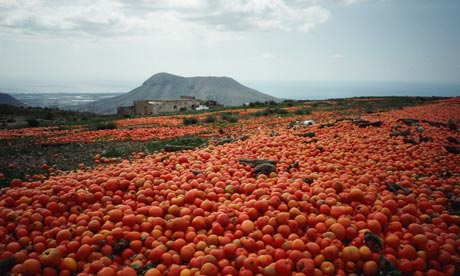
Surplus tomatoes are dumped on farmland in Tenerife, Canary Islands, Spain.
Photograph: Sally A. Morgan/Ecoscene/Corbis
Eliminating the millions of tonnes of food thrown away annually in the US and UK could lift more than a billion people out of hunger worldwide, experts claim.
Government officials, food experts and representatives of the retail trade brought together by the Food Ethics Council argue that excessive consumption of food in rich countries inflates food prices in the developing world. Buying food, which is then often wasted, reduces overall supply and pushes up the price of food, making grain less affordable for poor and undernourished people in other parts of the world. Food waste also costs UK consumers £10.2bn a year and when production, transportation and storage are factored in, it is responsible for 5% of the UK's greenhouse gas emissions...
Stuart calculated that the hunger of 1.5bn people could be alleviated by eradicating the food wasted by British consumers and American retailers, food services and householders, including the arable crops such as wheat, maize and soy to produce the wasted meat and dairy products. He added that the production of wasted food also squanders resources, and said that the irrigation water used by farmers to grow wasted food would be enough for the equivalent domestic water needs of 9bn people.
Food waste costs every household in the UK between £250 and £400 a year, figures that are likely to be updated this autumn when the government's waste agency WRAP publishes new statistics. Producing and distributing the 6.7m tonnes of edible food that goes uneaten and into waste in the UK also accounts for 18m tonnes of CO2.
for complete article:
Adam Vaughan
2009-09-09
http://www.guardian.co.uk/environment/2009/sep/08/food-waste
~ Excessive consumption in rich countries 'takes food out of mouths of poor' by inflating food prices on global market ~
Surplus tomatoes are dumped on farmland in Tenerife, Canary Islands, Spain.
Photograph: Sally A. Morgan/Ecoscene/Corbis
Eliminating the millions of tonnes of food thrown away annually in the US and UK could lift more than a billion people out of hunger worldwide, experts claim.
Government officials, food experts and representatives of the retail trade brought together by the Food Ethics Council argue that excessive consumption of food in rich countries inflates food prices in the developing world. Buying food, which is then often wasted, reduces overall supply and pushes up the price of food, making grain less affordable for poor and undernourished people in other parts of the world. Food waste also costs UK consumers £10.2bn a year and when production, transportation and storage are factored in, it is responsible for 5% of the UK's greenhouse gas emissions...
Stuart calculated that the hunger of 1.5bn people could be alleviated by eradicating the food wasted by British consumers and American retailers, food services and householders, including the arable crops such as wheat, maize and soy to produce the wasted meat and dairy products. He added that the production of wasted food also squanders resources, and said that the irrigation water used by farmers to grow wasted food would be enough for the equivalent domestic water needs of 9bn people.
Food waste costs every household in the UK between £250 and £400 a year, figures that are likely to be updated this autumn when the government's waste agency WRAP publishes new statistics. Producing and distributing the 6.7m tonnes of edible food that goes uneaten and into waste in the UK also accounts for 18m tonnes of CO2.
for complete article:
Adam Vaughan
2009-09-09
http://www.guardian.co.uk/environment/2009/sep/08/food-waste
US and China to Unveil Joint Plan to 'Take Over' Cleantech Market
US and China to Unveil Joint Plan to 'Take Over' Cleantech Market
~ Business collaboration between US and China to secure clean technology market opportunities will be unveiled at World Economic Forum in Dalian ~
A joint US-China plan to "take over the world" in low-carbon technology will be revealed tomorrow at a meeting of Davos's World Economic Forum in Dalian.
The sweeping initiative to secure the opportunities arising from tackling climate change is based on top-level business collaboration between the two superpowers, with some deals already done. One obstacle, however, will be growing trade friction over clean technology.
Leading industrialists, entrepreneurs and financiers from the world's two biggest polluters have marked out the development strategy for a trillion dollar "greentech" market for inclusion in a bilateral climate agreement that is expected to be signed by the two governments when Obama visits China in November.
The global clean technology market would get a major boost from any deal at the global climate summit in Copenhagen in December.
Under the plan, cash from the two nations and private sector acumen would be used to massively expand China's solar, wind, carbon capture and smart-grid markets in a move that could be as groundbreaking as the commercialisation of the internet...
for complete article:
Jonathan Watts
2009-09-09
http://www.guardian.co.uk/environment/2009/sep/09/china-us-greentech-plan
~ Business collaboration between US and China to secure clean technology market opportunities will be unveiled at World Economic Forum in Dalian ~
A joint US-China plan to "take over the world" in low-carbon technology will be revealed tomorrow at a meeting of Davos's World Economic Forum in Dalian.
The sweeping initiative to secure the opportunities arising from tackling climate change is based on top-level business collaboration between the two superpowers, with some deals already done. One obstacle, however, will be growing trade friction over clean technology.
Leading industrialists, entrepreneurs and financiers from the world's two biggest polluters have marked out the development strategy for a trillion dollar "greentech" market for inclusion in a bilateral climate agreement that is expected to be signed by the two governments when Obama visits China in November.
The global clean technology market would get a major boost from any deal at the global climate summit in Copenhagen in December.
Under the plan, cash from the two nations and private sector acumen would be used to massively expand China's solar, wind, carbon capture and smart-grid markets in a move that could be as groundbreaking as the commercialisation of the internet...
for complete article:
Jonathan Watts
2009-09-09
http://www.guardian.co.uk/environment/2009/sep/09/china-us-greentech-plan
06 September 2009
U.S. Public Survey on Climate Change for 2009
Global Warming’s Six Americas 2009:
An Audience Segmentation Analysis
Download the PDF at:
http://research.yale.edu/environment/climate/ or http://environment.yale.edu/uploads/SixAmericas2009.pdf
Last week, the Yale Project on Climate Change and the George Mason University Center for Climate Change Communications released their 2009 “Six America’s” study. The study finds that the U.S. population can be broadly broken up into six different categories that the study’s authors name as follows: Alarmed, Concerned, Cautious, Disengaged, Doubtful, and Dismissive. Here’s how the Executive Summary describes each of the six groups:
The Alarmed (18%) are fully convinced of the reality and seriousness of climate change and are already taking individual, consumer, and political action to address it. The Concerned (33%) – the largest of the six Americas – are also convinced that global warming is happening and a serious problem, but have not yet engaged the issue personally. Three other Americas – the Cautious (19%), the Disengaged (12%) and the Doubtful (11%) – represent different stages of understanding and acceptance of the problem, and none are actively involved. The final America – the Dismissive (7%) – are very sure it is not happening and are actively involved as opponents of a national effort to reduce greenhouse gas emissions.
The survey made a number of interesting findings:
* Large majorities of all six groups are skeptical of humanity’s ability to address climate disruption (Figure 13).
* The Dismissive are as certain that climate disruption isn’t even happening as the Alarmed are certain that climate disruption is happening. (Figure 5).
* Both the Alarmed and the Dismissive are very confident that they know what’s really going on with climate (Figure 7).
* Four of the six groups (Alarmed, Concerned, Caution, and Disengaged) all at least “somewhat support” carbon dioxide (CO2) regulations (Figure 19).
* Only the Dismissive group actually opposes increased fuel efficiency standards, and even then just barely (Figure 20).
* All six groups at least “somewhat support” rebates for solar power installation and/or fuel efficient vehicles (Figure 21).
* There is limited support for carbon capitalism, aka cap and trade, across all groups (Figure 22).
* While the Alarmed and Concerned are largely Democrats, and the Doubtful and Dismissive are largely Republicans, iindependents are split nearly equally across all six groups (Figure 29).
* All the groups are neutral to trusting of scientists as good sources of information about climate disruption, and all the groups are neutral to distrustful of the media as good sources of information (Figures 35 and 36 respectively).
* Catholics trend slightly toward being Alarmed, Protestants trend slightly toward being Doubtful, Mormons toward being Dismissive, Jews toward being Alarmed, “other Christians” toward being Dismissive, and all other religious groups (non-religious, Buddhist, Hindu, Muslim, and non-Christians) toward being Alarmed (Table 23).
* The Dismissive have the highest number of self-identified “evangelical” or “born-again” Christians of any group (Figure 33).
* The Dismissive listen to the radio the most, get the most information from the Web, read newspapers the least, and watch the least television of all the six groups (Table 27).
* The Dismissive listen to the least “apolitical” news and have the most politically-biased news consumption of all the gruops. The Concerned (not the Alarmed) are the group that trend opposite of the Dismissive. Furthermore, the Dismissive are the most polarized in their news habits – all of the other five groups consume more varied news (NPR, MSNBC, CNN, and Fox) than the Dismissive, which get their news almost exclusively from a few sources (Fox, for example). The Alarmed consume the widest variety of news sources (Table 28).
An Audience Segmentation Analysis
Download the PDF at:
http://research.yale.edu/environment/climate/ or http://environment.yale.edu/uploads/SixAmericas2009.pdf
Last week, the Yale Project on Climate Change and the George Mason University Center for Climate Change Communications released their 2009 “Six America’s” study. The study finds that the U.S. population can be broadly broken up into six different categories that the study’s authors name as follows: Alarmed, Concerned, Cautious, Disengaged, Doubtful, and Dismissive. Here’s how the Executive Summary describes each of the six groups:
The Alarmed (18%) are fully convinced of the reality and seriousness of climate change and are already taking individual, consumer, and political action to address it. The Concerned (33%) – the largest of the six Americas – are also convinced that global warming is happening and a serious problem, but have not yet engaged the issue personally. Three other Americas – the Cautious (19%), the Disengaged (12%) and the Doubtful (11%) – represent different stages of understanding and acceptance of the problem, and none are actively involved. The final America – the Dismissive (7%) – are very sure it is not happening and are actively involved as opponents of a national effort to reduce greenhouse gas emissions.
The survey made a number of interesting findings:
* Large majorities of all six groups are skeptical of humanity’s ability to address climate disruption (Figure 13).
* The Dismissive are as certain that climate disruption isn’t even happening as the Alarmed are certain that climate disruption is happening. (Figure 5).
* Both the Alarmed and the Dismissive are very confident that they know what’s really going on with climate (Figure 7).
* Four of the six groups (Alarmed, Concerned, Caution, and Disengaged) all at least “somewhat support” carbon dioxide (CO2) regulations (Figure 19).
* Only the Dismissive group actually opposes increased fuel efficiency standards, and even then just barely (Figure 20).
* All six groups at least “somewhat support” rebates for solar power installation and/or fuel efficient vehicles (Figure 21).
* There is limited support for carbon capitalism, aka cap and trade, across all groups (Figure 22).
* While the Alarmed and Concerned are largely Democrats, and the Doubtful and Dismissive are largely Republicans, iindependents are split nearly equally across all six groups (Figure 29).
* All the groups are neutral to trusting of scientists as good sources of information about climate disruption, and all the groups are neutral to distrustful of the media as good sources of information (Figures 35 and 36 respectively).
* Catholics trend slightly toward being Alarmed, Protestants trend slightly toward being Doubtful, Mormons toward being Dismissive, Jews toward being Alarmed, “other Christians” toward being Dismissive, and all other religious groups (non-religious, Buddhist, Hindu, Muslim, and non-Christians) toward being Alarmed (Table 23).
* The Dismissive have the highest number of self-identified “evangelical” or “born-again” Christians of any group (Figure 33).
* The Dismissive listen to the radio the most, get the most information from the Web, read newspapers the least, and watch the least television of all the six groups (Table 27).
* The Dismissive listen to the least “apolitical” news and have the most politically-biased news consumption of all the gruops. The Concerned (not the Alarmed) are the group that trend opposite of the Dismissive. Furthermore, the Dismissive are the most polarized in their news habits – all of the other five groups consume more varied news (NPR, MSNBC, CNN, and Fox) than the Dismissive, which get their news almost exclusively from a few sources (Fox, for example). The Alarmed consume the widest variety of news sources (Table 28).
President Eisenhower's Warning On The Rise Of Extremist Movements In U.S.
Ike’s Other Warning
In this summer of town hall disruptions and birth-certificate controversies, a summer when it seemed as if the Republican Party had been captured by its extremist wing, it is worth recalling a now-obscure letter from President Dwight D. Eisenhower.
Although Eisenhower is commonly remembered for a farewell address that raised concerns about the “military-industrial complex,” his letter offers an equally important — and relevant — warning: to beware the danger posed by those seeking freedom from the “mental stress and burden” of democracy.
The story began in 1958, when Eisenhower received a letter from Robert Biggs, a terminally ill World War II veteran. Biggs told the president that he “felt from your recent speeches the feeling of hedging and a little uncertainty.” He added, “We wait for someone to speak for us and back him completely if the statement is made in truth.”
Eisenhower could have discarded Biggs’s note or sent a canned response. But he didn’t. He composed a thoughtful reply. After enduring Senator Joseph McCarthy of Wisconsin, who had smeared his old colleague Gen. George C. Marshall as a Communist sympathizer, and having guarded the Republican Party against the newly emergent radical right John Birch Society, which labeled him and much of his cabinet Soviet agents, the president perhaps welcomed the opportunity to expound on his vision of the open society.
“I doubt that citizens like yourself could ever, under our democratic system, be provided with the universal degree of certainty, the confidence in their understanding of our problems, and the clear guidance from higher authority that you believe needed,” Eisenhower wrote on Feb. 10, 1959. “Such unity is not only logical but indeed indispensable in a successful military organization, but in a democracy debate is the breath of life.”
Eisenhower also recommended a short book — “The True Believer” by Eric Hoffer, a self-educated itinerant longshoreman who earned the nickname “the stevedore philosopher.” “Faith in a holy cause,” Hoffer wrote, “is to a considerable extent a substitute for the lost faith in ourselves.”
Though Eisenhower was criticized for lacking an intellectual framework or even an interest in ideas, he was drawn to Hoffer’s insights. He explained to Biggs that Hoffer “points out that dictatorial systems make one contribution to their people which leads them to tend to support such systems — freedom from the necessity of informing themselves and making up their own minds concerning these tremendous complex and difficult questions.” The authoritarian follower, Eisenhower suggested, desired nothing more than insulation from the pressures of a free society.
Alluding to Senator McCarthy and his allies, Eisenhower pointed out that cold war fears were distorted and exploited for political advantage. “It is difficult indeed to maintain a reasoned and accurately informed understanding of our defense situation on the part of our citizenry when many prominent officials, possessing no standing or expertness as they themselves claim it, attempt to further their own ideas or interests by resorting to statements more distinguished by stridency than by accuracy.”
It is worth noting, of course, that these Cold War exaggerations weren’t just a Republican specialty: John F. Kennedy was making a supposed “missile gap” between the United States and the Soviet Union a key element of his presidential campaign.
In closing his letter, Eisenhower praised Biggs for his “fortitude in pondering these problems despite your deep personal adversity.” Perhaps it was the president’s sense of solidarity with a fellow soldier that prompted him to respond to Biggs with such care; and perhaps it was his experience as supreme commander of Allied forces in Europe that taught him that the rise of extreme movements and authoritarianism could take root anywhere — even in a democracy.
~ Max Blumenthal is the author of “Republican Gomorrah: Inside the Movement That Shattered the Party.” ~
for complete op-ed piece:
Ike's Other Warning
Max Blumenthal
2009-09-02
http://www.nytimes.com/2009/09/03/opinion/03blumenthal.html?_r=1&scp=1&sq=Max%20Blumenthal&st=cse
for President Dwight D. Eisenhower's letter to Biggs:
To Robert J. Biggs
Document #1051
1959-02-10
http://www.eisenhowermemorial.org/presidential-papers/second-term/documents/1051.cfm
for complete interview with Max Blumenthal about the rise of the radical right in the U.S., its growth as a movement, and effort to capture control of the Republican Party:
Republican Gomorrah: Inside the Movement that Shattered the Party
2009-09-04
http://www.democracynow.org/2009/9/4/republican_gomorrah_inside_the_movement_that
In this summer of town hall disruptions and birth-certificate controversies, a summer when it seemed as if the Republican Party had been captured by its extremist wing, it is worth recalling a now-obscure letter from President Dwight D. Eisenhower.
Although Eisenhower is commonly remembered for a farewell address that raised concerns about the “military-industrial complex,” his letter offers an equally important — and relevant — warning: to beware the danger posed by those seeking freedom from the “mental stress and burden” of democracy.
The story began in 1958, when Eisenhower received a letter from Robert Biggs, a terminally ill World War II veteran. Biggs told the president that he “felt from your recent speeches the feeling of hedging and a little uncertainty.” He added, “We wait for someone to speak for us and back him completely if the statement is made in truth.”
Eisenhower could have discarded Biggs’s note or sent a canned response. But he didn’t. He composed a thoughtful reply. After enduring Senator Joseph McCarthy of Wisconsin, who had smeared his old colleague Gen. George C. Marshall as a Communist sympathizer, and having guarded the Republican Party against the newly emergent radical right John Birch Society, which labeled him and much of his cabinet Soviet agents, the president perhaps welcomed the opportunity to expound on his vision of the open society.
“I doubt that citizens like yourself could ever, under our democratic system, be provided with the universal degree of certainty, the confidence in their understanding of our problems, and the clear guidance from higher authority that you believe needed,” Eisenhower wrote on Feb. 10, 1959. “Such unity is not only logical but indeed indispensable in a successful military organization, but in a democracy debate is the breath of life.”
Eisenhower also recommended a short book — “The True Believer” by Eric Hoffer, a self-educated itinerant longshoreman who earned the nickname “the stevedore philosopher.” “Faith in a holy cause,” Hoffer wrote, “is to a considerable extent a substitute for the lost faith in ourselves.”
Though Eisenhower was criticized for lacking an intellectual framework or even an interest in ideas, he was drawn to Hoffer’s insights. He explained to Biggs that Hoffer “points out that dictatorial systems make one contribution to their people which leads them to tend to support such systems — freedom from the necessity of informing themselves and making up their own minds concerning these tremendous complex and difficult questions.” The authoritarian follower, Eisenhower suggested, desired nothing more than insulation from the pressures of a free society.
Alluding to Senator McCarthy and his allies, Eisenhower pointed out that cold war fears were distorted and exploited for political advantage. “It is difficult indeed to maintain a reasoned and accurately informed understanding of our defense situation on the part of our citizenry when many prominent officials, possessing no standing or expertness as they themselves claim it, attempt to further their own ideas or interests by resorting to statements more distinguished by stridency than by accuracy.”
It is worth noting, of course, that these Cold War exaggerations weren’t just a Republican specialty: John F. Kennedy was making a supposed “missile gap” between the United States and the Soviet Union a key element of his presidential campaign.
In closing his letter, Eisenhower praised Biggs for his “fortitude in pondering these problems despite your deep personal adversity.” Perhaps it was the president’s sense of solidarity with a fellow soldier that prompted him to respond to Biggs with such care; and perhaps it was his experience as supreme commander of Allied forces in Europe that taught him that the rise of extreme movements and authoritarianism could take root anywhere — even in a democracy.
~ Max Blumenthal is the author of “Republican Gomorrah: Inside the Movement That Shattered the Party.” ~
for complete op-ed piece:
Ike's Other Warning
Max Blumenthal
2009-09-02
http://www.nytimes.com/2009/09/03/opinion/03blumenthal.html?_r=1&scp=1&sq=Max%20Blumenthal&st=cse
for President Dwight D. Eisenhower's letter to Biggs:
To Robert J. Biggs
Document #1051
1959-02-10
http://www.eisenhowermemorial.org/presidential-papers/second-term/documents/1051.cfm
for complete interview with Max Blumenthal about the rise of the radical right in the U.S., its growth as a movement, and effort to capture control of the Republican Party:
Republican Gomorrah: Inside the Movement that Shattered the Party
2009-09-04
http://www.democracynow.org/2009/9/4/republican_gomorrah_inside_the_movement_that
Climate Change: Melting Ice Will Trigger Wave of Natural Disasters
Climate Change: Melting Ice Will Trigger Wave of Natural Disasters
~ Scientists at the University College London's Climate Forcing of Geological Hazards Conference next week will warn of earthquakes, avalanches and volcanic eruptions as the atmosphere heats up and geology is altered. Even Britain could face being struck by tsunamis ~
Scientists are to outline dramatic evidence that global warming threatens the planet in a new and unexpected way – by triggering earthquakes, tsunamis, avalanches and volcanic eruptions.
Reports by international groups of researchers – to be presented at [the University College London's (UCL) Climate Forcing of Geological Hazards conference] next week – will show that climate change...will not only affect the atmosphere and the sea but will alter the geology of the Earth.
Melting glaciers will set off avalanches, floods and mud flows in the Alps and other mountain ranges; torrential rainfall in the UK is likely to cause widespread erosion; while disappearing Greenland and Antarctic ice sheets threaten to let loose underwater landslides, triggering tsunamis that could even strike the seas around Britain.
At the same time the disappearance of ice caps will change the pressures acting on the Earth's crust and set off volcanic eruptions across the globe. Life on Earth faces a warm future – and a fiery one...Some of the key evidence to be presented at the conference will come from studies of past volcanic activity. These indicate that when ice sheets disappear the number of eruptions increases, said Professor David Pyle, of Oxford University's earth sciences department.
"The last ice age came to an end between 12,000 to 15,000 years ago and the ice sheets that once covered central Europe shrank dramatically," added Pyle. "The impact on the continent's geology can by measured by the jump in volcanic activity that occurred at this time."
In the Eiffel region of western Germany a huge eruption created a vast caldera, or basin-shaped crater, 12,900 years ago, for example. This has since flooded to form the Laacher See, near Koblenz. Scientists are now studying volcanic regions in Chile and Alaska – where glaciers and ice sheets are shrinking rapidly as the planet heats up – in an effort to anticipate the eruptions that might be set off...
According to Professor Mark Maslin of UCL, [an unexpected impact of ice sheet melt] is likely to be the release of the planet's methane hydrate deposits. These ice-like deposits are found on the seabed and in the permafrost regions of Siberia and the far north... [Methane] is 25 times more powerful than carbon dioxide as a greenhouse gas."
A build-up of permafrost methane in the atmosphere would produce a further jump in global warming and accelerate the process of climate change...It was not just the warming of the sea that was the problem, added Maslin. As the ice around Greenland and Antarctica melted, sediments would pour off land masses and cliffs would crumble, triggering underwater landslides that would break open more hydrate reserves on the sea-bed. Again there would be a jump in global warming. "These are key issues that we will have to investigate over the next few years," he said.
There is also a danger of earthquakes, triggered by disintegrating glaciers, causing tsunamis off Chile, New Zealand and Newfoundland in Canada, Nasa scientist Tony Song will tell the conference. The last on this list could even send a tsunami across the Atlantic, one that might reach British shores.
for complete article:
Robin McKie
2009-09-06
http://www.guardian.co.uk/environment/2009/sep/06/global-warming-natural-disasters-conference
~ Scientists at the University College London's Climate Forcing of Geological Hazards Conference next week will warn of earthquakes, avalanches and volcanic eruptions as the atmosphere heats up and geology is altered. Even Britain could face being struck by tsunamis ~
Scientists are to outline dramatic evidence that global warming threatens the planet in a new and unexpected way – by triggering earthquakes, tsunamis, avalanches and volcanic eruptions.
Reports by international groups of researchers – to be presented at [the University College London's (UCL) Climate Forcing of Geological Hazards conference] next week – will show that climate change...will not only affect the atmosphere and the sea but will alter the geology of the Earth.
Melting glaciers will set off avalanches, floods and mud flows in the Alps and other mountain ranges; torrential rainfall in the UK is likely to cause widespread erosion; while disappearing Greenland and Antarctic ice sheets threaten to let loose underwater landslides, triggering tsunamis that could even strike the seas around Britain.
At the same time the disappearance of ice caps will change the pressures acting on the Earth's crust and set off volcanic eruptions across the globe. Life on Earth faces a warm future – and a fiery one...Some of the key evidence to be presented at the conference will come from studies of past volcanic activity. These indicate that when ice sheets disappear the number of eruptions increases, said Professor David Pyle, of Oxford University's earth sciences department.
"The last ice age came to an end between 12,000 to 15,000 years ago and the ice sheets that once covered central Europe shrank dramatically," added Pyle. "The impact on the continent's geology can by measured by the jump in volcanic activity that occurred at this time."
In the Eiffel region of western Germany a huge eruption created a vast caldera, or basin-shaped crater, 12,900 years ago, for example. This has since flooded to form the Laacher See, near Koblenz. Scientists are now studying volcanic regions in Chile and Alaska – where glaciers and ice sheets are shrinking rapidly as the planet heats up – in an effort to anticipate the eruptions that might be set off...
According to Professor Mark Maslin of UCL, [an unexpected impact of ice sheet melt] is likely to be the release of the planet's methane hydrate deposits. These ice-like deposits are found on the seabed and in the permafrost regions of Siberia and the far north... [Methane] is 25 times more powerful than carbon dioxide as a greenhouse gas."
A build-up of permafrost methane in the atmosphere would produce a further jump in global warming and accelerate the process of climate change...It was not just the warming of the sea that was the problem, added Maslin. As the ice around Greenland and Antarctica melted, sediments would pour off land masses and cliffs would crumble, triggering underwater landslides that would break open more hydrate reserves on the sea-bed. Again there would be a jump in global warming. "These are key issues that we will have to investigate over the next few years," he said.
There is also a danger of earthquakes, triggered by disintegrating glaciers, causing tsunamis off Chile, New Zealand and Newfoundland in Canada, Nasa scientist Tony Song will tell the conference. The last on this list could even send a tsunami across the Atlantic, one that might reach British shores.
for complete article:
Robin McKie
2009-09-06
http://www.guardian.co.uk/environment/2009/sep/06/global-warming-natural-disasters-conference
U.S. Share of Worldwide Arms Market Grows
U.S. Share of Worldwide Arms Market Grows
Despite a recession that knocked down global arms sales last year, the United States expanded its role as the world’s leading weapons supplier, increasing its share to more than two-thirds of all foreign armaments deals, according to a new Congressional study [the “Conventional Arms Transfers to Developing Nations"].
The United States signed weapons agreements valued at $37.8 billion in 2008, or 68.4 percent of all business in the global arms bazaar, up significantly from American sales of $25.4 billion the year before.
Italy was a distant second, with $3.7 billion in worldwide weapons agreements in 2008, while Russia was third with $3.5 billion in arms sales last year — down considerably from the $10.8 billion in weapons deals signed by Moscow in 2007.
The growth in weapons sales by the United States last year was particularly noticeable against worldwide trends. The value of global arms sales in 2008 was $55.2 billion, a drop of 7.6 percent from 2007 and the lowest total for international weapons agreements since 2005...
Weapons sales to developing nations reached $42.2 billion in 2008, only a nominal increase from the $41.1 billion in 2007.
The United States was the leader not only in arms sales worldwide, but also to the subset of nations in the developing world, signing $29.6 billion in weapons agreements with these nations, or 70.1 percent of all such deals.
The study found that the larger arms deals concluded by the United States with developing nations last year included a $6.5 billion air defense system for the United Arab Emirates, a $2.1 billion jet fighter deal with Morocco and a $2 billion attack helicopter agreement with Taiwan. Other large weapons agreements were reached between the United States and India, Iraq, Saudi Arabia, Egypt, South Korea and Brazil.
Russia was far behind in 2008 with $3.3 billion in weapons sales to the developing world, about 7.8 percent of all such agreements. The report notes that while Moscow continues to have China and India as its main weapons clients, Russia’s new focus is on arms sales to Latin American, in particular to Venezuela.
France was third with $2.5 billion in arms sales to developing nations, or about 5.9 percent of weapons deals with these countries.
The top buyers in the developing world in 2008 were the United Arab Emirates, which signed $9.7 billion in arms deals, Saudi Arabia, which signed $8.7 billion in weapons agreements, and Morocco, with $5.4 billion in arms purchases.
The study uses figures in 2008 dollars, with amounts for previous years adjusted for inflation to give a constant financial measurement.
for complete article:
Thom Shankar
2009-09-07
http://www.nytimes.com/2009/09/07/world/07weapons.html?_r=1&ref=global-home
Despite a recession that knocked down global arms sales last year, the United States expanded its role as the world’s leading weapons supplier, increasing its share to more than two-thirds of all foreign armaments deals, according to a new Congressional study [the “Conventional Arms Transfers to Developing Nations"].
The United States signed weapons agreements valued at $37.8 billion in 2008, or 68.4 percent of all business in the global arms bazaar, up significantly from American sales of $25.4 billion the year before.
Italy was a distant second, with $3.7 billion in worldwide weapons agreements in 2008, while Russia was third with $3.5 billion in arms sales last year — down considerably from the $10.8 billion in weapons deals signed by Moscow in 2007.
The growth in weapons sales by the United States last year was particularly noticeable against worldwide trends. The value of global arms sales in 2008 was $55.2 billion, a drop of 7.6 percent from 2007 and the lowest total for international weapons agreements since 2005...
Weapons sales to developing nations reached $42.2 billion in 2008, only a nominal increase from the $41.1 billion in 2007.
The United States was the leader not only in arms sales worldwide, but also to the subset of nations in the developing world, signing $29.6 billion in weapons agreements with these nations, or 70.1 percent of all such deals.
The study found that the larger arms deals concluded by the United States with developing nations last year included a $6.5 billion air defense system for the United Arab Emirates, a $2.1 billion jet fighter deal with Morocco and a $2 billion attack helicopter agreement with Taiwan. Other large weapons agreements were reached between the United States and India, Iraq, Saudi Arabia, Egypt, South Korea and Brazil.
Russia was far behind in 2008 with $3.3 billion in weapons sales to the developing world, about 7.8 percent of all such agreements. The report notes that while Moscow continues to have China and India as its main weapons clients, Russia’s new focus is on arms sales to Latin American, in particular to Venezuela.
France was third with $2.5 billion in arms sales to developing nations, or about 5.9 percent of weapons deals with these countries.
The top buyers in the developing world in 2008 were the United Arab Emirates, which signed $9.7 billion in arms deals, Saudi Arabia, which signed $8.7 billion in weapons agreements, and Morocco, with $5.4 billion in arms purchases.
The study uses figures in 2008 dollars, with amounts for previous years adjusted for inflation to give a constant financial measurement.
for complete article:
Thom Shankar
2009-09-07
http://www.nytimes.com/2009/09/07/world/07weapons.html?_r=1&ref=global-home
04 September 2009
UN Chief: We Are Heading Towards an Abyss
UN Chief: We Are Heading Towards an Abyss
~ Rapid progress is needed in climate talks, UN Secretary-General Ban Ki-moon told some 150 governments gathered at the World Climate Conference
UN chief Ban Ki-moon told a meeting of some 150 governments on Thursday that time is running out for a new climate deal to cut greenhouse gas emissions.
The Copenhagen talks in December are looming and little real negotiating time is left "to resolve some of the most complex issues," the UN Secretary-General told the World Climate Conference. "We need rapid progress."
Only limited progress in the talks has been made to hammer out a new accord to replace the 1997 Kyoto Protocol on reducing the gases blamed for global warming. Meanwhile, climate change is advancing.
"Our foot is stuck on the accelerator and we are heading towards an abyss," said Ban, warning that climate change could spell widespread economic disaster.
He noted that he had just visited the Arctic and was alarmed by what he saw...
"...[W]e are certainly going to face a dire crisis if not a catastrophe across the world," he told the conference.
The climate conference in Geneva is aimed at providing ways for the world to cope with global warming that will occur because of greenhouse gases already in the atmosphere, regardless of what the Copenhagen meeting achieves.
On Thursday the delegates in Geneva approved the creation of a Global Framework for Climate Services to improve climate forecasts. Among its aims is to make sure that early warnings for tsunamis and hurricanes reach everybody and that farmers in remote African regions know about upcoming droughts and floods.
for complete article:
AP/Michael von Bülow
2009-09-04
http://en.cop15.dk/news/view+news?newsid=2021
~ Rapid progress is needed in climate talks, UN Secretary-General Ban Ki-moon told some 150 governments gathered at the World Climate Conference
UN chief Ban Ki-moon told a meeting of some 150 governments on Thursday that time is running out for a new climate deal to cut greenhouse gas emissions.
The Copenhagen talks in December are looming and little real negotiating time is left "to resolve some of the most complex issues," the UN Secretary-General told the World Climate Conference. "We need rapid progress."
Only limited progress in the talks has been made to hammer out a new accord to replace the 1997 Kyoto Protocol on reducing the gases blamed for global warming. Meanwhile, climate change is advancing.
"Our foot is stuck on the accelerator and we are heading towards an abyss," said Ban, warning that climate change could spell widespread economic disaster.
He noted that he had just visited the Arctic and was alarmed by what he saw...
"...[W]e are certainly going to face a dire crisis if not a catastrophe across the world," he told the conference.
The climate conference in Geneva is aimed at providing ways for the world to cope with global warming that will occur because of greenhouse gases already in the atmosphere, regardless of what the Copenhagen meeting achieves.
On Thursday the delegates in Geneva approved the creation of a Global Framework for Climate Services to improve climate forecasts. Among its aims is to make sure that early warnings for tsunamis and hurricanes reach everybody and that farmers in remote African regions know about upcoming droughts and floods.
for complete article:
AP/Michael von Bülow
2009-09-04
http://en.cop15.dk/news/view+news?newsid=2021
Copenhagen Failure Would Damage World Trade
Copenhagen Failure Would Damage World Trade
~ Should the parties to the UN Framework Convention on Climate Change fail to agree this December, it could have severe harmful effects on international trade, warns the World Trade Organisation chief
Not only would temperatures continue to rise with a range of threats to populations if no international accord on climate change is found, but the international system of trade would also be jeopardized.
“I sincerely hope that (agreement) will happen in Copenhagen. If it doesn’t happen, our job at the WTO will become more difficult,” Pascal Lamy, head of the World Trade Organisation (WTO) tells the Financial Times.
He refers to the trend that some countries impose taxes or similar measures on goods from countries with lower standards in climate protection. This trend will only grow stronger if a new, more comprehensive agreement to succeed the Kyoto Protocol does not come in place.
“Going-alone measures will not achieve the desired results. Relying on trade measures to fix global environmental problems will not work. I am of the firm conviction that the relationship between international trade and climate change would be best defined as a follow-up to a consensual international accord on climate change that successfully embraces all major polluters,” says Pascal Lamy.
for complete article:
Morten Andersen
2009-09-04
http://en.cop15.dk/news/view+news?newsid=2026
~ Should the parties to the UN Framework Convention on Climate Change fail to agree this December, it could have severe harmful effects on international trade, warns the World Trade Organisation chief
Not only would temperatures continue to rise with a range of threats to populations if no international accord on climate change is found, but the international system of trade would also be jeopardized.
“I sincerely hope that (agreement) will happen in Copenhagen. If it doesn’t happen, our job at the WTO will become more difficult,” Pascal Lamy, head of the World Trade Organisation (WTO) tells the Financial Times.
He refers to the trend that some countries impose taxes or similar measures on goods from countries with lower standards in climate protection. This trend will only grow stronger if a new, more comprehensive agreement to succeed the Kyoto Protocol does not come in place.
“Going-alone measures will not achieve the desired results. Relying on trade measures to fix global environmental problems will not work. I am of the firm conviction that the relationship between international trade and climate change would be best defined as a follow-up to a consensual international accord on climate change that successfully embraces all major polluters,” says Pascal Lamy.
for complete article:
Morten Andersen
2009-09-04
http://en.cop15.dk/news/view+news?newsid=2026
Climate Change Threatens Crops
Farmers Warned to Get Ready
Climate change threatens crops
Even if global temperatures rise slowly, climate change could slash the yields of some of the world's most important crops almost in half, according to a new study co-authored by an N.C. State University scientist.
The study, recently published online in Proceedings of the National Academy of Sciences, looked at three frequently used scenarios for global warming. It found that the average U.S. yields for corn, soybeans and cotton could plummet 30 percent to 46 percent by the end of the century under the slowest warming scenario, and 63 percent to 82 percent under the quickest...
Scientists are starting to look more closely at temperature spikes and dips because they can have outsized impact, said David Walter Wolfe, a Cornell University expert on the effects of climate change on crops...A simple example, Wolfe said, is freezing. A study using the average of lows for several days might not even show below-freezing temperatures, and yet farmers may have suffered a catastrophe. At the other end of the temperature scale, one day of mid-90s temperatures can kill all the flowers on a crop of pepper plants...
Wolfe frequently speaks to farmers and said his message is always the same: They are the first generation of growers who can't count on historical climate information to help them plan things such as when to plant and what varieties to choose.
"They're no longer farming in a static environment," he said. "They can't rely on the calendar to tell them when to plant, they can't rely on the variety of seeds they have always used, and they can't rely on dealing with the same insect pests, because it's all a moving target now."
for complete article:
Jay Price
2009-09-04
http://www.newsobserver.com/news/story/1674429.html
Climate change threatens crops
Even if global temperatures rise slowly, climate change could slash the yields of some of the world's most important crops almost in half, according to a new study co-authored by an N.C. State University scientist.
The study, recently published online in Proceedings of the National Academy of Sciences, looked at three frequently used scenarios for global warming. It found that the average U.S. yields for corn, soybeans and cotton could plummet 30 percent to 46 percent by the end of the century under the slowest warming scenario, and 63 percent to 82 percent under the quickest...
Scientists are starting to look more closely at temperature spikes and dips because they can have outsized impact, said David Walter Wolfe, a Cornell University expert on the effects of climate change on crops...A simple example, Wolfe said, is freezing. A study using the average of lows for several days might not even show below-freezing temperatures, and yet farmers may have suffered a catastrophe. At the other end of the temperature scale, one day of mid-90s temperatures can kill all the flowers on a crop of pepper plants...
Wolfe frequently speaks to farmers and said his message is always the same: They are the first generation of growers who can't count on historical climate information to help them plan things such as when to plant and what varieties to choose.
"They're no longer farming in a static environment," he said. "They can't rely on the calendar to tell them when to plant, they can't rely on the variety of seeds they have always used, and they can't rely on dealing with the same insect pests, because it's all a moving target now."
for complete article:
Jay Price
2009-09-04
http://www.newsobserver.com/news/story/1674429.html
Current Economic Growth Model Is 'Immoral', Says Prescott
Current Economic Growth Model Is 'Immoral', Says Prescott
John Prescott, the former UK climate negotiator, called on developed nations today to accept a new model of economic growth that would create a more equitable spread of carbon emissions in the world. Speaking to the Guardian in Beijing, Prescott said talks at Copenhagen would probably not be decided until an 11th-hour crisis, but that no global consensus could be reached without a fairer spread of emissions...
"The reality is that the world has found a rationing process. It is not ... get growth as fast as you can and get the jobs and sod the rest," he said. "The world will have 9 billion people by 2050. If you still want growth and prosperity, do you keep on the model you have now? It's immoral."
Prescott has no say in the final decision this time but will attend the talks in Copenhagen as a rapporteur for the Council of Europe, allowing him to be a vocal observer. His remarks address a core issue: how to allow developing nations such as China and India to grow their economies and lift billions from poverty without generating enormous greenhouse gas emissions, as past growth in the developed world did...
"If we are deciding a global formula not to suffer consequences of climate change, we had better make it fair to achieve a consensus because that is the key at the end of day. "
Although, he said, none of the nations are showing their hands yet, he predicted politicians would have to find an agreement.
"The science is so clear. For policymakers to just walk away from that would be disastrous. I can't believe they will do it."
In line with many developing nations, Prescott says targets should be set according to emissions per person rather than percentage cuts from past levels, as was the case in Kyoto. If wealthy citizens try to maintain their high-polluting nations, he predicted a political crisis...
for complete article:
Jonathan Watts
2009-09-04
http://www.guardian.co.uk/environment/2009/sep/04/prescott-economic-growth-immoral
John Prescott, the former UK climate negotiator, called on developed nations today to accept a new model of economic growth that would create a more equitable spread of carbon emissions in the world. Speaking to the Guardian in Beijing, Prescott said talks at Copenhagen would probably not be decided until an 11th-hour crisis, but that no global consensus could be reached without a fairer spread of emissions...
"The reality is that the world has found a rationing process. It is not ... get growth as fast as you can and get the jobs and sod the rest," he said. "The world will have 9 billion people by 2050. If you still want growth and prosperity, do you keep on the model you have now? It's immoral."
Prescott has no say in the final decision this time but will attend the talks in Copenhagen as a rapporteur for the Council of Europe, allowing him to be a vocal observer. His remarks address a core issue: how to allow developing nations such as China and India to grow their economies and lift billions from poverty without generating enormous greenhouse gas emissions, as past growth in the developed world did...
"If we are deciding a global formula not to suffer consequences of climate change, we had better make it fair to achieve a consensus because that is the key at the end of day. "
Although, he said, none of the nations are showing their hands yet, he predicted politicians would have to find an agreement.
"The science is so clear. For policymakers to just walk away from that would be disastrous. I can't believe they will do it."
In line with many developing nations, Prescott says targets should be set according to emissions per person rather than percentage cuts from past levels, as was the case in Kyoto. If wealthy citizens try to maintain their high-polluting nations, he predicted a political crisis...
for complete article:
Jonathan Watts
2009-09-04
http://www.guardian.co.uk/environment/2009/sep/04/prescott-economic-growth-immoral
03 September 2009
UN Development Chief: Copenhagen Might Not Be Final Step
UN Development Chief: Copenhagen Might Not Be Final Step
~ It is not a failure if the UN climate conference in December does not sign a final deal, says UN Development Chief Helen Clark.
UN Development Chief Helen Clark is toning down expectations for the UN climate conference in Copenhagen.
"Copenhagen has to be viewed as a very important step. Would it be overoptimistic to say that it would be the final one? Of course," she says to the Financial Times. "If there's no deal as such, it won't be a failure. I think the conference will be positive but it won't dot every 'i' and cross every 't'."
According to the newspaper, her warning is a clear example of the fine line UN officials are treading as they try to press for greater urgency in the talks while tempering hopes for the outcome.
Helen Clark, a former New Zealand Prime Minister, plays a key role in preparing the few chances of speeding up negotiations before the conference in Copenhagen in December. Among these opportunities there will be a meeting of heads of state and government at the UN in New York on September 22, and the industrialized countries in the Group of 20 will meet a few days later in Pittsburgh.
"When you gather a significant body of heads of government, there's an opportunity to lift ambition and aspiration," Helen Clark says, noting that progress could be made. "The key thing is that it [the climate process] must continue to have momentum because there is a way to run before Kyoto expires."
The binding goals for greenhouse gas reductions settled in the Kyoto Protocol expire in 2012.
for complete article:
2009-09-02
http://en.cop15.dk/news/view+news?newsid=2009
~ It is not a failure if the UN climate conference in December does not sign a final deal, says UN Development Chief Helen Clark.
UN Development Chief Helen Clark is toning down expectations for the UN climate conference in Copenhagen.
"Copenhagen has to be viewed as a very important step. Would it be overoptimistic to say that it would be the final one? Of course," she says to the Financial Times. "If there's no deal as such, it won't be a failure. I think the conference will be positive but it won't dot every 'i' and cross every 't'."
According to the newspaper, her warning is a clear example of the fine line UN officials are treading as they try to press for greater urgency in the talks while tempering hopes for the outcome.
Helen Clark, a former New Zealand Prime Minister, plays a key role in preparing the few chances of speeding up negotiations before the conference in Copenhagen in December. Among these opportunities there will be a meeting of heads of state and government at the UN in New York on September 22, and the industrialized countries in the Group of 20 will meet a few days later in Pittsburgh.
"When you gather a significant body of heads of government, there's an opportunity to lift ambition and aspiration," Helen Clark says, noting that progress could be made. "The key thing is that it [the climate process] must continue to have momentum because there is a way to run before Kyoto expires."
The binding goals for greenhouse gas reductions settled in the Kyoto Protocol expire in 2012.
for complete article:
2009-09-02
http://en.cop15.dk/news/view+news?newsid=2009
Warming Arctic Follows 1,900 Years of Cooling
Warming Arctic Follows 1,900 Years of Cooling, Scientists Find
~ Global Warming Could Forestall Ice Age
The Arctic was cooling for 1,900 years because of a natural change in Earth's orbit until greenhouse gas accumulation from the use of fossil fuels reversed the trend in recent decades, according to a study published Thursday in Science magazine.
Scientists reconstructed the temperature record of the past 2,000 years using evidence from tree rings, ice cores and lake sediment, and found a steady cooling trend in Arctic summer temperatures of about 0.5 degrees Celsius — 0.9 degrees Fahrenheit — during the first 1,900 years. The cooling was caused by a slow natural cycle in Earth orbit that continues in this century.
"The summer cooling would likely be continuing today were it not for the increase of greenhouse gases from fossil fuel burning," said David Schneider, a scientist at the National Center for Atmospheric Research and one of the authors of the study. "The results are important in showing that the dramatic changes happening today — and particularly the rapidity of the changes — are not natural."
Darrell Kaufman, a professor of geology and environmental science at Northern Arizona State University and the lead author of the study, put it this way: "The warmth in the Arctic during the second half of the 20th century, combined with the last decade, is striking against the backdrop of the previous 1,900 years. ... The second half of the 20th century was warmer in the Arctic than any other half-century of the last 2,000 years."
Further, 1999 to 2008 was the warmest decade in the Arctic of any in that period, the report in Science said. Temperatures were about 1.4 degrees Celsius — 2.5 degrees Fahrenheit — higher than would have been expected if the natural cooling trend had continued.
Scientists already knew that the Arctic is warming two to three times faster than the rest of the planet is.
The new study gives a better understanding of how the climate system behaves over longer time scales, Schneider said...
for complete articles:
Warming Arctic follows 1,900 years of cooling, scientists find
2009-09-03
http://www.mcclatchydc.com/environment/story/74861.html
Global Warming Could Forestall Ice Age, Study Suggests
2009-09-03
http://www.nytimes.com/2009/09/04/science/earth/04arctic.html?_r=1&ref=global-home
~ Global Warming Could Forestall Ice Age
The Arctic was cooling for 1,900 years because of a natural change in Earth's orbit until greenhouse gas accumulation from the use of fossil fuels reversed the trend in recent decades, according to a study published Thursday in Science magazine.
Scientists reconstructed the temperature record of the past 2,000 years using evidence from tree rings, ice cores and lake sediment, and found a steady cooling trend in Arctic summer temperatures of about 0.5 degrees Celsius — 0.9 degrees Fahrenheit — during the first 1,900 years. The cooling was caused by a slow natural cycle in Earth orbit that continues in this century.
"The summer cooling would likely be continuing today were it not for the increase of greenhouse gases from fossil fuel burning," said David Schneider, a scientist at the National Center for Atmospheric Research and one of the authors of the study. "The results are important in showing that the dramatic changes happening today — and particularly the rapidity of the changes — are not natural."
Darrell Kaufman, a professor of geology and environmental science at Northern Arizona State University and the lead author of the study, put it this way: "The warmth in the Arctic during the second half of the 20th century, combined with the last decade, is striking against the backdrop of the previous 1,900 years. ... The second half of the 20th century was warmer in the Arctic than any other half-century of the last 2,000 years."
Further, 1999 to 2008 was the warmest decade in the Arctic of any in that period, the report in Science said. Temperatures were about 1.4 degrees Celsius — 2.5 degrees Fahrenheit — higher than would have been expected if the natural cooling trend had continued.
Scientists already knew that the Arctic is warming two to three times faster than the rest of the planet is.
The new study gives a better understanding of how the climate system behaves over longer time scales, Schneider said...
for complete articles:
Warming Arctic follows 1,900 years of cooling, scientists find
2009-09-03
http://www.mcclatchydc.com/environment/story/74861.html
Global Warming Could Forestall Ice Age, Study Suggests
2009-09-03
http://www.nytimes.com/2009/09/04/science/earth/04arctic.html?_r=1&ref=global-home
02 September 2009
UN: Rich Countries Will Suffer Unless They Help Poor on Climate Change
UN: Rich Countries Will Suffer Unless They Help Poor on Climate Change
~ £300bn needed by poor nations to tackle carbon emissions
~ Failure to give could reduce world gross product by 20%
The world's rich countries need to embark on a huge transfer of funds to developing countries in order for both groups to grow richer and reduce their carbon emissions significantly, a United Nations report urges today.
Delaying spending on mitigating climate change in the developing world "runs the real danger of locking in dirtier investments for several more decades", says the annual survey from the UN's Department of Economic and Social Affairs (UNDESA).
Ahead of this weekend's meeting of G20 finance ministers in London, the report estimates that developed countries need immediately to transfer around 1% of world gross product (WGP), or $500-600bn (£300-370bn), to poor countries.
Carrying on with business as usual, or making only minor changes, could lose 20% of WGP so doing nothing would be an expensive mistake, it argues.
UN secretary-general Ban Ki-moon says the report "makes the case for meeting both the climate challenge and the development challenge by recognising the links between the two and proceeding along low-emissions, high-growth pathways".
The report adds, using unusually strong language, that "by any measure, the amounts currently promised for meeting the climate challenge in the near term are woefully inadequate".
It continues: "The failure of wealthy countries to honour long-standing commitments of international support for poverty reduction and adequate transfers of resources and technology remains the single biggest obstacle to meeting the climate change challenge."...
"If the international community is serious about a 'global new deal', it should be just as serious about committing resources on the same scale as was needed to tackle the financial crisis and defeat political extremism."...
The report argues that the technologies that would allow developing countries to switch to a sustainable development path do exist. These include low-energy buildings, new drought-resistant crop strains and more advanced primary renewables.
But they are often prohibitively expensive and, the report says, such a transformation would require "a level of international support and solidarity rarely mustered outside a wartime setting"....
"The idea of freezing the current level of global inequality over the next half century or more (as the world goes about trying to solve the climate problem) is economically, politically and ethically unacceptable," the report says.
for complete article:
2009-09-01
http://www.guardian.co.uk/business/2009/sep/01/globalrecession-global-economy
~ £300bn needed by poor nations to tackle carbon emissions
~ Failure to give could reduce world gross product by 20%
The world's rich countries need to embark on a huge transfer of funds to developing countries in order for both groups to grow richer and reduce their carbon emissions significantly, a United Nations report urges today.
Delaying spending on mitigating climate change in the developing world "runs the real danger of locking in dirtier investments for several more decades", says the annual survey from the UN's Department of Economic and Social Affairs (UNDESA).
Ahead of this weekend's meeting of G20 finance ministers in London, the report estimates that developed countries need immediately to transfer around 1% of world gross product (WGP), or $500-600bn (£300-370bn), to poor countries.
Carrying on with business as usual, or making only minor changes, could lose 20% of WGP so doing nothing would be an expensive mistake, it argues.
UN secretary-general Ban Ki-moon says the report "makes the case for meeting both the climate challenge and the development challenge by recognising the links between the two and proceeding along low-emissions, high-growth pathways".
The report adds, using unusually strong language, that "by any measure, the amounts currently promised for meeting the climate challenge in the near term are woefully inadequate".
It continues: "The failure of wealthy countries to honour long-standing commitments of international support for poverty reduction and adequate transfers of resources and technology remains the single biggest obstacle to meeting the climate change challenge."...
"If the international community is serious about a 'global new deal', it should be just as serious about committing resources on the same scale as was needed to tackle the financial crisis and defeat political extremism."...
The report argues that the technologies that would allow developing countries to switch to a sustainable development path do exist. These include low-energy buildings, new drought-resistant crop strains and more advanced primary renewables.
But they are often prohibitively expensive and, the report says, such a transformation would require "a level of international support and solidarity rarely mustered outside a wartime setting"....
"The idea of freezing the current level of global inequality over the next half century or more (as the world goes about trying to solve the climate problem) is economically, politically and ethically unacceptable," the report says.
for complete article:
2009-09-01
http://www.guardian.co.uk/business/2009/sep/01/globalrecession-global-economy
Why Coral Reefs Face a Catastrophic Future
Why Coral Reefs Face a Catastrophic Future
Destroyed by rising carbon levels, acidity, pollution, algae, bleaching and El Niño, coral reefs require a dramatic change in our carbon policy to have any chance of survival
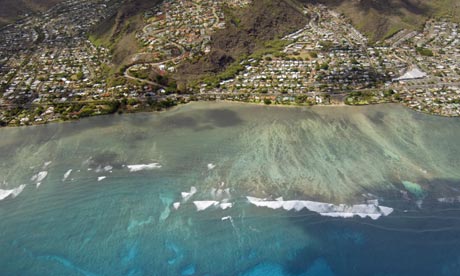
An aerial view of the coastline along Hawaii Kai on the Hawaiian Island of Oahu where organic sediment is one of the major threat to the reef. Photograph: Ed Darack/Corbis
...Within just a few decades, experts are warning, the tropical reefs strung around the middle of our planet like a jewelled corset will reduce to rubble. Giant piles of slime-covered rubbish will litter the sea bed and spell in large distressing letters for the rest of foreseeable time: Humans Were Here.
"The future is horrific," says Charlie Veron, an Australian marine biologist who is widely regarded as the world's foremost expert on coral reefs. "There is no hope of reefs surviving to even mid-century in any form that we now recognise. If, and when, they go, they will take with them about one-third of the world's marine biodiversity. Then there is a domino effect, as reefs fail so will other ecosystems. This is the path of a mass extinction event, when most life, especially tropical marine life, goes extinct."
Alex Rogers, a coral expert with the Zoological Society of London, talks of an "absolute guarantee of their annihilation". And David Obura, another coral heavyweight and head of CORDIO East Africa, a research group in Kenya, is equally pessimistic: "I don't think reefs have much of a chance. And what's happening to reefs is a parable of what is going to happen to everything else."
These are desperate words, stripped of the usual scientific caveats and expressions of uncertainty, and they are a measure of the enormity of what's happening to our reefs....
Human impact has tipped that balance. Loaded with the agricultural nutrients nitrates and phosphates, rivers now spill their polluted waters into the sea. Sediment and sewage cloud the clear waters, while over-fishing plays havoc with the finely tuned community of fish and sharks that kept the reef nibbling down to sustainable levels. All of this is enough to wreck coral without any help from climate change.
Global warming, predictably, has made the situation worse. Secure in their tropical currents, coral reefs have evolved to operate within a fairly narrow temperature range, yet, in the late 1970s and 1980s, coral scientists got an unpleasant demonstration of what happens when the hot tap is left on too long. "The algae go berserk," said Rogers. Scientists think the algae react to the warmer water and increased sunlight by producing toxic oxygen compounds called superoxides, which can damage the coral. The coral respond by ejecting their algal lodgers, leaving the reefs starved of nutrients and deathly white...
Remember the carbon dioxide that we left dissolving in the oceans? Billions and billions of tonnes of it over the last 150 years or so since the industrial revolution...that dissolved pollution has been steadily turning the oceans more acidic...As a result, the surface waters of the world's oceans have dropped by about 0.1 pH unit...It sounds small, but is a truly jaw-dropping change for coral reefs.
For reefs to rebuild their stony skeletons, they rely on the seawater washing over them to be rich in the calcium mineral aragonite. Put simply, the more acid the seawater, the less aragonite it can hold, and the less corals can rebuild their structure. Earlier this year, a paper in the journal Science reported that calcification rates across the Great Barrier Reefs have dropped 14% since 1990...
Rogers says carbon dioxide levels in the atmosphere are already over the safe limits for coral reefs. And even the most ambitious political targets for carbon cuts, based on limiting temperature rise to 2C, are insufficient. Their only hope, he says, is a long-term carbon concentration much lower than today's...
for complete article:
2009-09-02
http://www.guardian.co.uk/environment/2009/sep/02/coral-catastrophic-future
Destroyed by rising carbon levels, acidity, pollution, algae, bleaching and El Niño, coral reefs require a dramatic change in our carbon policy to have any chance of survival
An aerial view of the coastline along Hawaii Kai on the Hawaiian Island of Oahu where organic sediment is one of the major threat to the reef. Photograph: Ed Darack/Corbis
...Within just a few decades, experts are warning, the tropical reefs strung around the middle of our planet like a jewelled corset will reduce to rubble. Giant piles of slime-covered rubbish will litter the sea bed and spell in large distressing letters for the rest of foreseeable time: Humans Were Here.
"The future is horrific," says Charlie Veron, an Australian marine biologist who is widely regarded as the world's foremost expert on coral reefs. "There is no hope of reefs surviving to even mid-century in any form that we now recognise. If, and when, they go, they will take with them about one-third of the world's marine biodiversity. Then there is a domino effect, as reefs fail so will other ecosystems. This is the path of a mass extinction event, when most life, especially tropical marine life, goes extinct."
Alex Rogers, a coral expert with the Zoological Society of London, talks of an "absolute guarantee of their annihilation". And David Obura, another coral heavyweight and head of CORDIO East Africa, a research group in Kenya, is equally pessimistic: "I don't think reefs have much of a chance. And what's happening to reefs is a parable of what is going to happen to everything else."
These are desperate words, stripped of the usual scientific caveats and expressions of uncertainty, and they are a measure of the enormity of what's happening to our reefs....
Human impact has tipped that balance. Loaded with the agricultural nutrients nitrates and phosphates, rivers now spill their polluted waters into the sea. Sediment and sewage cloud the clear waters, while over-fishing plays havoc with the finely tuned community of fish and sharks that kept the reef nibbling down to sustainable levels. All of this is enough to wreck coral without any help from climate change.
Global warming, predictably, has made the situation worse. Secure in their tropical currents, coral reefs have evolved to operate within a fairly narrow temperature range, yet, in the late 1970s and 1980s, coral scientists got an unpleasant demonstration of what happens when the hot tap is left on too long. "The algae go berserk," said Rogers. Scientists think the algae react to the warmer water and increased sunlight by producing toxic oxygen compounds called superoxides, which can damage the coral. The coral respond by ejecting their algal lodgers, leaving the reefs starved of nutrients and deathly white...
Remember the carbon dioxide that we left dissolving in the oceans? Billions and billions of tonnes of it over the last 150 years or so since the industrial revolution...that dissolved pollution has been steadily turning the oceans more acidic...As a result, the surface waters of the world's oceans have dropped by about 0.1 pH unit...It sounds small, but is a truly jaw-dropping change for coral reefs.
For reefs to rebuild their stony skeletons, they rely on the seawater washing over them to be rich in the calcium mineral aragonite. Put simply, the more acid the seawater, the less aragonite it can hold, and the less corals can rebuild their structure. Earlier this year, a paper in the journal Science reported that calcification rates across the Great Barrier Reefs have dropped 14% since 1990...
Rogers says carbon dioxide levels in the atmosphere are already over the safe limits for coral reefs. And even the most ambitious political targets for carbon cuts, based on limiting temperature rise to 2C, are insufficient. Their only hope, he says, is a long-term carbon concentration much lower than today's...
for complete article:
2009-09-02
http://www.guardian.co.uk/environment/2009/sep/02/coral-catastrophic-future
Subscribe to:
Posts (Atom)

 Posts
Posts

