
Destroyed by rising carbon levels, acidity, pollution, algae, bleaching and El Niño, coral reefs require a dramatic change in our carbon policy to have any chance of survival
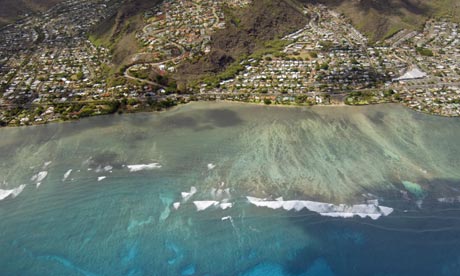
An aerial view of the coastline along Hawaii Kai on the Hawaiian Island of Oahu where organic sediment is one of the major threat to the reef. Photograph: Ed Darack/Corbis
...Within just a few decades, experts are warning, the tropical reefs strung around the middle of our planet like a jewelled corset will reduce to rubble. Giant piles of slime-covered rubbish will litter the sea bed and spell in large distressing letters for the rest of foreseeable time: Humans Were Here.
"The future is horrific," says Charlie Veron, an Australian marine biologist who is widely regarded as the world's foremost expert on coral reefs. "There is no hope of reefs surviving to even mid-century in any form that we now recognise. If, and when, they go, they will take with them about one-third of the world's marine biodiversity. Then there is a domino effect, as reefs fail so will other ecosystems. This is the path of a mass extinction event, when most life, especially tropical marine life, goes extinct."
Alex Rogers, a coral expert with the Zoological Society of London, talks of an "absolute guarantee of their annihilation". And David Obura, another coral heavyweight and head of CORDIO East Africa, a research group in Kenya, is equally pessimistic: "I don't think reefs have much of a chance. And what's happening to reefs is a parable of what is going to happen to everything else."
These are desperate words, stripped of the usual scientific caveats and expressions of uncertainty, and they are a measure of the enormity of what's happening to our reefs....
Human impact has tipped that balance. Loaded with the agricultural nutrients nitrates and phosphates, rivers now spill their polluted waters into the sea. Sediment and sewage cloud the clear waters, while over-fishing plays havoc with the finely tuned community of fish and sharks that kept the reef nibbling down to sustainable levels. All of this is enough to wreck coral without any help from climate change.
Global warming, predictably, has made the situation worse. Secure in their tropical currents, coral reefs have evolved to operate within a fairly narrow temperature range, yet, in the late 1970s and 1980s, coral scientists got an unpleasant demonstration of what happens when the hot tap is left on too long. "The algae go berserk," said Rogers. Scientists think the algae react to the warmer water and increased sunlight by producing toxic oxygen compounds called superoxides, which can damage the coral. The coral respond by ejecting their algal lodgers, leaving the reefs starved of nutrients and deathly white...
Remember the carbon dioxide that we left dissolving in the oceans? Billions and billions of tonnes of it over the last 150 years or so since the industrial revolution...that dissolved pollution has been steadily turning the oceans more acidic...As a result, the surface waters of the world's oceans have dropped by about 0.1 pH unit...It sounds small, but is a truly jaw-dropping change for coral reefs.
For reefs to rebuild their stony skeletons, they rely on the seawater washing over them to be rich in the calcium mineral aragonite. Put simply, the more acid the seawater, the less aragonite it can hold, and the less corals can rebuild their structure. Earlier this year, a paper in the journal Science reported that calcification rates across the Great Barrier Reefs have dropped 14% since 1990...
Rogers says carbon dioxide levels in the atmosphere are already over the safe limits for coral reefs. And even the most ambitious political targets for carbon cuts, based on limiting temperature rise to 2C, are insufficient. Their only hope, he says, is a long-term carbon concentration much lower than today's...
for complete article:
2009-09-02
http://www.guardian.co.uk/environment/2009/sep/02/coral-catastrophic-future


 Posts
Posts

