
The Nile Delta is under threat from rising sea levels. Without the food it produces, Egypt faces catastrophe
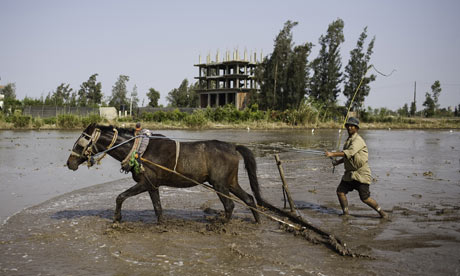
A farmer ploughs his rice paddy in the Delta. Photograph: Jason Larkin
...Two years ago, the Intergovernmental Panel on Climate Change declared Egypt's Nile Delta to be among the top three areas on the planet most vulnerable to a rise in sea levels, and even the most optimistic predictions of global temperature increase will still displace millions of Egyptians from one of the most densely populated regions on earth.
The Delta spills out from the northern stretches of the capital into 10,000 square miles of farmland fed by the Nile's branches. It is home to two-thirds of the country's rapidly growing population, and responsible for more than 60% of its food supply: Egypt relies unconditionally on it for survival. But with its 270km of coastline lying at a dangerously low elevation (large parts are between zero and 1m above sea level, with some areas lying below it), any melting of the polar ice caps could see its farmland and cities – including the historical port of Alexandria – transformed into an ocean floor. A 1m rise in the sea level, which many experts think likely within the next 100 years, will cause 20% of the Delta to go underwater. At the other extreme, the 14m rise that would result from the disappearance of Greenland and western Antarctica would leave the Mediterranean lapping at the northern suburbs of Cairo, with practically all of the Delta underwater.
Already, a series of environmental crises are parking themselves on the banks of the Nile. Some are subtle, like the river's quiet vanishing act in the Delta's northern fields; others, like the dramatic collapse of coastal lands into the ocean, are more striking. [...the menace of coastal erosion, which is steadily ingesting the edge of Egypt in some places at an astonishing rate of almost 100m a year.] Major flooding is yet to become a reality but, from industrial pollution to soil salinity, a whole new set of interconnected green concerns is now forcing its way into Egyptian public discourse for the first time.
"The Delta is a kind of Bangladesh story," says Dr Rick Tutwiler, director of the American University in Cairo's Desert Development Centre. "You've got a massive population, overcrowding, a threat to all natural resources from the pressure of all the people, production, pollution, cars and agricultural chemicals. And on top of all that, there's the rising sea. It's the perfect storm."
..."We currently have a major water deficit in Egypt, with only 700 cubic metres of freshwater per person," explains Professor Salah Soliman of Alexandria University. "That's already short of the 1,000 cubic metres per person the UN believes is the minimum needed for water security. Now, with the population increase, it will drop to 450 cubic metres per person – and this is all before we take into account the impact of climate change."
That impact is likely to be a 70% drop in the amount of Nile water reaching the Delta over the next 50 years, due to increased evaporation and heavier demands on water use upstream. The consequences of all these ecological changes on food production are staggering: experts at Egypt's Soils, Water and Environment Research Institute predict that wheat and maize yields could be down 40% and 50% respectively in the next 30 years, and that farmers who make a living off the land will lose around $1,000 per hectare for each degree rise in the average temperature...
"We're not responsible for climate change," says Soliman, pointing out that Egypt's contribution to global carbon emissions is an underwhelming 0.5%, nine times less per capita than the US. "But unfortunately the consequence of climate change is no respecter of national borders."
for complete article:
2009-08-21
http://www.guardian.co.uk/environment/2009/aug/21/climate-change-nile-flooding-farming


 Posts
Posts

